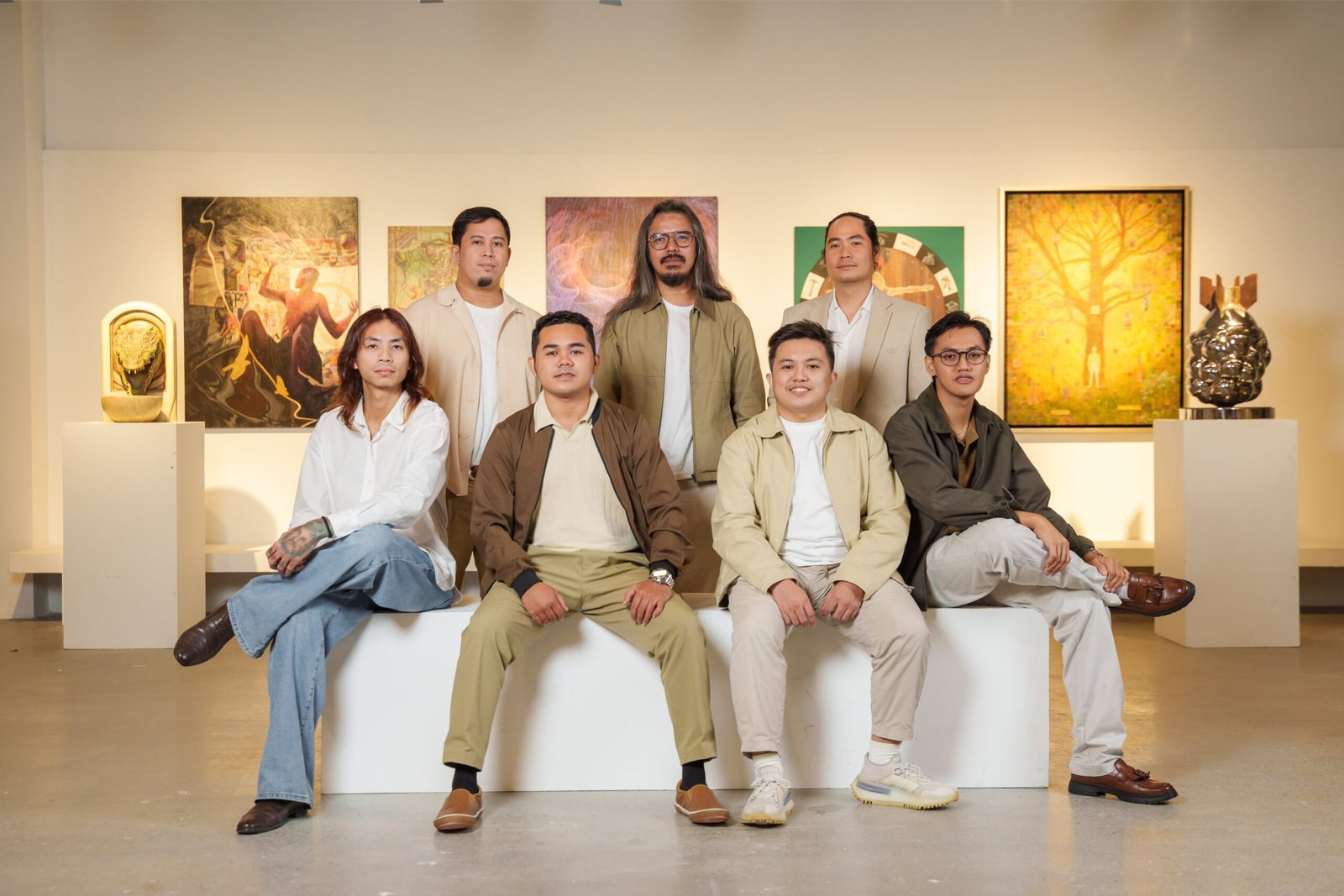
Interview The Kanto and Novice teams
Images Metrobank MADE, with Artgiveson Arreglado
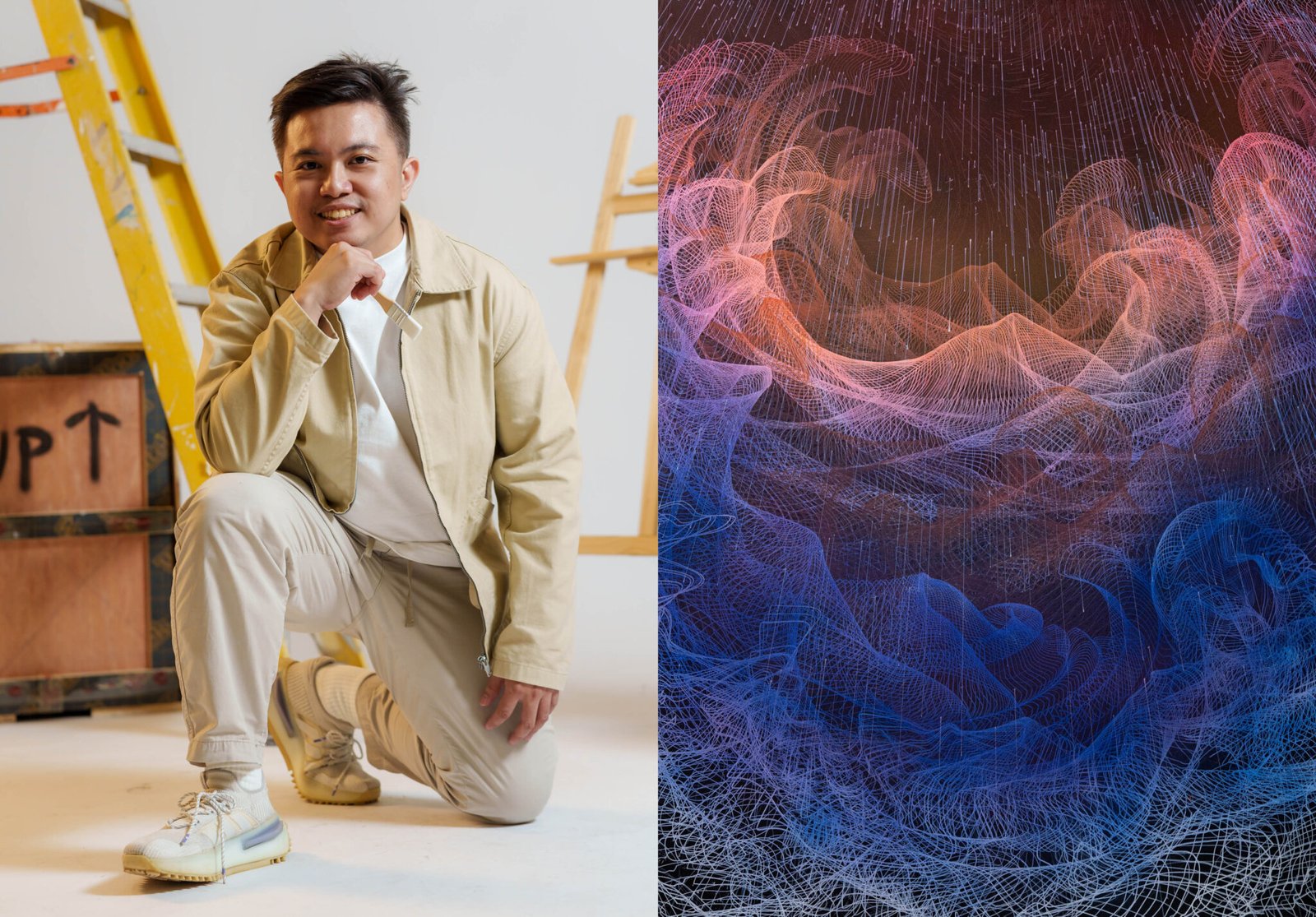
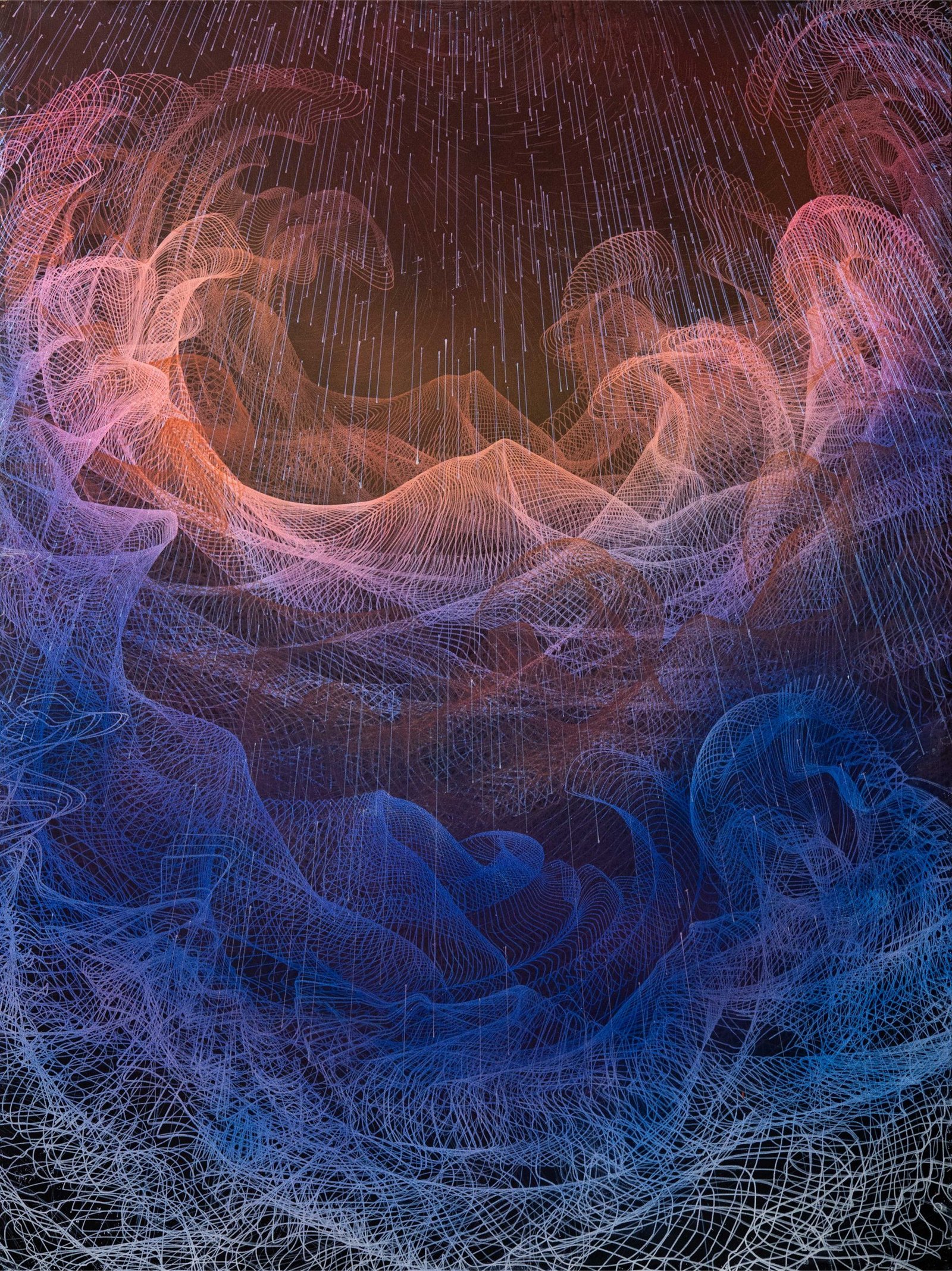
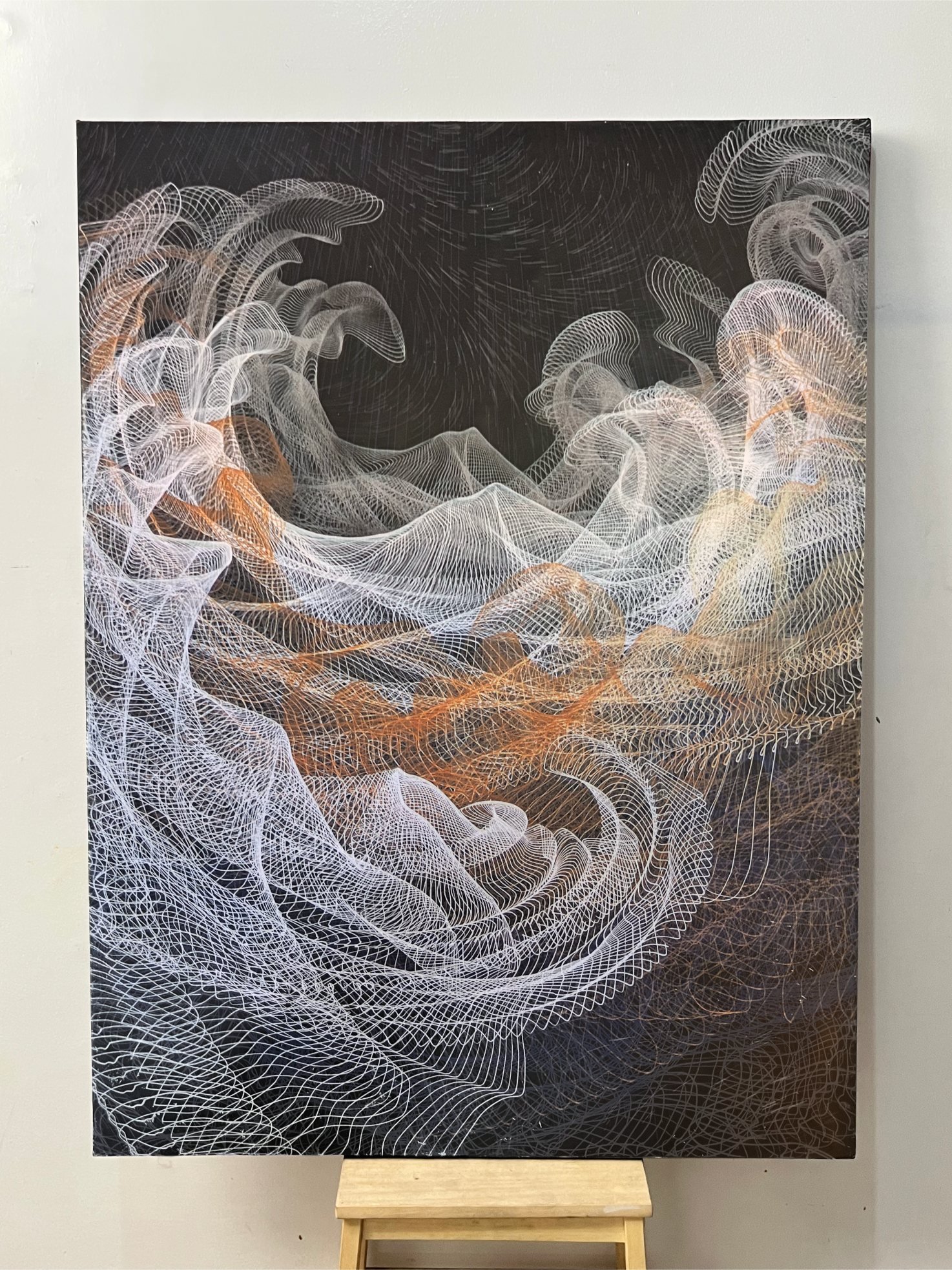
Tacloban’s name comes with a warning: Tinakluban, meaning to be covered. This is the starting point of Artgiveson Arreglado’s MADE 2026 oil and acrylic on canvas category special citation-winning painting, To Weather With You, which depicts an abstracted portrait of the city after the onslaught of Typhoon Yolanda, the tragedy most outsiders remember it by.
Arreglado concocted a landscape in flux: waves that fold into terrain, crests that resemble debris from another angle, a layer of rain rendered in a near-invisible interference blue that reveals itself only when the light shifts. It is collective memory as abstraction: not a single moment of darkness, but the accumulated weight of everything that came before and after the deluge.
This year’s theme, “Traverse: Creativity in Motion,” sparked the conversation that follows, in which Arreglado talks through the painting’s long gestation, the sculpture concept it beat out, and what it means to bring something this personal to a stage as institutional as MADE.
Hi, Artgiveson! Congratulations on your MADE win! Before we get into the piece itself, most artists point to a moment or a person that first pulled them toward the arts. Who or what was yours?
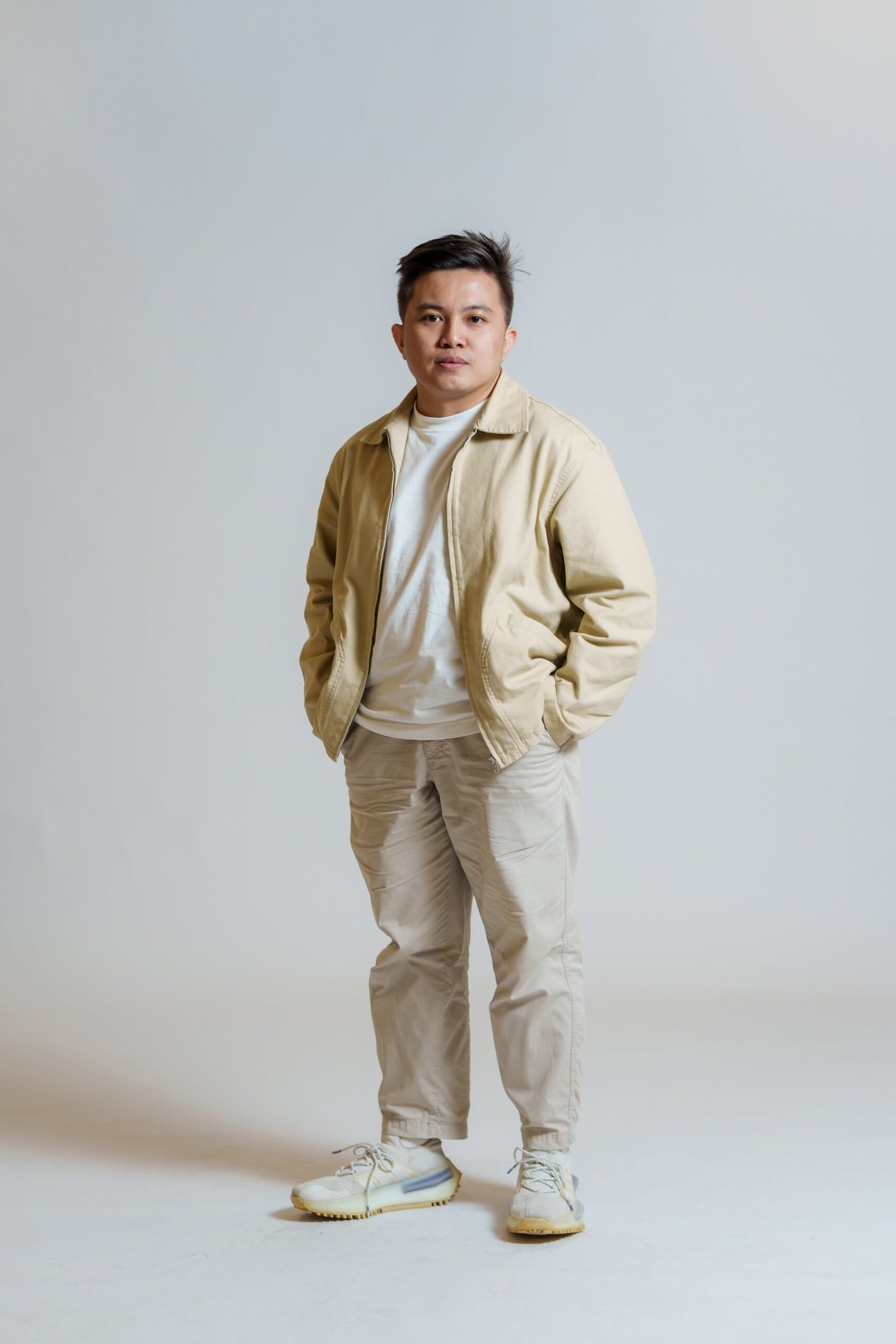
Artgiveson Arreglado, MADE 2026 Special Citation for Oil and Acrylic on Canvas: I guess you could say art was really in the family, literally. All three of us siblings have “ART” in our names. My father named us, and he used to paint cinema billboards back when movie posters were still hand-painted. He never really got to pursue art as a career, but he encouraged me to draw and paint.
In grade school, I started joining art competitions, and I surprisingly won some. That was when I started taking art more seriously.
Eventually, I applied to the Philippine High School for the Arts in Makiling. That’s where my connection to MADE started. During my PHSA audition, one of my proctors worked on his MADE piece while we took the exam. He later became one of my teachers and eventually became a MADE Awardee himself. So, looking back, my journey with MADE really started long before I ever joined the competition.
After PHSA, I took up Architecture at UP Diliman. During architecture school, I found my way back to painting through art competitions. I lost most of them, but they gave me the exposure and motivation to keep going.
So, winning MADE on my first try feels very full circle. I went from watching my teacher work on his MADE piece during my PHSA audition to now being a MADE Awardee myself.
Every artist carries around more ideas than they can make room for. Something about your work won out over the rest at MADE. What was your big idea for your winning work? Did anything else come close to taking its place?
Artgiveson Arreglado: To Weather With You is really about my relationship with my hometown, Tacloban.
The idea started three years ago, around the 10th anniversary of Typhoon Yolanda. I wanted to create something that could look back at how far we’ve come since then. Kasi madalas, especially for outsiders, Tacloban is remembered only through Typhoon Yolanda, as if doon nagsisimula at nagtatapos yung kwento niya.
So, the challenge for me was to create a work that reflected the city more deeply, instead of simply recreating the tragedy itself.
In this painting, I imagined a landscape that constantly turns and reforms. The flowing lines become waves and terrain, helping me make sense of change and understand the scale of what happened during Yolanda. Because for a moment, it really felt like an entire place had disappeared.
I was also inspired by the origin of the word Tacloban, from tinakluban, meaning “to be covered.” It reminded me that places carry buried histories that slowly reveal themselves over time. My process reflects that idea through the accumulation of lines and forms that slowly build the landscape’s layers.
I wanted to capture the feeling of weathering something difficult, not by painting the storm literally, but by creating an experience that the viewer and I could share. It’s about enduring alongside a place, and I think many Filipinos can relate to that. In a way, through this work, we could weather together.
The winning work is a painting, but I had a similar concept that I thought would work well as a sculpture. Even before the call for entries, I was encouraged to consider sculpture instead because I felt the painting category was pretty crowded, and it might be harder to weather through.
I had a fairly solid concept and approach for the sculpture piece, but many technical and material aspects would take time to research, test, and execute. With painting, on the other hand, I already had a good grasp of the visual language and technique, but only a loose idea of what the final work should look like.
I eventually decided to submit a painting because, at that point, I knew I was a stronger painter than sculptor, and painting was simply the more practical medium given the time. I also knew that MADE required a very high level of mastery and excellence in whatever medium you chose. But at the same time, this was my first time joining, so I didn’t really know where I stood in relation to the competition. I was very convinced that I was nowhere near winning. I was really just submitting to test the waters, see how I would place among the other artists, and experience what the process was like.
Because I knew the competition demanded a certain level of excellence in painting and composition, that also influenced how I approached the work. I knew that simply making a technically competent painting probably wouldn’t be enough, so I tried to build toward a more compelling narrative and make the concept carry as much weight as the execution.
I think what made it more challenging for me was that I was an abstract painter. Abstraction can be pretty unconventional in a competition like this, especially compared to more immediately recognizable figurative entries. So, I felt that the work had to do more than demonstrate technical ability. It also had to give the abstraction enough of a narrative or conceptual entry point for people to engage with it.
There’s usually a piece of the finished work only the artist knows about, like a material swapped in at the last minute, a detail handled a certain way for reasons known only to you. What’s that detail in this piece?
Artgiveson Arreglado: I find that in a lot of my work, there’s usually some kind of last-minute change or adjustment. Whether it’s a layer or detail that didn’t work out and I had to salvage, or a new approach I discovered along the way that I felt could elevate the piece.
For this piece, there were two significant last-minute changes.
The first was the final layer of waves and troughs. As I was nearing the end of the painting, I decided to leave that layer somewhat unfinished, with missing lines and details. Compared to the more defined central crests, it looked much more chaotic, almost like the forms weren’t meeting enough to fully complete themselves. But I ended up liking that quality. I thought that as the layers recede, the waves could also become more erratic and fragmented, rather than everything becoming more defined.
The second was the paint I used for the rain pattern. I had originally tested a more translucent white for those lines. But just before I started that layer, I saw a bottle of interference blue acrylic that I had never really used before. I avoided using it because it was almost transparent, but I thought this piece might actually be a good place to try it because transparency was what I wanted for the rain anyway.
After I finished the layer and it dried, I noticed that the blue interference sheen became visible when viewed from a different angle. It made the rain look almost like wet streaks on the surface, and it complemented the peachy hues of the painting much better than the white would have. That was a great discovery for me because it wasn’t something I planned initially, but it ended up contributing a lot to how the final piece felt.
Where or what aspect of your piece would you want someone to slow down, and what would they find at the end of the wait?
Artgiveson Arreglado: Yes, my approach was twofold. I wanted the viewer to feel the painting’s impact immediately, but also to spend a little more time with it and realize there’s more than meets the eye.
Early on, I actually considered putting a central figure in the painting to anchor the whole thing and give the viewer a sense of scale. Using figures to establish scale in landscapes is pretty common, so I initially thought, why not? But I realized that for this piece, the scale I was trying to convey was almost insurmountable. Even the scale of the tragedy itself is difficult to comprehend.
So, I decided to remove the figure and instead let the viewer search through the painting and, in a way, scale themselves against it. At first glance, you might just see waves and streaks. But if you spend more time with it, you start noticing all these different layers. The waves can start resembling mesh or terrain, and eventually you might notice the wind veins underneath everything else.
And hopefully, at some point, the question shifts from “What am I looking at?” to “What does this make me feel?” You might start wondering whether you’re looking at a place, a landscape, or a particular moment during an event. Then, once you learn the context of where the painting comes from, those things start to take on another meaning.
So, I think what I want the viewer to find at the end of that wait isn’t necessarily one fixed interpretation, but a sense that the painting is much larger than what they initially thought they were looking at.
Craft has its difficulties that cost the most sweat but draw the least attention. What gave you the hardest time technically in bringing this piece to life?
Artgiveson Arreglado: At that point, I had already figured out the technical side of my practice and visual language, how to create forms and translate figures into abstract images.
The bigger challenge was learning how to curate those forms and compose them into narratives that could connect to broader aspects of life. I became more interested in capturing the spirit of places and moments, rather than simply painting figures and placing them against a tapestry or an unassuming landscape. It became less about what I could make and more about what those forms could communicate: memory, history, and a sense of place.
I sat with this idea for years because I wanted to be deliberate about what I was asking the painting to carry, especially when engaging with something as difficult as my chosen subject matter.
Stepping back from this piece and looking at your practice as a whole, where does Echoes sit against everything else you’ve made?
Artgiveson Arreglado: As a young painter, my body of work is still relatively short. I also tend to treat each painting as a standalone exploration, both in technique and in subject. I always want to test and improve multiple aspects within a single piece. For example, in one painting, I might explore different elements, intensities, and layers while also touching on subjects that might seem distant from the actual image, like “land reform” or “flood control.”
So, if you look at my body of work, they share the same visual language, but each painting has its own leap in terms of thought and technique under the hood.
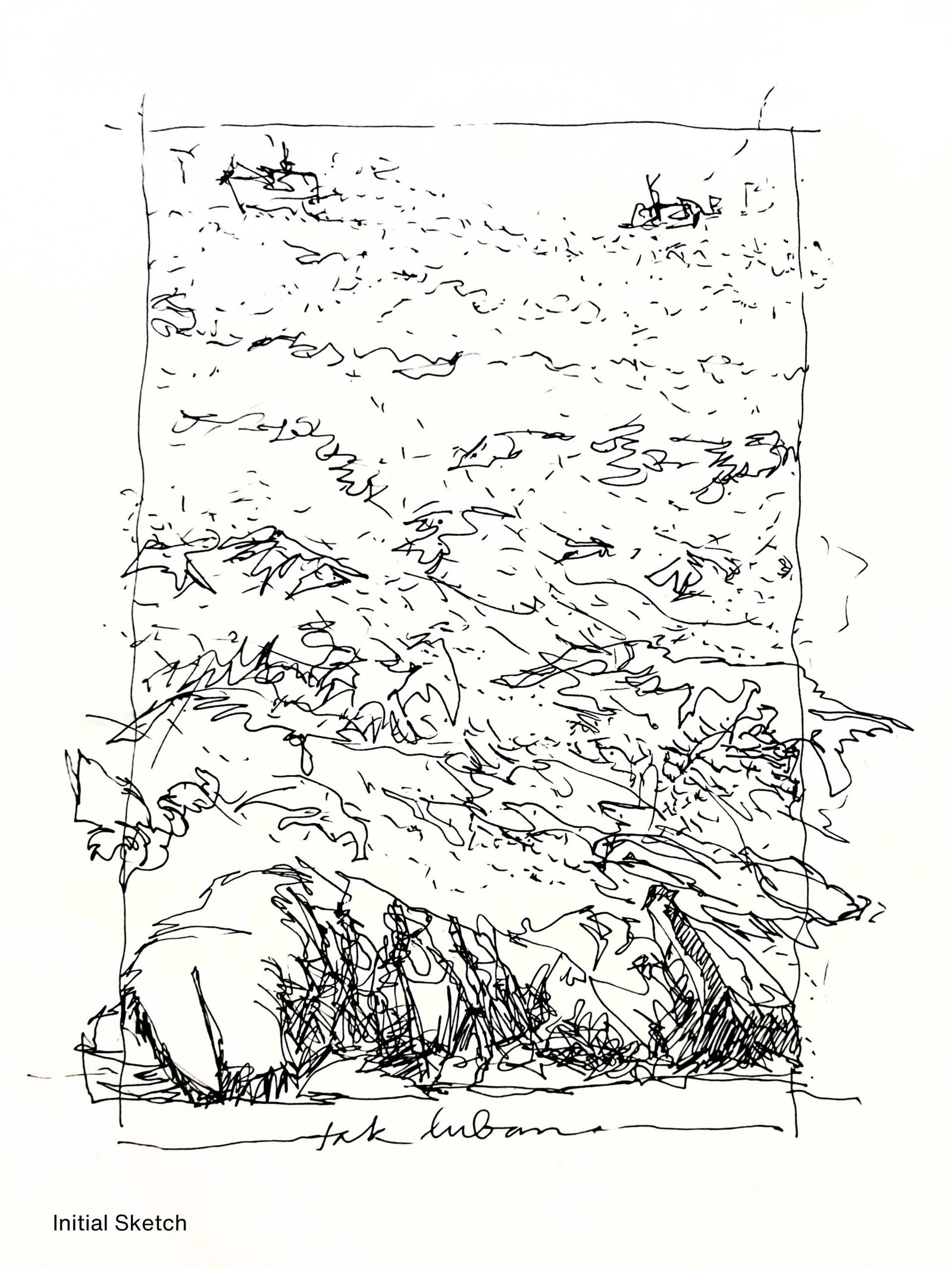
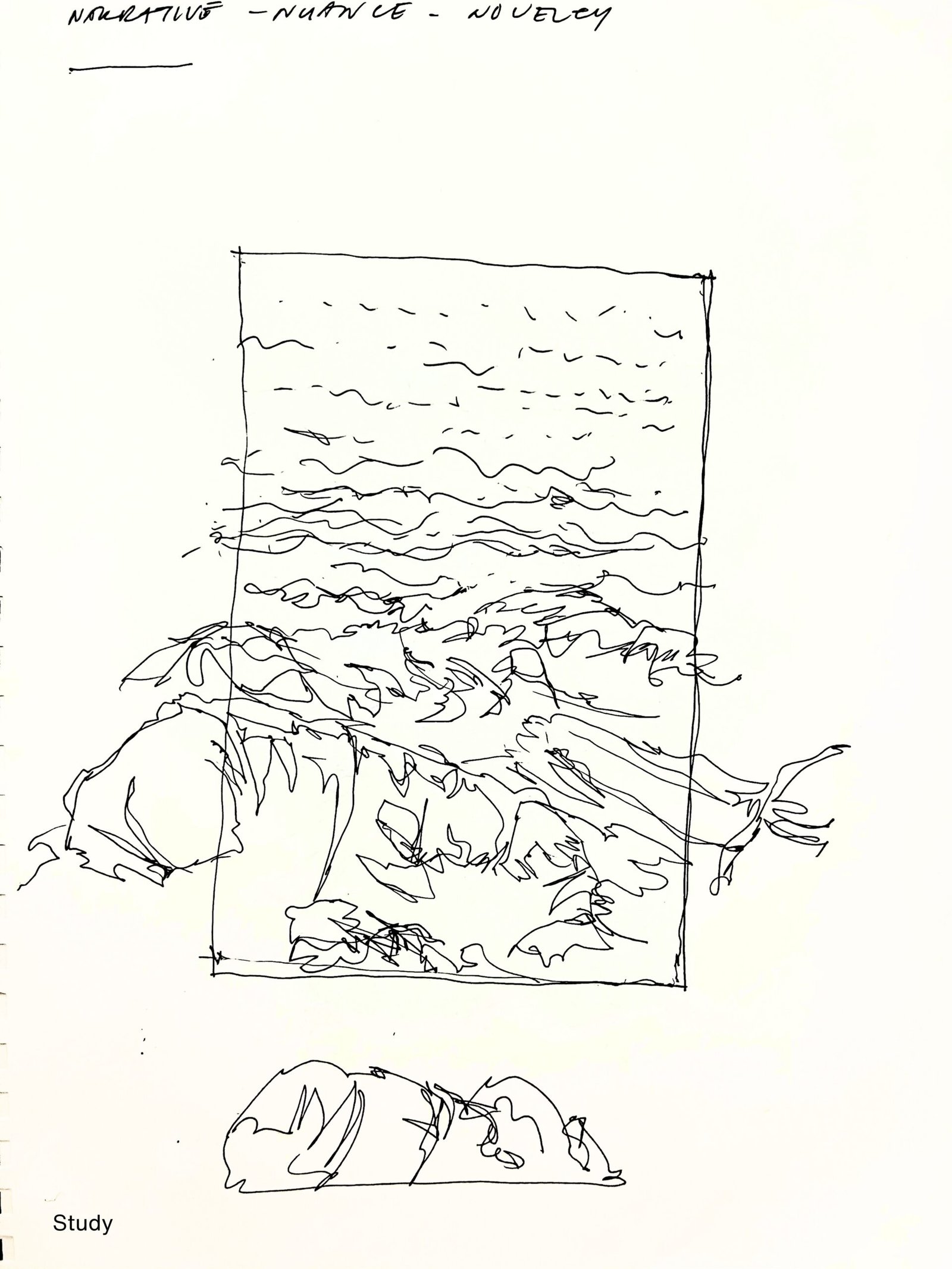
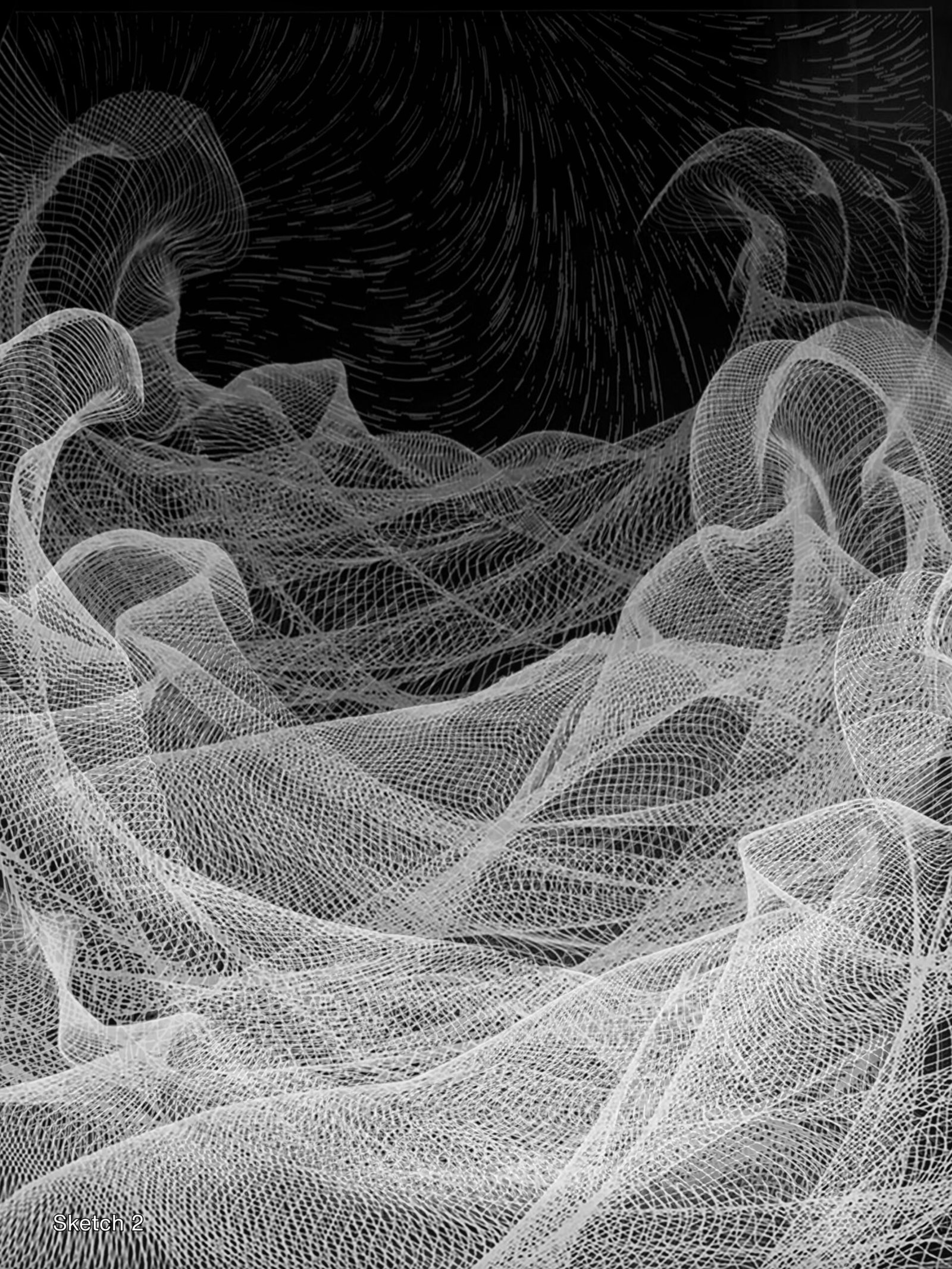
For the MADE piece, I would honestly say it sits somewhere in the middle of the pack. I don’t usually sketch my paintings. I prefer to work directly on the canvas and see how the paint and materials respond. But because this piece was for MADE, I wanted to test new approaches without making the final work look experimental or incomplete. I made two or three actual-size versions first. The final piece is quite large, so you can imagine how much material and time those prototypes took.
I tested many compositional possibilities. What if there was more noise and movement in the lines? What if there were color gradients? What if geometric elements contrasted with the waves? At the same time, I was thinking about the semiotics of the forms. What do these waves actually mean? If I clustered them in a certain way, would they stop reading as waves and start resembling piles of debris? When the crests converge toward the center, could they create a sense of an impending surge, like something about to be swept away?
All of that eventually culminated in the final piece. I brought together what I felt were the strongest ideas from those earlier versions. And even after finishing it, I was already thinking about what I would do next if the piece didn’t get in. I would step back and ask where it was still weak and what I could improve.
So, looking at it now, I would still say it’s somewhere in the middle of the pack, mainly because I’ve since made work where I feel I’ve pushed some of those ideas much further.
Creating To Weather With You
What has someone told you about what they saw in the piece that surprised you?
Artgiveson Arreglado: Oh yes, a fellow awardee left a comment that really struck me. When he first saw my work online, he said, “Ah, pasok ito, kakaiba yung itsura,” implying that he thought I might win. Then he saw it mounted on the wall while he was submitting his own work during the semifinals, and he told me it was really good in person. He described it as “photogenic,” but at the same time, he said it was even more beautiful in person.
I really liked that anecdote because, for a long time, I had actually forgotten about the idea of trying to make my work distinct from other painters. Once I figured out a visual language that felt unique to me, I quickly moved on and started building on top of it, trying to make it more refined and presentable, and eventually use it to tackle more difficult subjects.
At the same time, I still doubted my artmaking. I sometimes wondered whether what I was doing was enough, or whether the visual language was starting to get boring. So, I kept pushing myself to improve and iterate with every artwork.
That comment reminded me that, from the outside, my work could still feel quite fresh. I think I had become so used to looking at my own work that I had forgotten that. And maybe that freshness, that different way of approaching abstraction, was also part of what allowed the piece to stand out and receive recognition.
Of all the platforms and spaces open to a Filipino artist today, you brought this piece to Metrobank MADE under this year’s theme, “Traverse: Creativity in Motion.” What made the competition the right home for it?
Artgiveson Arreglado: This is an interesting question because, as an artist, you have to pick and choose the fights you want to fight, and find the right turf for them.
From the beginning, I knew that not every kind of artwork would necessarily fit MADE. I feel that the works being considered should, in some way, push the craft forward. And even though the competition is open-theme, I think there is also an underlying interest in works that speak to something broader about the Filipino experience. This year’s theme, “Traverse: Creativity in Motion,” also made sense to me because I see it as reflecting the artist’s journey through life, and how art itself can set things in motion.
With my MADE piece, although it started from a very personal contemplation of my experience and the experiences of the people in my hometown, I also realized that there’s something universal about the Filipino condition of weathering through storms and tragedy. Lahat naman ng Pilipino nakaranas na ng unos at paghihirap, whether through floods, typhoons, or other kinds of hardship.
I also think the idea of how a place transforms and shapes you is something a lot of Filipinos can relate to. I think we all carry the places we grew up in. For me, much of how I understand transformation comes from growing up in a place that was constantly changing and constantly having to adapt.
So, while the piece is very personal, I felt MADE was the right platform because it gave me an opportunity to take that personal experience and translate it into something that could hopefully resonate with people beyond my own story.
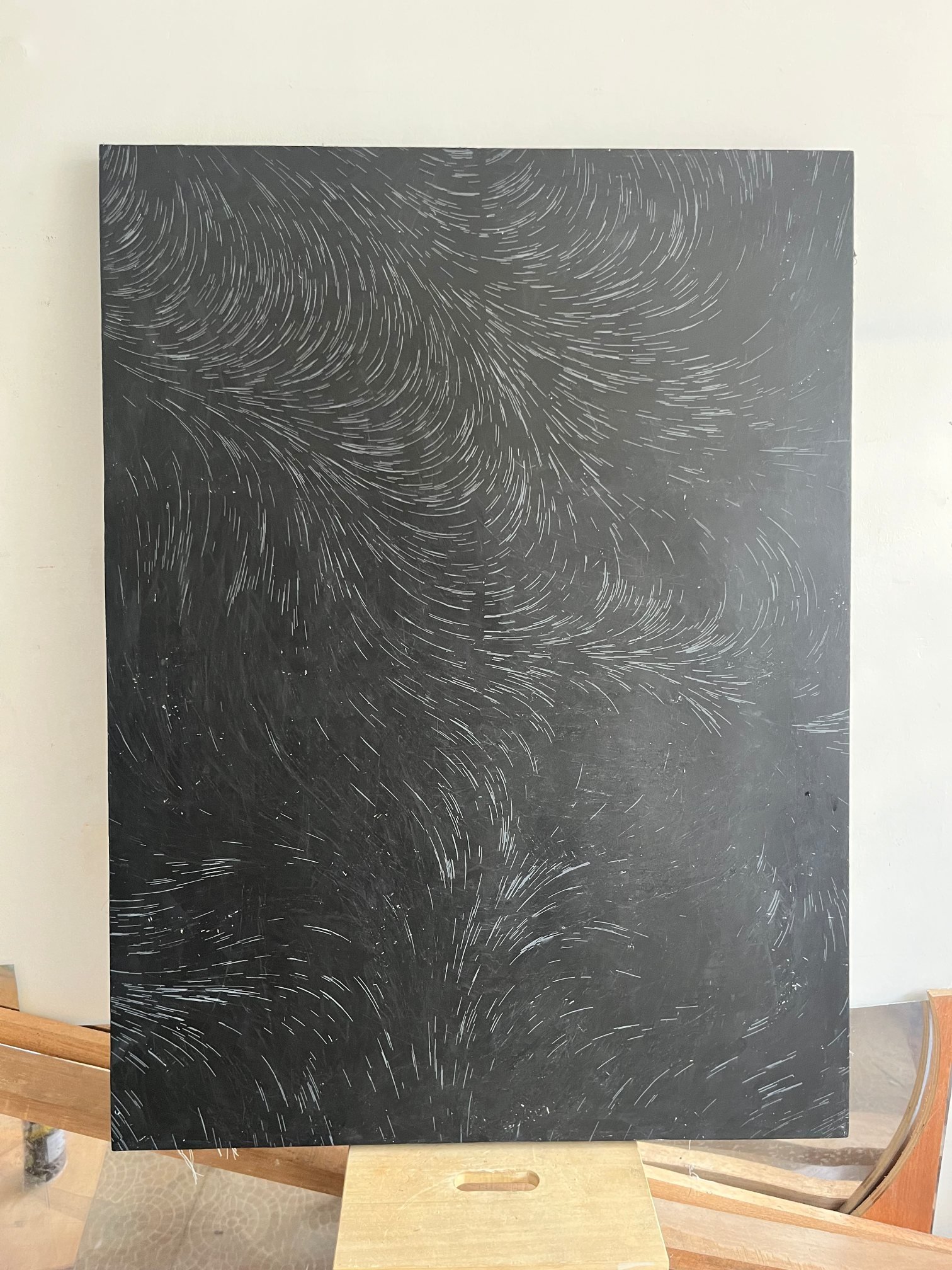
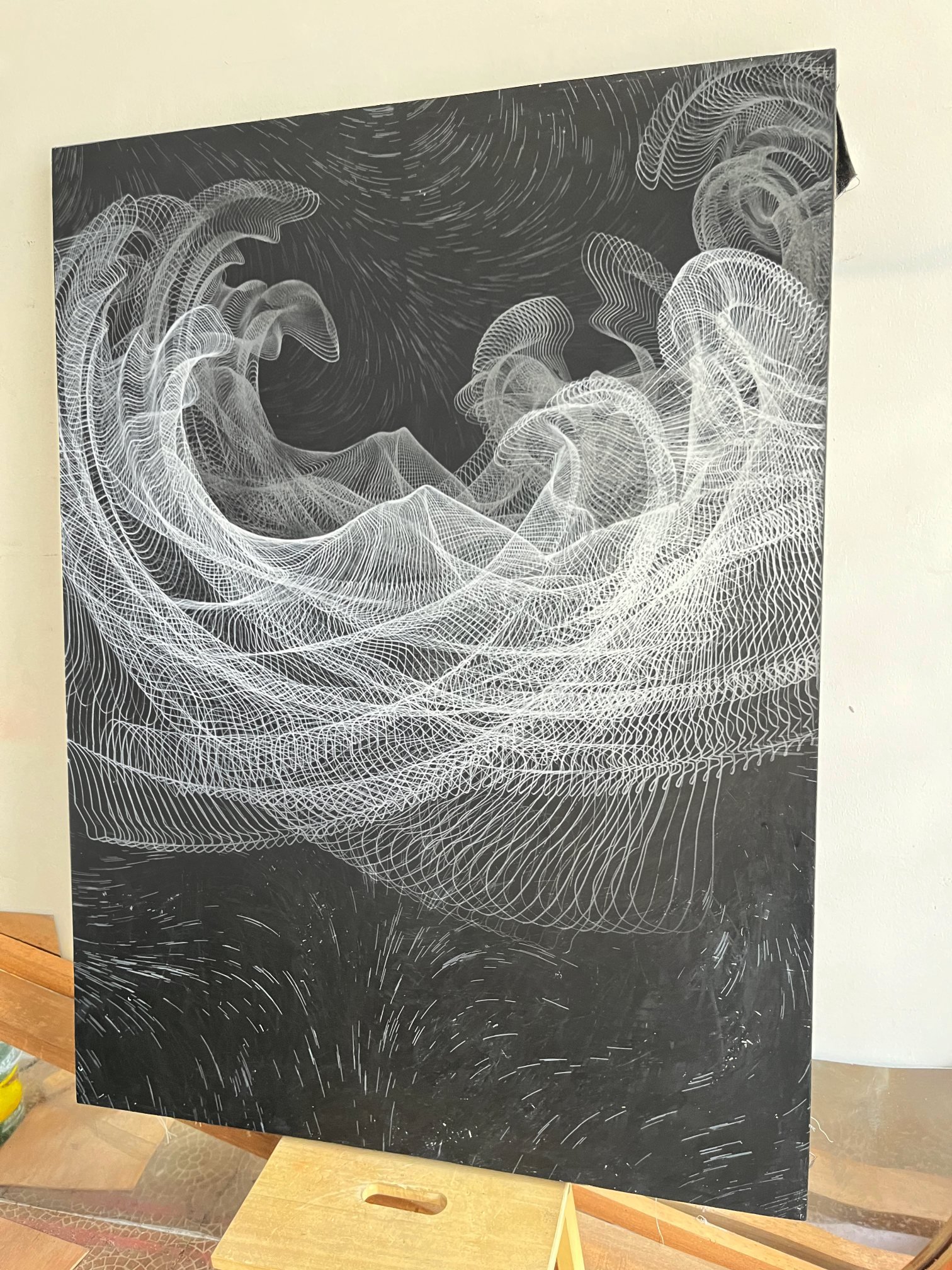
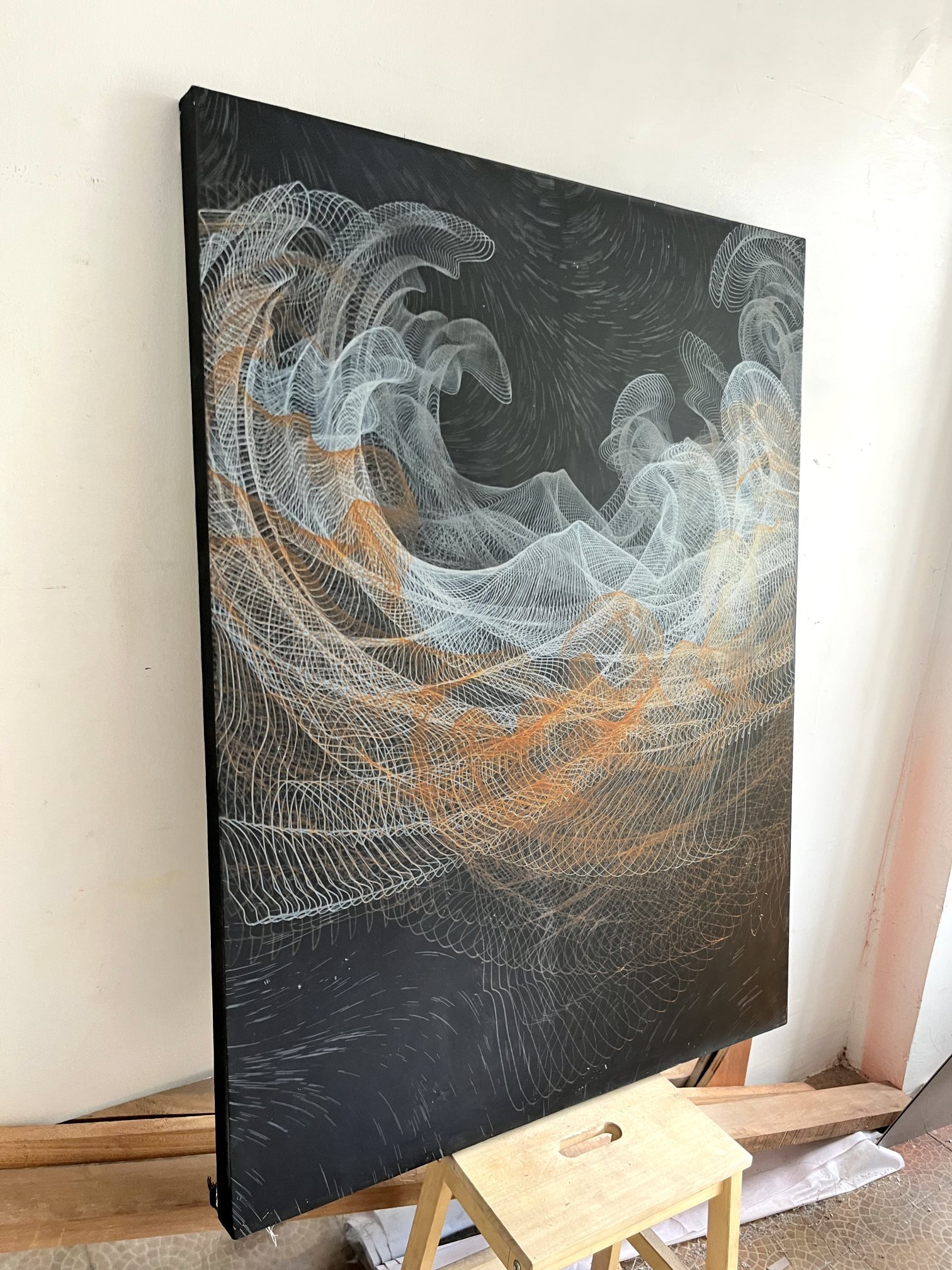
Creating To Weather With You
Metrobank MADE has been part of the Philippine art and design recognition landscape for forty-two years. In your own words, what does the program represent to you as an institution?
Artgiveson Arreglado: For me, MADE is a benchmark for Filipino artists. Especially as a young artist, it gives you a way to see where your work stands alongside other artists pushing their practice forward.
I also think what makes MADE significant is that it has been around for so long. Forty-two years is a long time, and that means it has witnessed so many shifts in Philippine art and design. The program has become part of that history, but it also continues to give new artists a space to contribute to what comes next.
This piece is now part of MADE’s history, and by extension, Philippine art’s. What do you hope it contributes to that bigger picture?
Artgiveson Arreglado: I hope this piece offers another way of looking at the Filipino experience, particularly through abstraction.
Many of the ideas in the painting come from something very personal to me: my relationship with Tacloban and my experience of growing up in a place that constantly changes and requires adaptation. But I also realized that the idea of weathering, of going through storms, tragedy, and transformation, is something that is deeply familiar to Filipinos.
I hope the piece shows that abstraction can speak to these experiences, too. It doesn’t always have to illustrate a specific event or tell a story literally. It can communicate through movement, accumulation, tension, and the way forms transform. For me, that’s where the painting becomes more than just a representation of a place. It becomes a way of thinking about how places shape us, and how we carry those places with us.
And honestly, as a young artist, I don’t expect one painting to define anything. I’m just happy to be part of this legacy, alongside the painters who have shaped the Philippine art scene and those who will continue to shape it. If this piece can occupy even a small place within that history and contribute another perspective to the ongoing conversation about Filipino art, then I think that would already mean a lot to me. •

Our MADE 2026 coverage is in synergy with Novice