
Words and interview Patricia Herbolario and the Kanto team
Images Tuxqs Rutaquio and the IdeaFirst Company
(JB De Leon, Yan Caringal, and Sef Tafalla)

“The book was better,” is a common shrug when a new adaptation reaches cinemas. As Manila’s theater industry grows, the same debate is likely headed for the stage, joining London and New York, where movie-to-stage productions already draw built-in audiences willing to fill seats without much persuading. For newer theatergoers weighing ticket prices against something unfamiliar, a known title carries real pull.
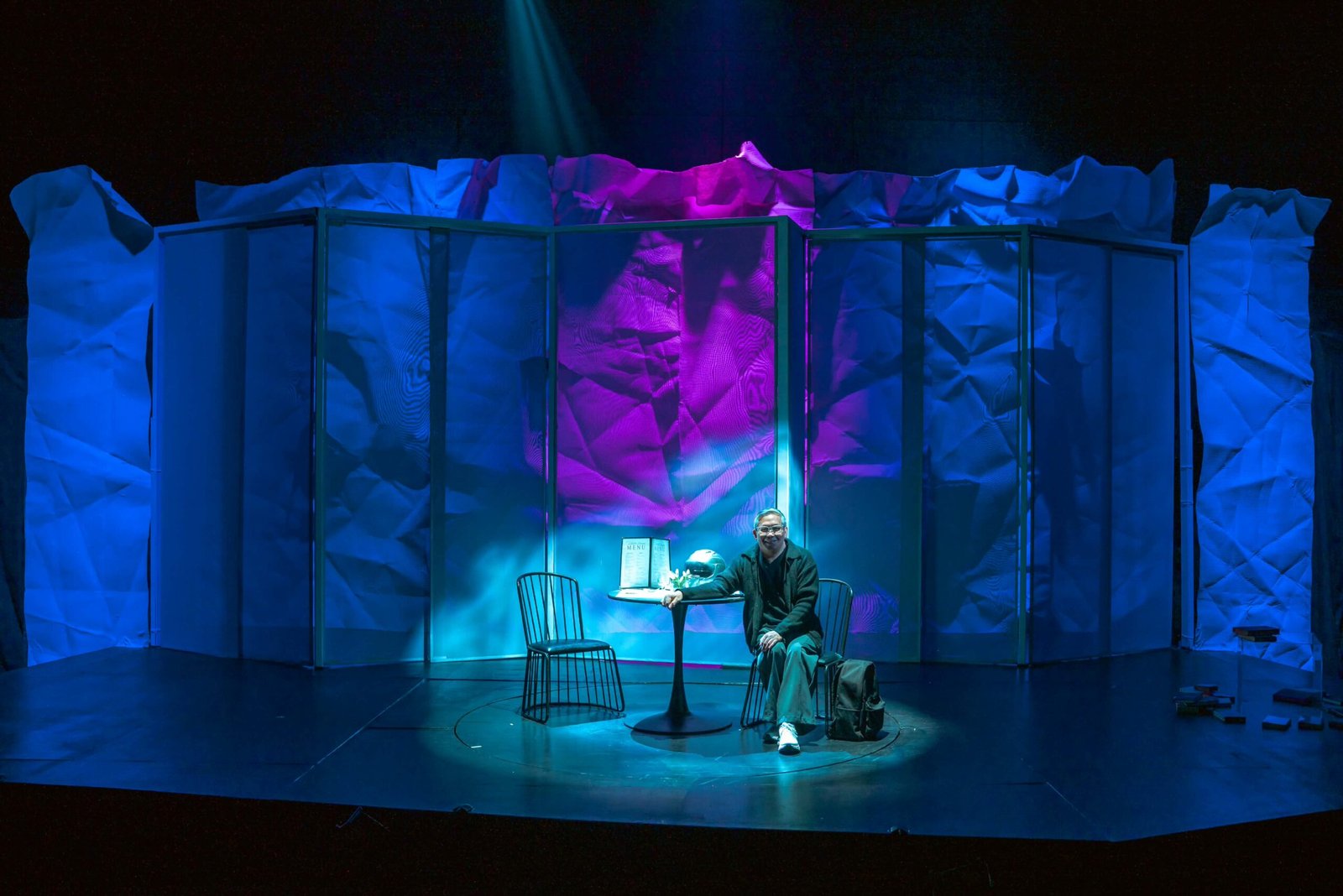
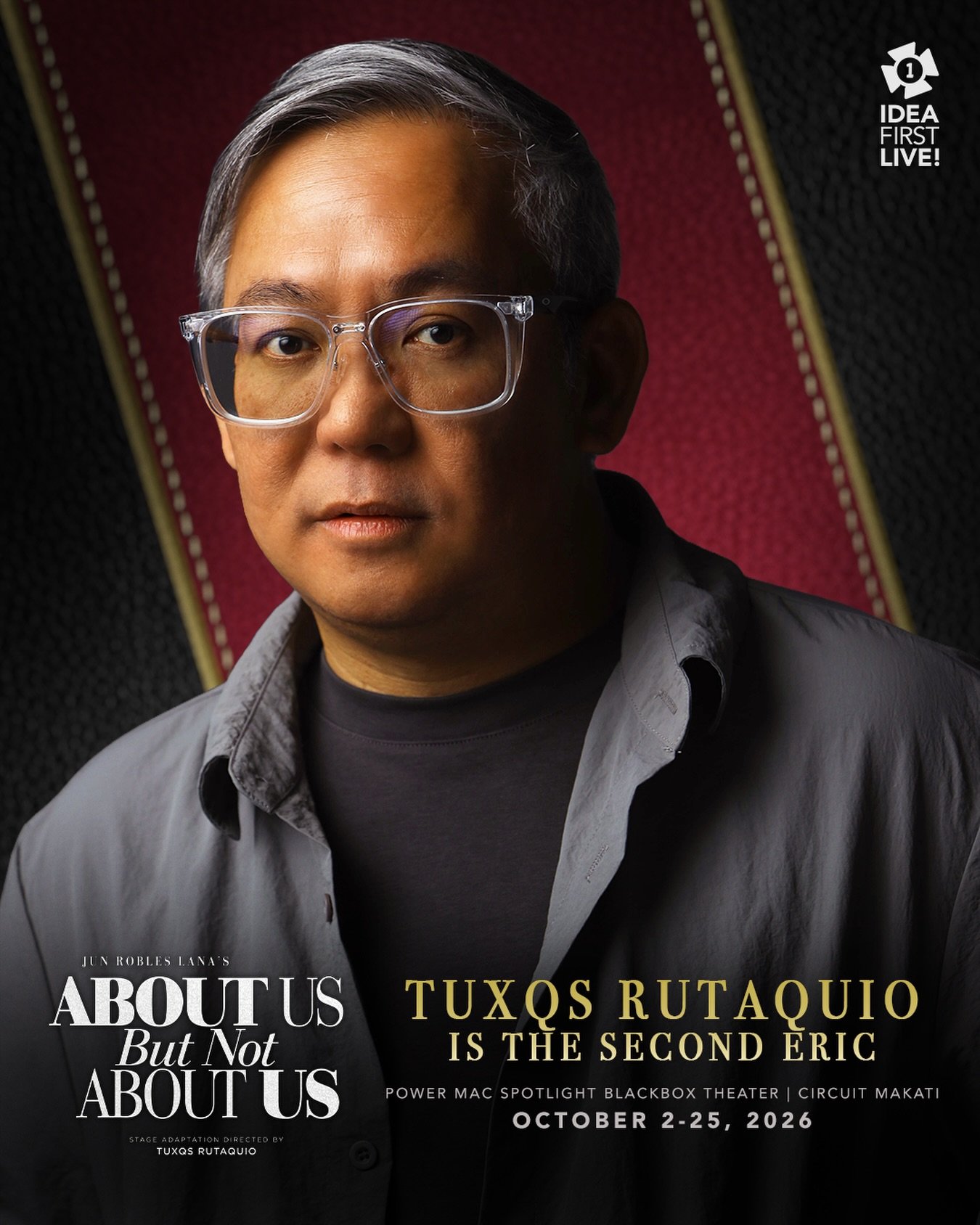
Theater still promises something a screen can’t reproduce: live performance demands raw vulnerability, no second takes, no framing cuts to hide behind, with the mise-en-scène claiming an entire room where film only needs a flat screen. IdeaFirst Company’s About Us, But Not About Us, written by Jun Robles Lana and based on his own 2022 psychological drama, returns to the stage this October. Kanto spoke with director Tuxqs Rutaquio about adapting cinematic material for a medium built on live presence.
Rhythm, not plot, is what a literal translation usually misses
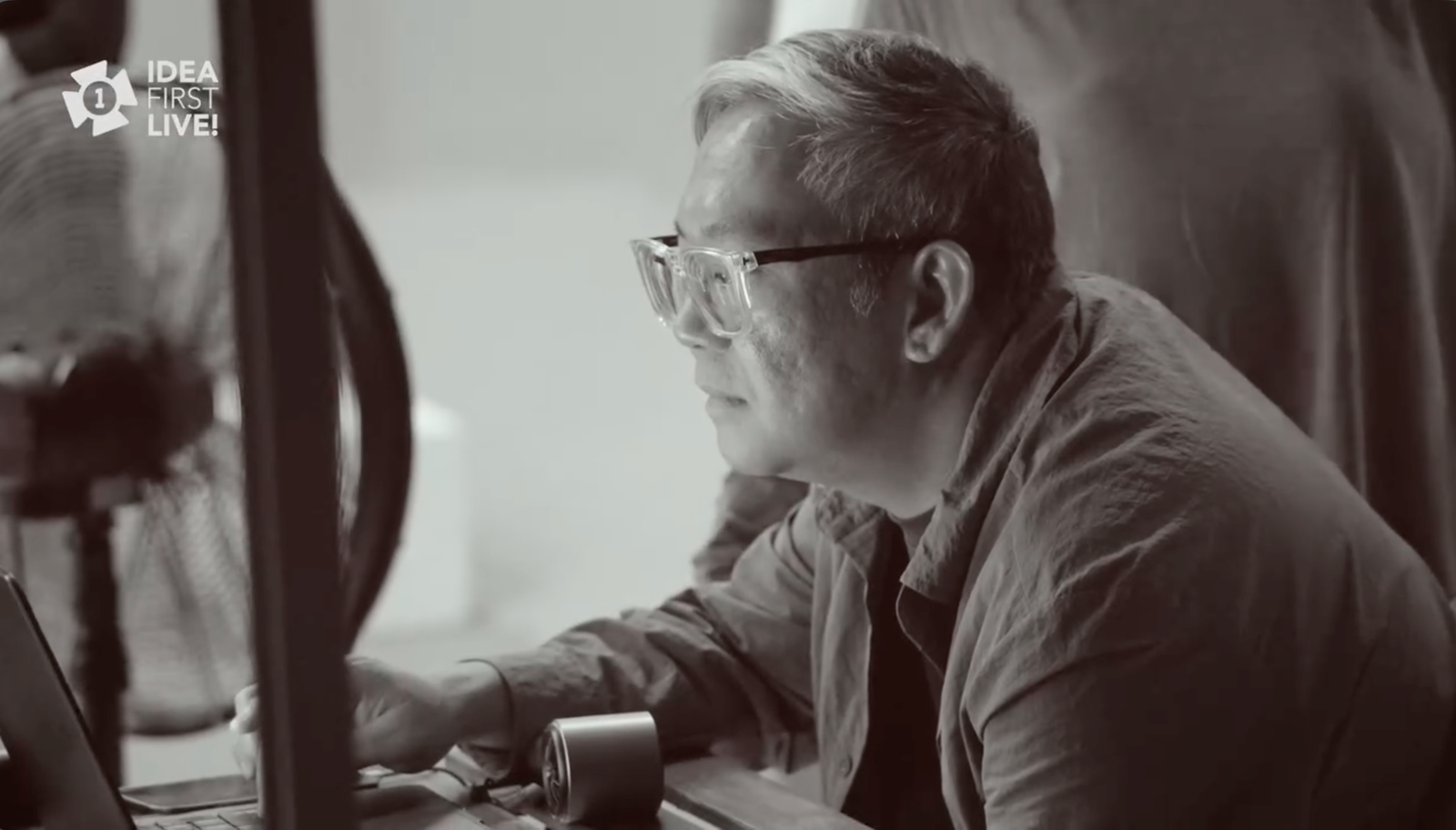
When asked about his process moving a film to the stage, and what people tend to overlook in that translation, Rutaquio starts by rejecting the idea that adaptation is a simple transfer of scenes:
“One of the biggest misconceptions about adapting a film for the stage is that it’s simply a matter of transferring scenes from one medium to another. It isn’t. The process begins with understanding what the work is truly about beneath its plot. Before asking how a scene should look onstage, I first ask what emotional and thematic function it serves. Once that becomes clear, the language of theater begins to reveal itself.
With About Us, But Not About Us, I also had the privilege of working with Jun Robles Lana as he revisited his own material. The stage adaptation is not a reproduction of the film but another telling of the same story. Theater cannot—and should not—compete with cinema on cinema’s terms. Film has editing, close-ups, and the ability to manipulate time and space almost invisibly. Theater possesses something equally powerful: the immediacy of live presence. The challenge is not recreating cinematic techniques onstage but discovering theatrical equivalents that evoke the same emotional truth.
Perhaps the most overlooked aspect of translating a film to the stage is rhythm. People often focus on dialogue, plot points, or visual similarities, but rhythm is what audiences actually experience. In film, rhythm is largely dictated in the editing room—the pace of cuts, reaction shots, camera movement, and music. In theater, rhythm is generated by actors sharing space with an audience in real time. It lives in pauses, breathing, proximity, and the accumulation of tension across uninterrupted scenes. If that rhythm is not rediscovered theatrically, even a faithful adaptation can feel strangely lifeless.
For me, fidelity is never about reproducing every line or every image. It is about preserving the emotional and philosophical core of the work while allowing the new medium to speak in its own language. If audiences leave the theater feeling the same questions, contradictions, and emotional weight that the film inspired—but experienced through something that only live performance can offer—then I believe the adaptation has remained faithful in the most meaningful way.”
Dialogue and silence do the same job
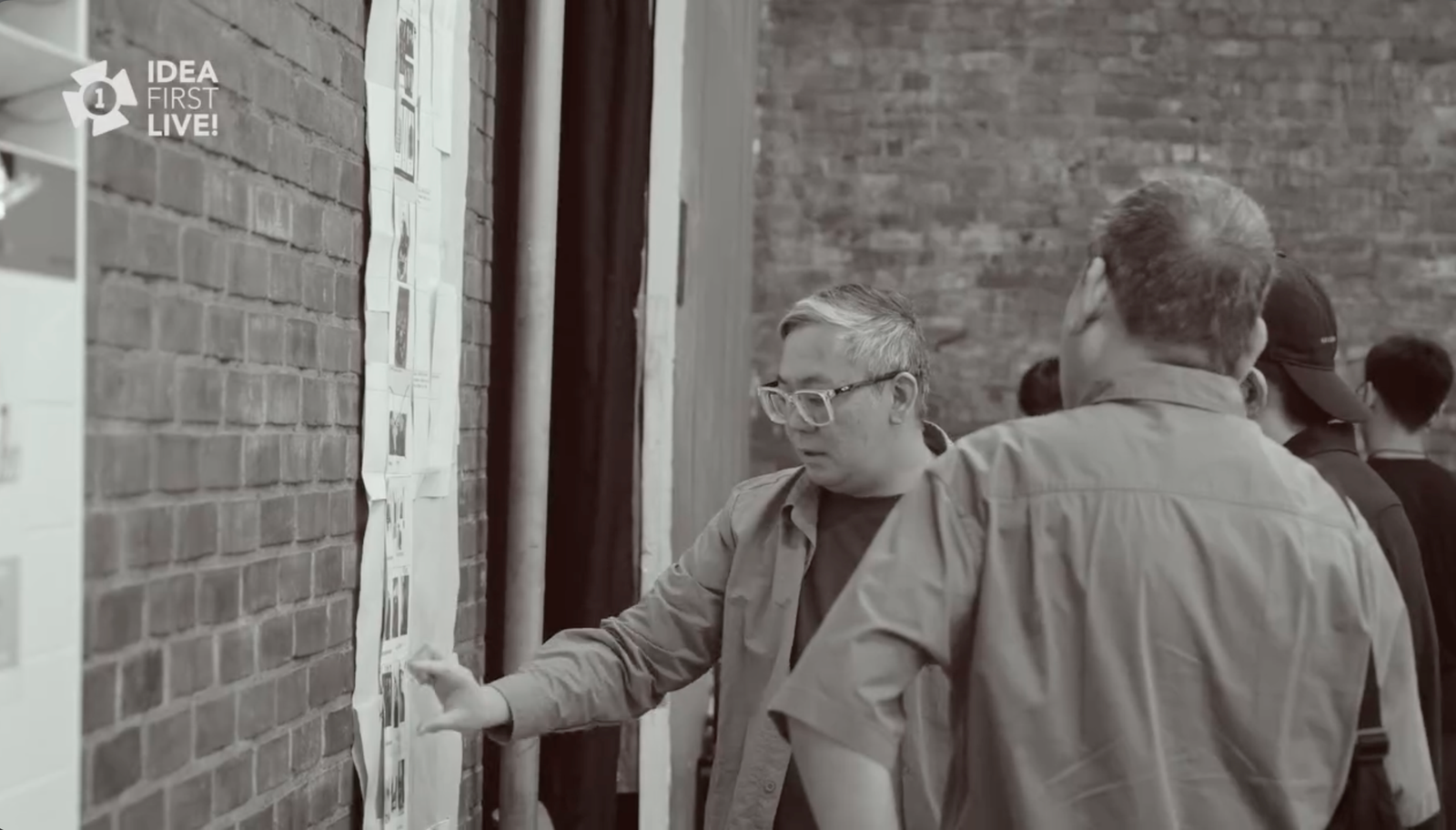
Where he draws the line on altering the source material comes down, for Rutaquio, to whether a scene needs explaining or simply needs to be felt:
“For me, dialogue and action have never existed as opposing forces. The best dialogue is action. Every line spoken should change something—whether it shifts power, reveals a truth, conceals an intention, or deepens a relationship. At the same time, there are moments when silence accomplishes far more than language ever could. One of the privileges of theater is that audiences witness thought becoming action in real time. They are not simply watching characters speak; they are watching people make choices before their very eyes.
When adapting a film to the stage, I constantly ask whether a scene needs to be explained or simply experienced. Cinema often relies on visual intimacy—a close-up, an edit, a fleeting glance—to communicate what a character is feeling. Theater doesn’t have that luxury, but it has something equally compelling: the actor’s sustained presence. Sometimes a line that works beautifully in a film becomes unnecessary onstage because the audience can read it in the actor’s body. Conversely, there are moments when a theatrical adaptation requires language or dramatic action that wasn’t necessary in the film because the stage asks the audience to imagine rather than observe through a camera lens.
That is where changes become necessary—not to improve the source material, but to allow it to breathe in a different medium.”
Rutaquio points to Marcus, Eric’s (Romnick Sarmenta) late partner, largely absent from the film and now embodied onstage by Epy Quizon, as the clearest example of a change made for the stage:
“In About Us, But Not About Us, for instance, the introduction of Marcus is more than an additional character. He reshapes the dynamics of the story and creates new opportunities for action rather than exposition. His presence doesn’t replace what existed in the film; it expands the emotional terrain that the audience is invited to navigate. At the same time, the process itself remained fluid—Jun was actively altering and adding lines throughout rehearsals, even up until opening night. That ongoing evolution reinforced the idea that the work was alive, responding to the actors, the space, and the discoveries made in the room. As a director, my responsibility is to embrace those new possibilities while ensuring that every addition still feels as though it belongs to the same emotional universe that Jun originally created.
What remains absolutely sacrosanct is never the literal form of the story but its emotional and moral center. Plot points may shift. Scenes may be restructured. Characters may evolve. But the questions the work asks of its audience—about truth, intimacy, memory, vulnerability, and the ways we construct our identities—must remain untouched. Those are the reasons the story exists in the first place.
Ultimately, I don’t think of adaptation as an act of translation alone. It is an act of listening. You listen to what the material is asking of the new medium and resist the temptation to preserve things simply because they existed before. Fidelity, to me, is not measured by how much is copied but by whether the audience walks away having encountered the same heart of the work, even if they arrived there by a different path.”
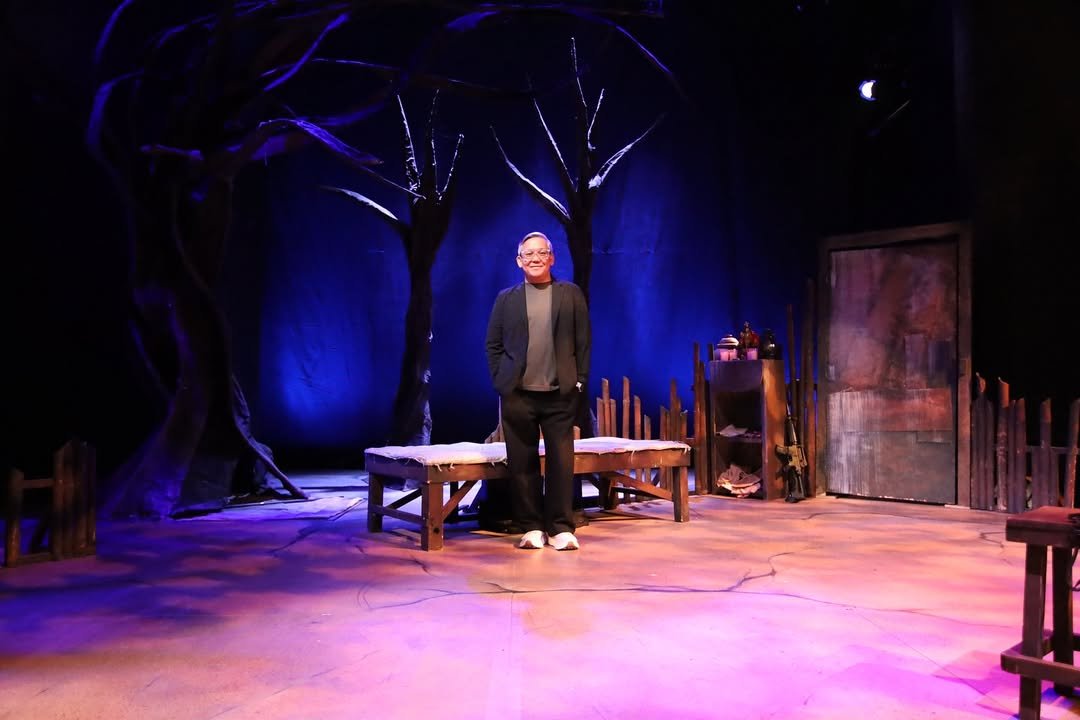
“For me, fidelity is never about reproducing every line or every image. It is about preserving the emotional and philosophical core of the work while allowing the new medium to speak in its own language.”
Familiarity is the real enemy of a second run
With the same cast returning for this run, Rutaquio shares a reminder to keep them from settling into memorized comfort:
“I often remind the cast that we are never performing for ourselves—we are performing for an audience that is encountering the story for the first time. That alone changes the responsibility. Familiarity can easily become the enemy of presence. The lines become easier, the movements more instinctive, and before you know it, you’re relying on memory rather than genuine listening. Our task is to resist that comfort.
For this rerun of About Us, But Not About Us, we don’t begin by trying to recreate what happened before. In fact, I discourage it. Every production exists within a different moment, a different audience, and even a different version of ourselves as artists. The experiences the actors have accumulated since the last run inevitably change how they understand these characters. Rather than suppressing that growth, I encourage them to bring it into the rehearsal room and ask, “What do I know now that I didn’t know before?” That question alone often unlocks new discoveries.
Perhaps the greatest challenge is preserving curiosity. I tell the actors that certainty is dangerous. The moment you think you’ve solved a scene, you’ve probably stopped investigating it. Rehearsals become less about perfecting choices and more about asking better questions. Why is this line being spoken today? What has changed in this relationship? What happens if we truly listen instead of anticipating? Those questions keep the work alive.
In the end, I don’t believe audiences come to watch actors repeat emotions. They come to witness something unfolding in front of them that feels immediate and truthful. The passion of opening night doesn’t come from novelty—it comes from genuine presence. If the actors continue to surprise one another, to listen deeply, and to remain open to discovery, then every performance, whether it’s the first or the fiftieth, has the possibility of feeling as though it is happening for the very first time.”
A play never really finishes; it just holds together for a night
Does a play ever reach a definitive version?
“I honestly don’t think theater ever arrives at a definitive version—not in the way a film eventually does. That’s one of the things I love most about the medium, and also what makes it so ephemeral. Each performance exists only in the moment it is shared between actors and audience, and once it ends, it can never be replicated in exactly the same way again. A play continues to evolve because the people making it continue to evolve, but also because each night is fleeting.
About Us, But Not About Us is a perfect example of that. We also have new actors joining as alternates, and every one of them brings a different rhythm, perspective, and emotional truth to the material. Those changes may seem subtle, but they inevitably reshape the production. And beyond that, each performance carries its own energy—shaped by the audience present that night, by the actors’ emotional states, by countless intangible factors. So rather than thinking of this as the definitive version, I see it as the most truthful version of the play at this particular moment, knowing that it will vanish as soon as the curtain falls.
What I do look for is a sense of coherence—when every artistic choice feels earned, when the actors understand not just what they’re doing but why they’re doing it, and when the production speaks with a unified voice. That doesn’t mean there is nothing left to improve. It simply means the production has found its integrity, even as it continues to shift and dissolve with each performance.
Perhaps the closest theater ever comes to a “definitive” version is not when nothing more can be changed, but when the work can stand on its own and continue revealing new meanings with every performance. If a production still allows both the artists and the audience to discover something they hadn’t seen before, then I think it is exactly where it needs to be. Ironically, it is this very ephemerality—this constant vanishing and renewal—that keeps a play alive.” •
About Us, But Not About Us
Stage adaptation directed by Tuxqs Rutaquio
An intense psychological drama that centers on a fraught conversation between Eric, a literature professor, and his student, Lancelot, meeting months after the suicide of Eric’s partner, Marcus. What starts as a casual lunch quickly unravels into a revelation of dark secrets and lies, exposing the complicated history and betrayals among the three men. Through their dialogue, the play explores themes of guilt, ambition, and identity, forcing the audience to piece together the chilling truth behind Marcus’s death. (Words by IdeaFirst Company)
About Us, But Not About Us runs October 2 to 25, 2026 at the Power Mac Center Spotlight Blackbox Theatre, Ayala Malls Circuit, Makati City. Shows Fridays at 8:00 PM, Saturdays at 3:00 and 8:00 PM, Sundays at 3:00 and 8:00 PM. Tickets run ₱2,800 to ₱3,920 via Ticket2Me.