Words Geli Tupas Arceño
Images Ginoe (Bayotany)
Editing Gabbie de la Cruz
Editor’s note: This article, originally titled “Out, Standing in the Field,” is a written account by Geli Tupas Arceño on the experience of witnessing and sharing in the experience of mounting “Bayotany” by artist Ginoe. Edits were made for Kanto.PH.
Seeding the Concrete
We would sink on those foldable camping chairs with our coffees and cigarettes, a late-night routine we have adopted since Ginoe started preparing for his solo show, Bayotany. Nylon seats furled around our bodies as we settled in repose while its aluminum frames were rooted firmly on the concrete, narrowly avoiding the railed drainage of the gutter. Behind us is a coffee cart whose barista would stay open a few hours after his usual closing time. Above us, apartment buildings loom in a backdrop of blackness, and the lights from the windows replace stars.
On this particular night, we would watch a cluster of palm trees on a rooftop, their pots just big enough to accommodate their growth.
“I can’t exactly put my relationship with plants into words; I just know it’s not the same as city folk,” Ginoe answered when I asked him whether the conception of Bayotany was amplified due to his relocation to Manila. The artist moved in 2022 after spending most of his life by the shores of Silay, a city in Negros Occidental, Visayas. The shift in the environment could be jarring, from the province’s effortless lushness to the imposing structures of urban Makati. “I feel my interest in plants heightened when I moved here,” he continued. “Every time I look at those palm trees on the rooftops here in our area, I can’t help but wonder: Do they know the sound of ocean waves?”
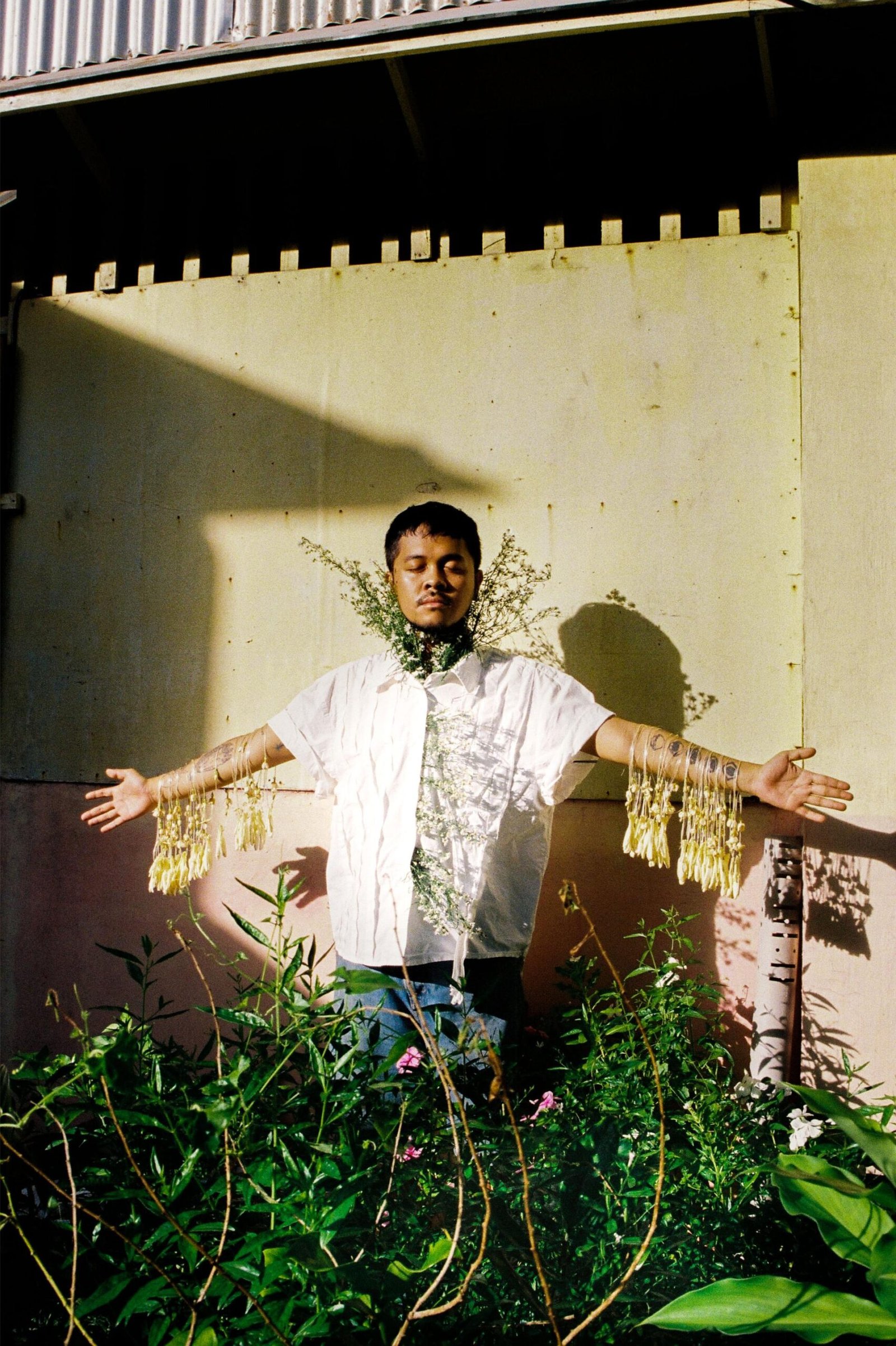
The conversation comes to a pause as a motorcycle rips by, the engine roaring with an intentionally stripped muffler; it tapers off into a disruptive thrum before distance finally kills the sound. We watched it disappear into a corner before turning back to the palms, unmoving in their rubber pots. “Coconuts are hollow, so they can float in the water and thrive in the sand. I can’t help but wonder how they got here and if they’ve even seen the ocean,” the artist shared.
Ginoe pointed to the street, “This is where I felt, not really dissonance, but if you look at our neighborhood, there are so many potted plants as well as butterflies. I love that because I feel like the people who do this are kindred spirits. Our neighborhood has no soil, so they make vessels because they have the same urge as I do. Daw pareho kami gintubuan, they grew up like me in that they have notions of being close to the soil. They see the soil as permeable, unlike all this,” he said, referring to the hard, impenetrable concrete road.
“In a natural sense, if I am stepping on soil, kabalo ko nga ilubong ko sa duta (I know I’ll be buried in the earth). But when I step on cement, I forget my mortality. I am only reminded of it when it floods, and I see the absence of soil to seep in the water.”
Germinating the Concept
Bayotany emerged as the exhibition title when Isola Tong, an artist with Waray roots and Ginoe’s friend, did ecological research and coined the neologism bayotic refugia. It combines bayot, a Bisayan term for queer or femme and biota, the animal and plant life of a particular region.
Ginoe recalled that after hearing about Isola’s work, he thought, “Daw kasadya (It would be fun) to make a show called Bayotany”. Coming from bayotic refugia, Bayotany is a play on the words bayot and botany, the scientific study of plants.
Some days, we would head to the nearest convenience store for an after-dinner probiotic drink. If we were lucky, the resin tables outside would be empty. We’d drag damp tissues across the sticky surfaces and settle into the cold steel seats, opening our notebooks to discuss works in progress. One night, Ginoe began organizing his notes on Bayotany. We talked at length about the ethos of the exhibition. He was struggling with the flow of a few paragraphs, so he started mapping his thoughts into a graph. That was when he decided the exhibition would be a series of autobiographical works exploring his experience of taking root and growing among plants. “I want to frame plants as producers and carriers of meaning,” he explained. He recognizes a sentience in a plant’s survival and growth, a quality he relates to as he cultivates his artistic journey and personhood.
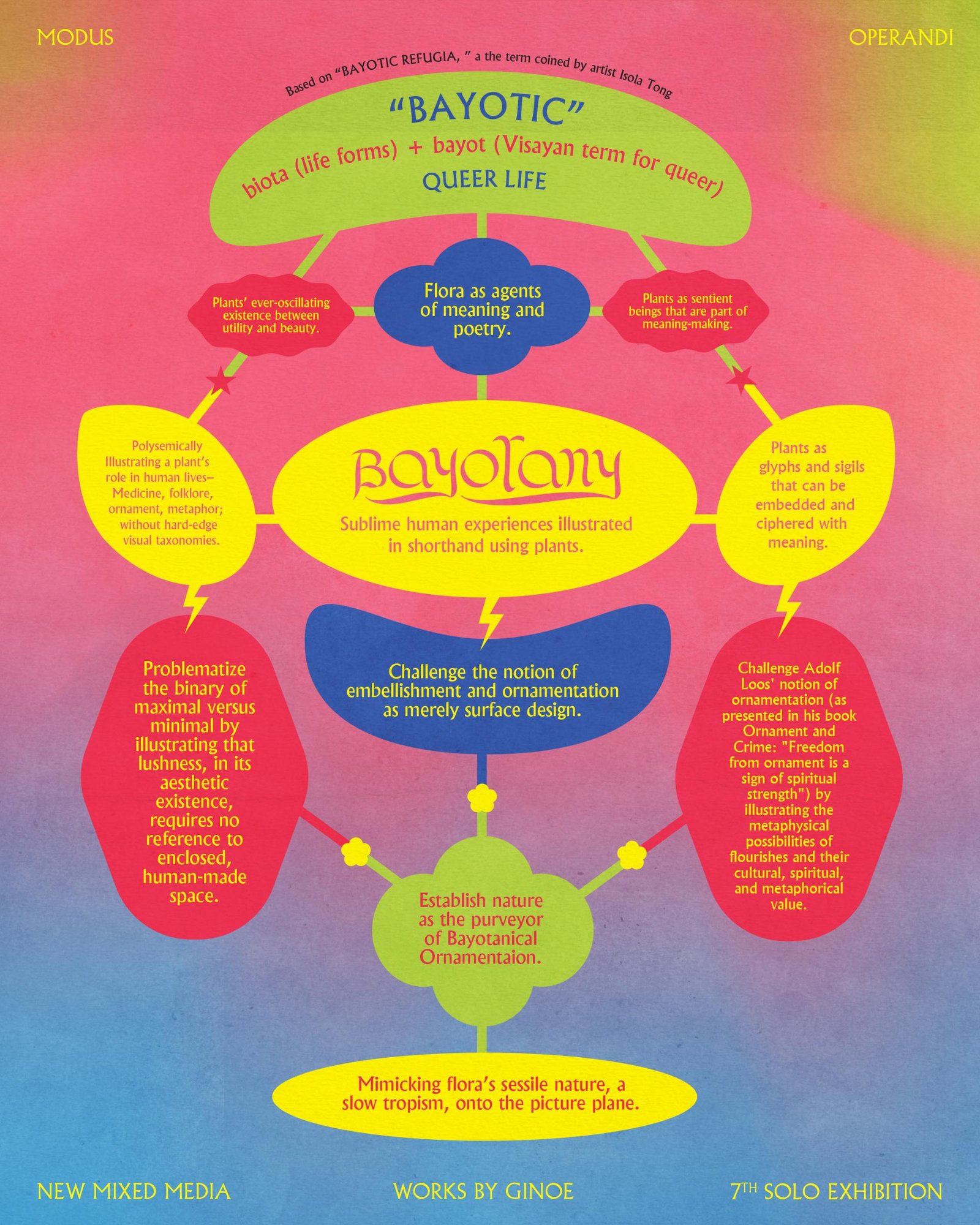
Originally, Ginoe intended for the artworks to simply have himself as the subject alongside a plant. However, he felt like his interaction with plants was more complicated than that. It became less about a side-by-side comparison with his life and the plant but more about the significance of the plant, the metaphysical and metaphorical relationship he shares with the memory of it.
The artist challenges the idea of plants as mere ornaments or metaphors. For Ginoe, a plant does not exist as a visual filler, but as a living entity with its own will. He doesn’t seek to control or curate it; instead, he meets it as an equal. “It’s more than just the surface,” he said. “Imagine seeing a plant without knowing how deep its roots run. Plants simply exist, and I interact with them—they’re not here for decoration. I want to feature species I’ve personally encountered, not those I’ve read about in handbooks or introduced by Western media, but ones rooted in my own life, especially in the histories passed down from my parents. I’m drawn to the etymologies and taxonomies carried through my mother and my mother tongue.”
Seedling from Childhood
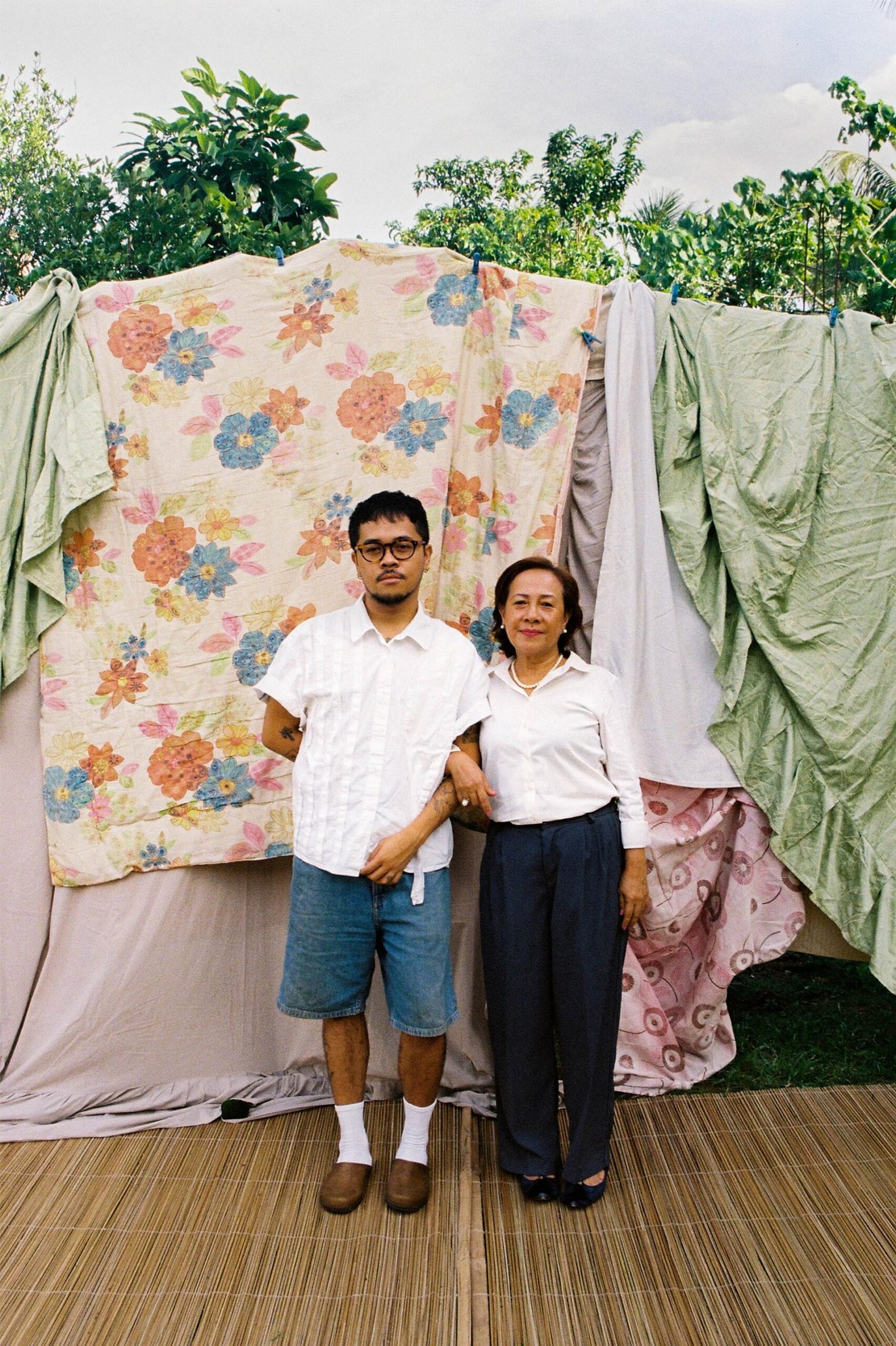
During the production of Bayotany, I was sleeping over at Ginoe’s three-floored pink house, dabsmack in the middle of white and brown square houses by the shores of Silay. Ginoe set up a studio on the ground floor for Bayotany’s art production, an open foyer that opens into the ugsaran or front yard, a stretch of wild grass with explosions of flower bushes and small fruit trees. A fitting backdrop for preparations for an exhibition about life and plants.
I remember one morning coming up to shower on the second floor, I came upon a square framed paper of a faded script with different leaves stamped on its border hanging on the door outside their family room: You are closer to God’s heart in a garden than anywhere else on earth.
Inside, Ginoe’s mother, Rosene, sat at the dining table across from his youngest sister, Zeta, talking about church. I caught some of their conversation “Wala man ko nagahambal nga kay gasimba ka kada-Domingo masalbar na ka dayon, pero daw tanom man na mo nga gina bunyagan kag ginatatap mo na, te sigehon mo na lang hasta magtambok kag magtubo (I am not saying that just because you attend mass every Sunday that you will be saved immediately. But like a plant that you are watering and caring for, you might as well keep doing it until it gets healthy and grow).”
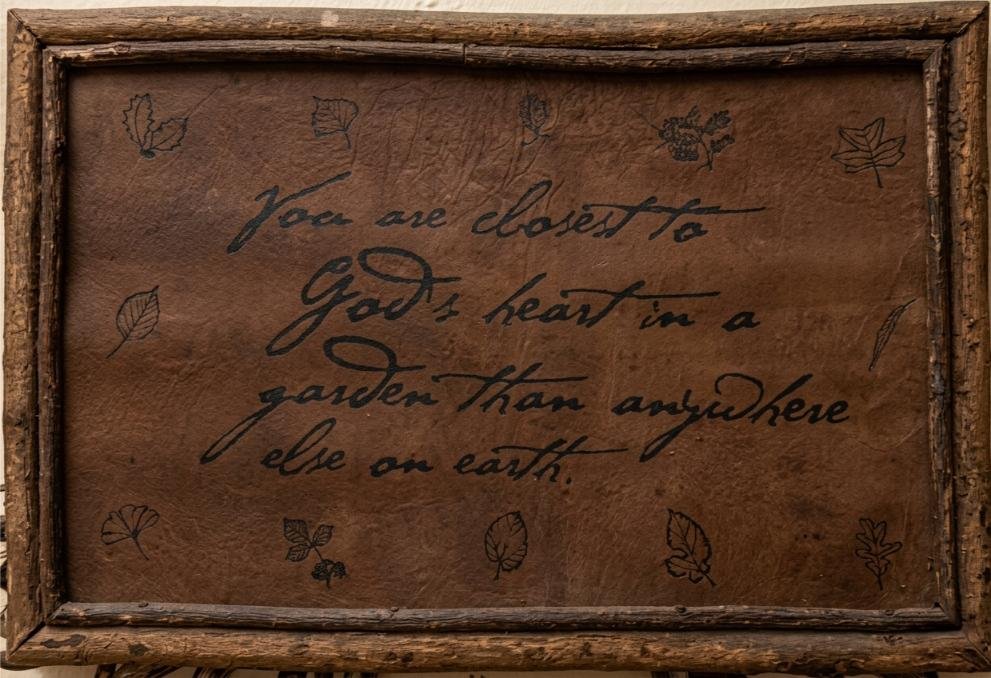
I started to understand why Ginoe fondly talks about how his childhood ugsaran was a garden in both a literal and metaphorical sense. “I see myself as a grafting of two flowers,” the artist shared. “My mother’s name is Rosene, while my father’s last name was Lilyboy.”
Both of Ginoe’s parents brought their own magic to the garden. His mother, a self-taught florist, had a green thumb so sure that “Miskan ano ipanghaboy niya nga liso, gatubo (Whatever seeds she throws, they grow)”. His mom would plant flowers and vegetables gathered from her excursions into nature, while his father, an agriculture major, planted bankiling, sarisa, chico, mango, and coconut trees that grew alongside Ginoe himself, their roots entwined with his own childhood. This is a Bisayan pre-colonial tradition centered around raising a child’s Dungan—an individual’s life force and vitality, which literally translates to “together”. Planting a tree that grows alongside a child weaves their spirits together, so that as the tree takes root and rises, the child’s dungan grows strong and resilient. Ginoe’s father made sure he had several dungan. As the artist grew up, he stationed his art studio in the spot where the bankiling trees used to grow, feeling that it was serendipitous.
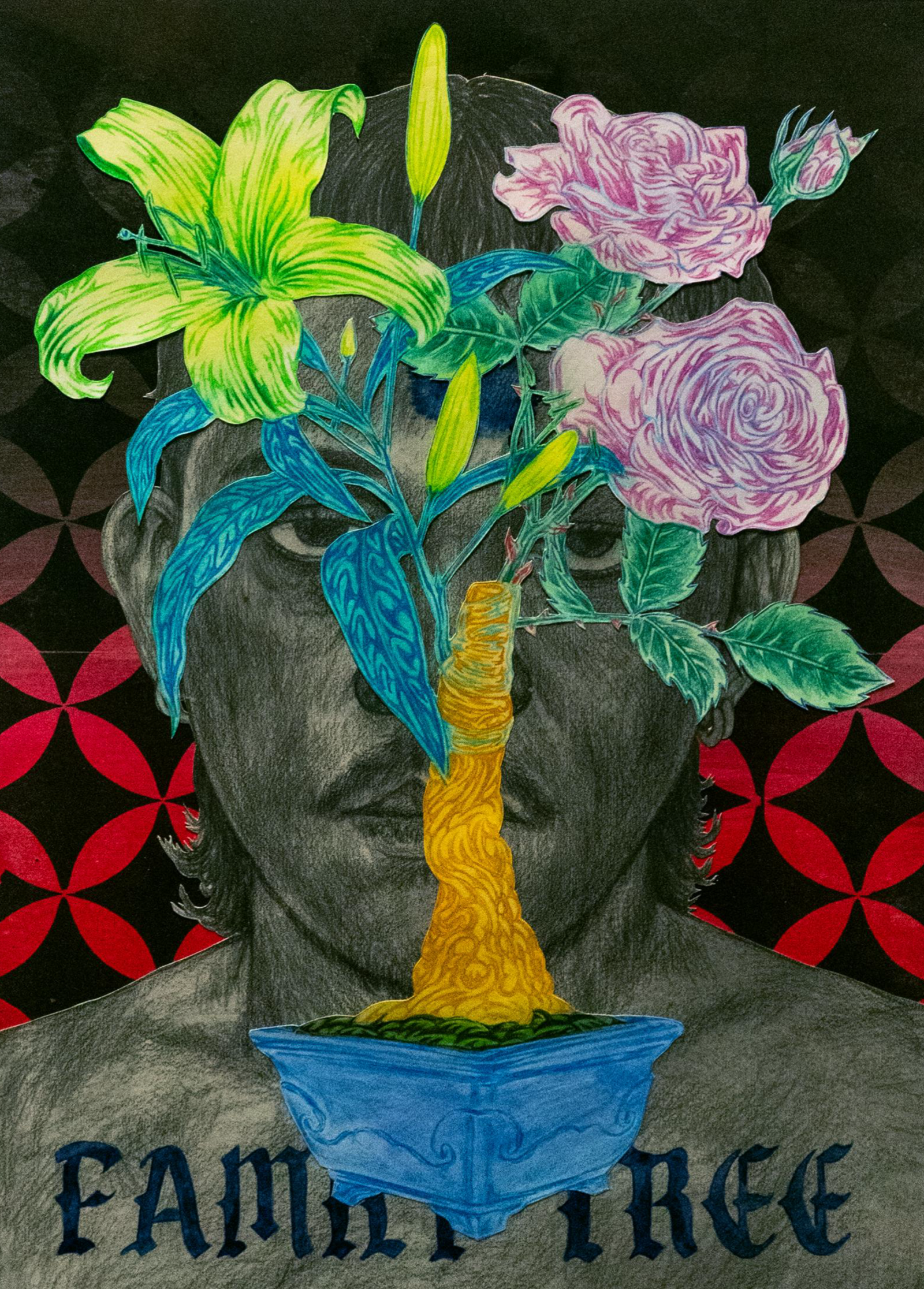
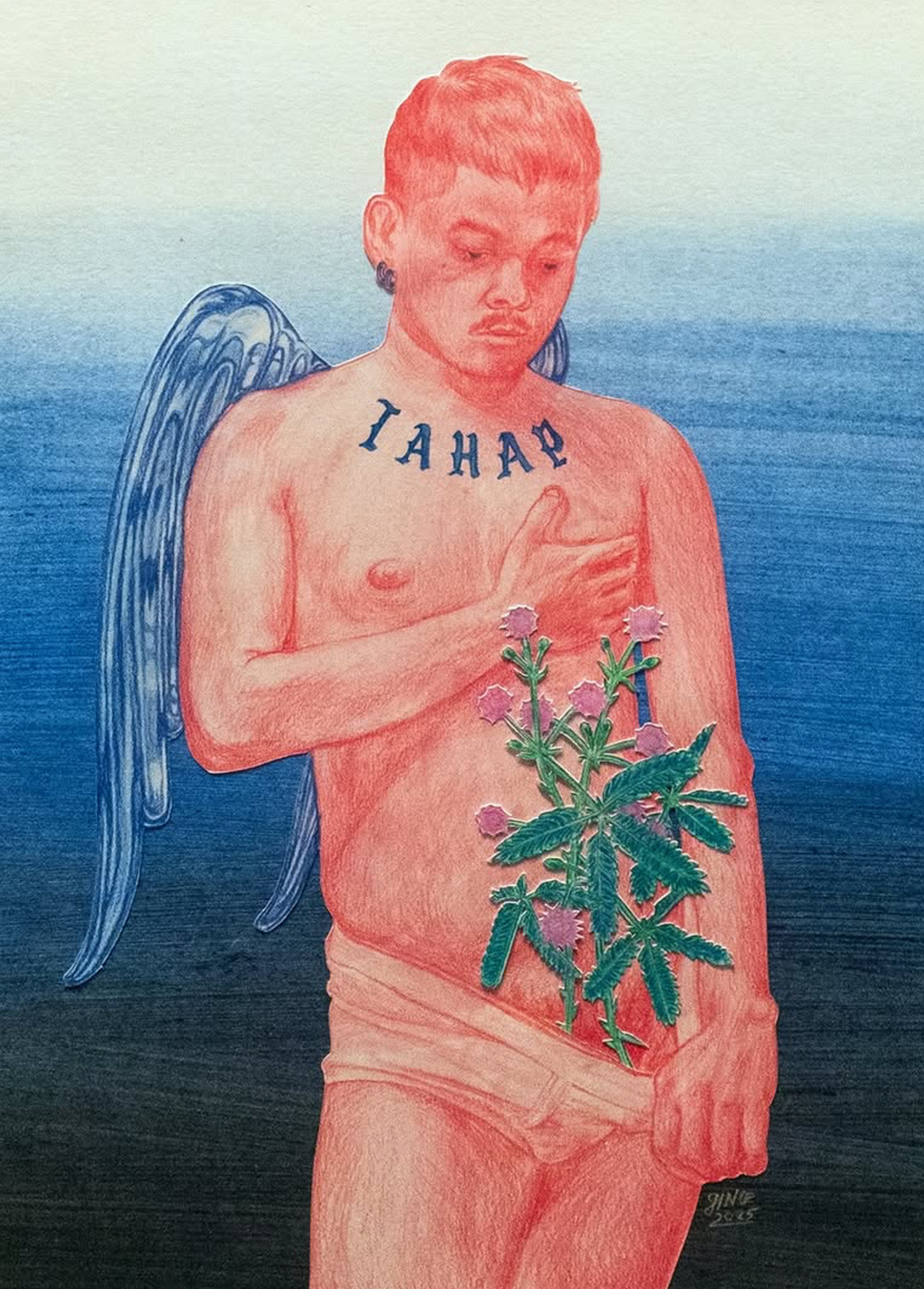
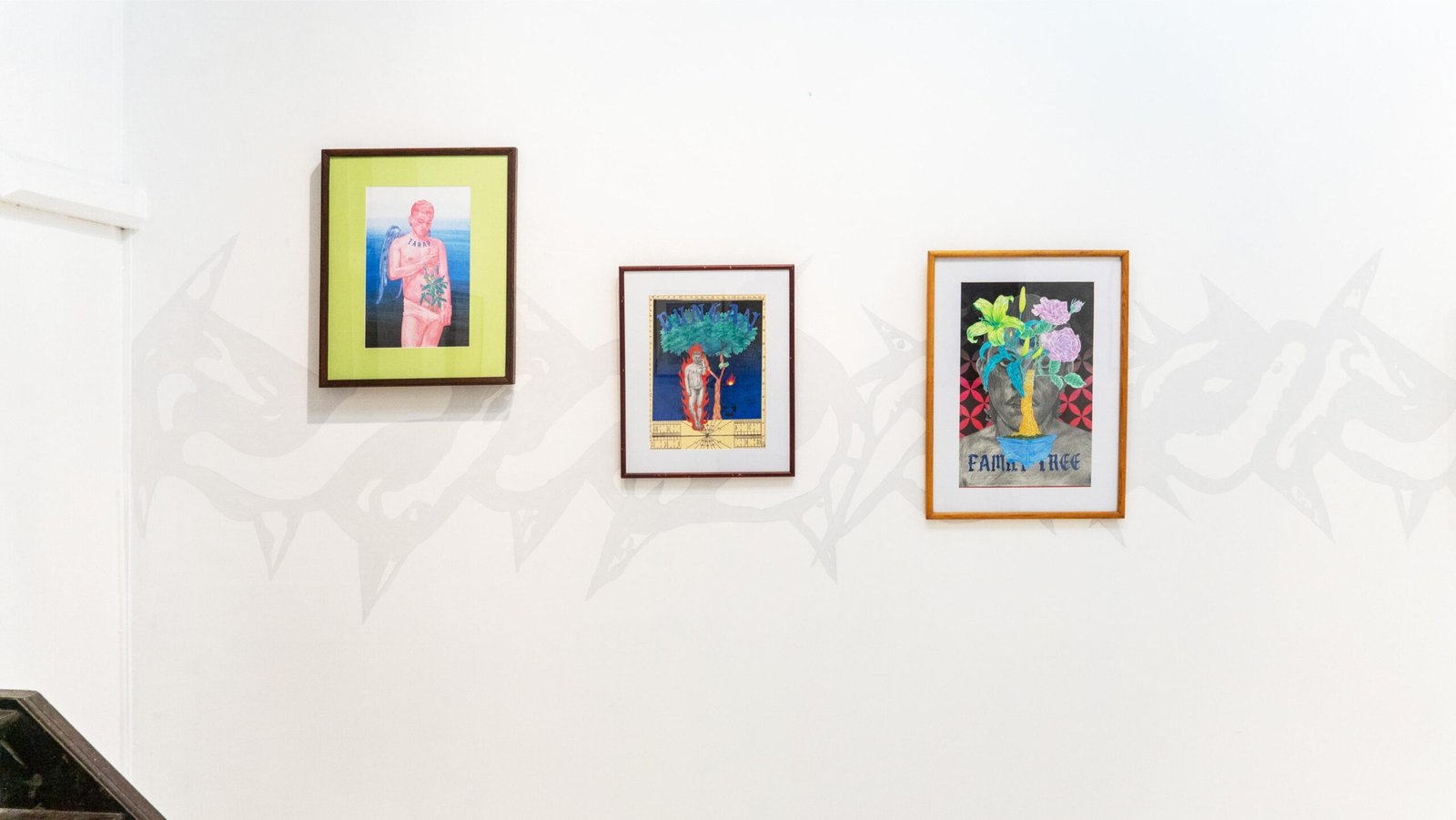
Above: Family Tree, Mixed media collage on paper, 2025 and Tahap, Mixed Media Collage, Found Frame, 2025. Below: Exhibition view of “Family Tree.” Photo by Nicolas Tolentino.
Ginoe also recalls birds carrying ghost peppers in different shades of purples and oranges into their garden, signaling luck and abundance. When the ghost peppers thrived, material abundance came pouring in, an experience of plants as symbols of divinity and protection. The artist emphasized that one of the main driving forces of Bayotany is that he got to experience plants not limited by ecology but as independent, metaphysical entities.
Though plants have been a big part of his art since the beginning, Bayotany is his first consolidated exploration of plants as the main subject. His very first show, “Good Mourning” (2019) featured fabric flowers dipped in cement, a form he used to concretize his perception of his mother’s grief following his father’s death—an attempt to prevent wilting and encasing it forever. Rosene has always had the impulse to mimic nature, especially in lifting spirits. Even when she no longer had a physical garden, she began crafting flowers out of paper. Ginoe sees his pieces in Bayotany as an extension of that same impulse.
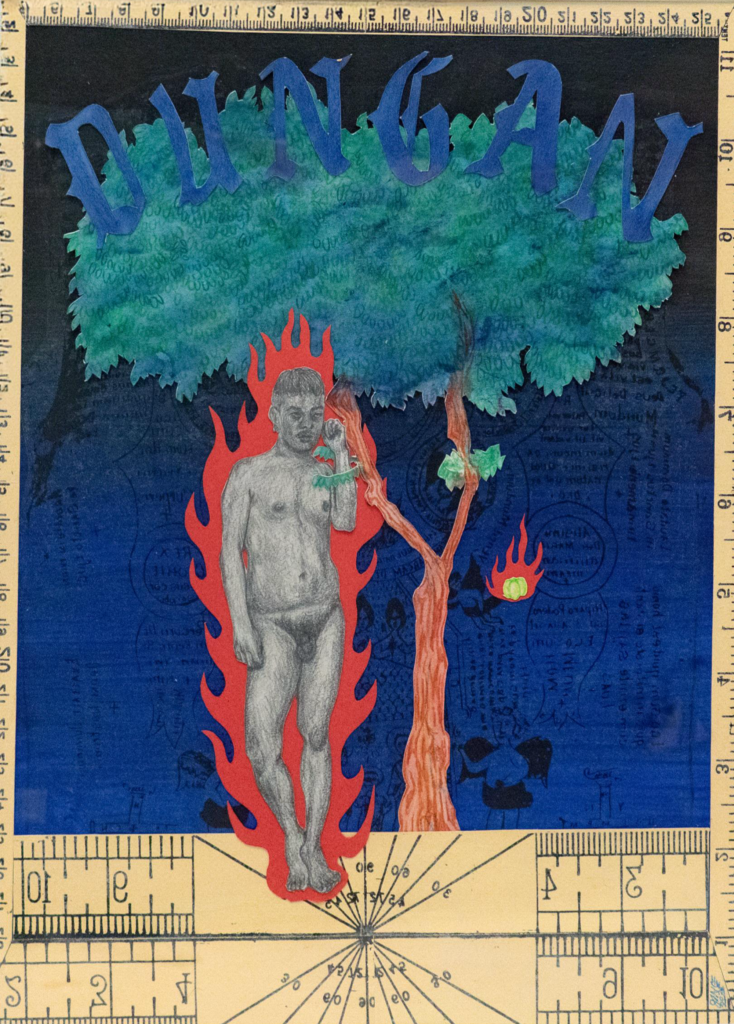
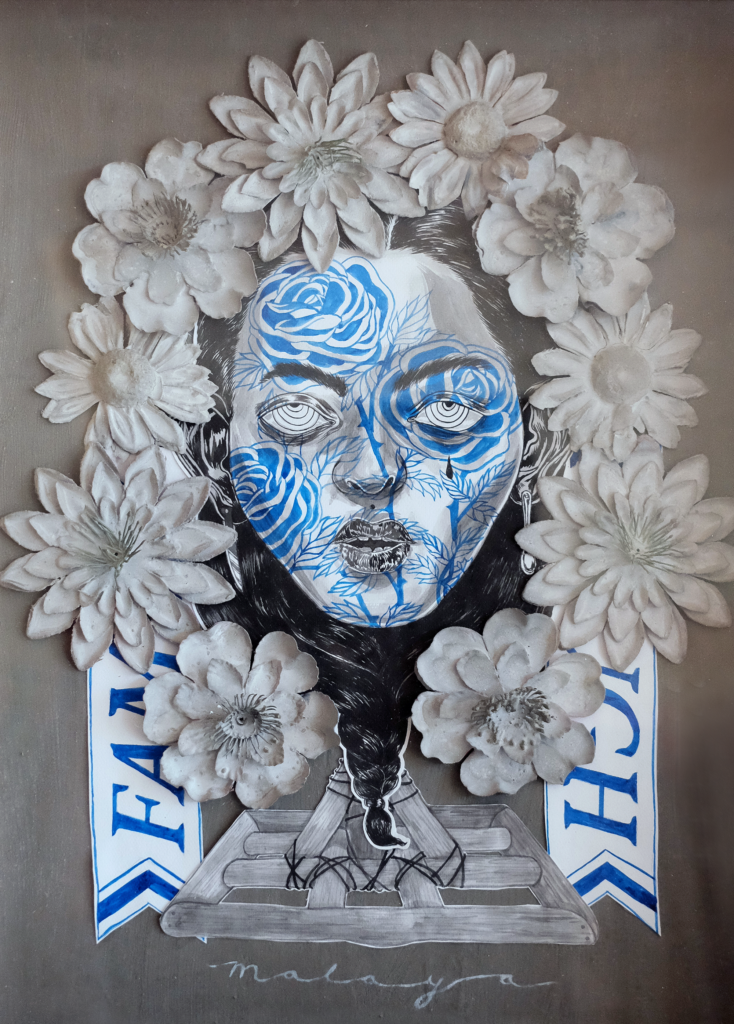
Left: Dungan, Mixed media collage on Paper, Bayotany, 2025. Right: Unwilting, Paper, Fabric flowers dipped in cement, wood, casket glass, Good Mourning, 2019, ArtInformal.
Flowering Images
One of the primary works of literature that Ginoe revisited throughout the production of Bayotany was Michael Pollan’s The Botany of Desire. It’s easy to see why the text became such a constant companion because Pollan’s work offers a succinct categorization of human-plant co-evolution, organized through fundamental human desires. We were particularly struck by one of Pollan’s observations regarding the seduction of the bee and other pollinators. In the book, Pollan argues that while we assume the bee is the subject harvesting nectar from the flower, it has in fact evolved to manipulate the bee’s desires for its own reproductive aims. As Pollan writes, “The bee thinks it’s the subject and the flower is the object, but that’s just a failure of imagination. From the flower’s point of view, the bee is just its way of getting its genes to the next flower.”
The artist wanted the works in Bayotany to operate in an act of seduction, to replicate the biological impulse of a flower enticing its pollinator. “Just as a plant uses its color, scent, and morphology to signal for a pollinator, gusto ko nga ang obra ko daw kaulumol (I want my works to be enticing) to draw the viewers into the frame.” He wants the viewer to be drawn in; the image acts as the nectar, and the glyphs act as the pollen. “I am planting seeds of direction, utilizing visual images and glyphs to encourage the viewer to engage with their own personal histories. I want them to talk about the plant, to tell me their stories, and in doing so participate in a mutual exchange of meaning.”
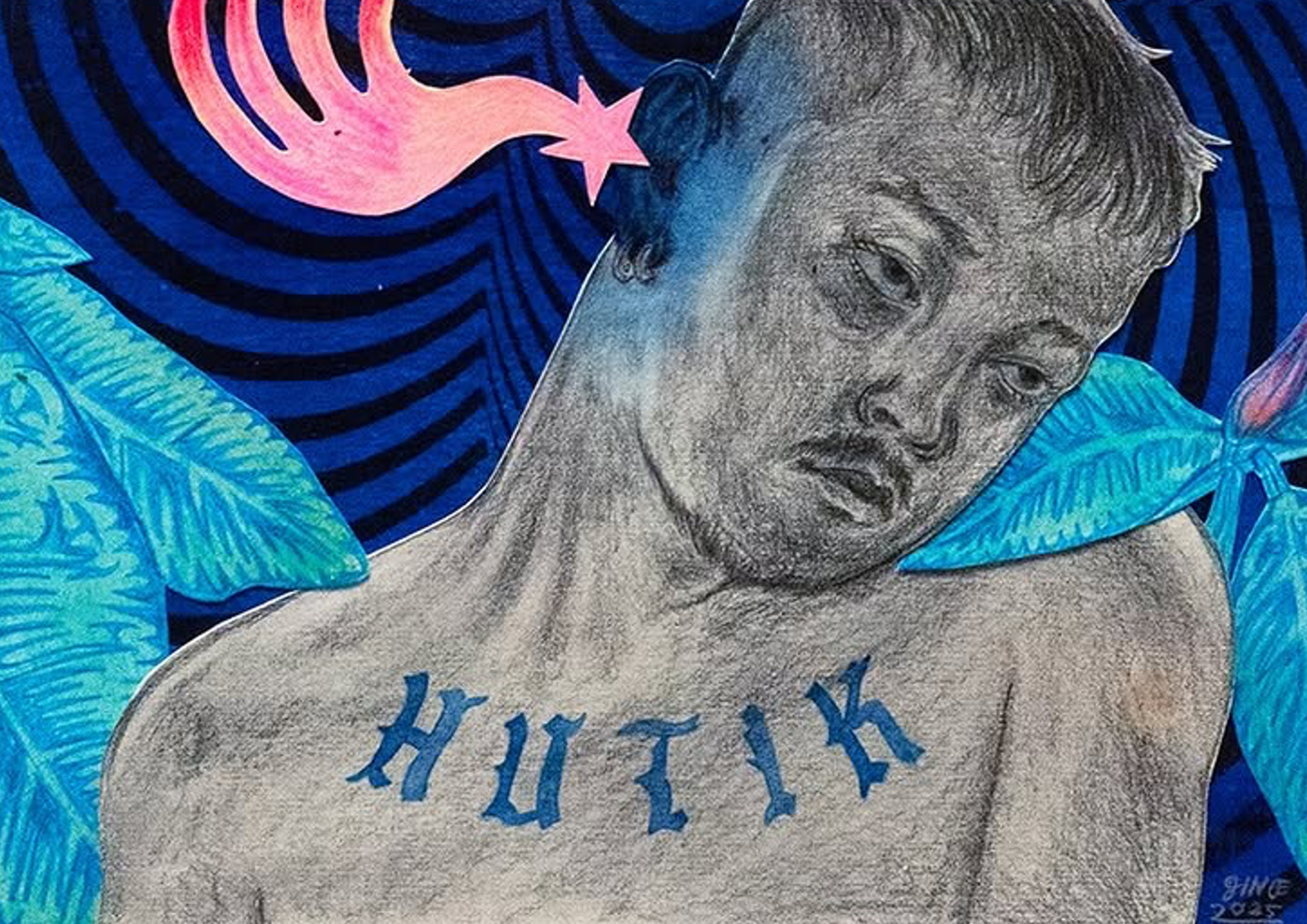
Ginoe also wants to introduce new possibilities of visual language and symbols. The plants in his works are local plants, and their meanings come from an autobiographical sense and also from the region. The artist rejects the rigid, imperial logic of Western taxonomy. In the Philippines, plants are not specimens to be sliced, dominated, or filed away. By trading empirical classification for an autobiographical, localized language, Ginoe shapes Bayotany into a space where human and plant meet not as objects, but as living, breathing participants in each other’s world.
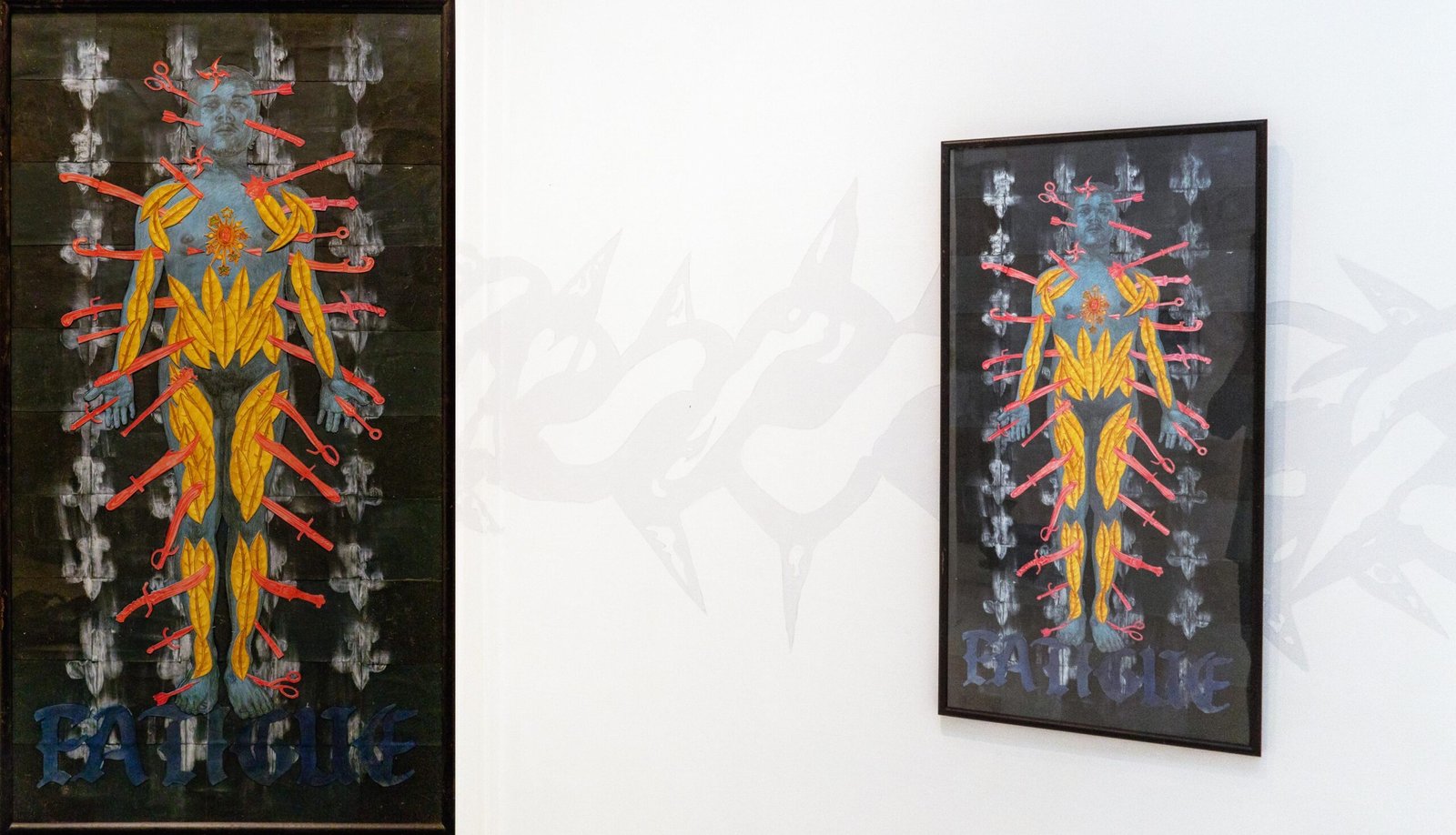
One of his ideas is that of the alibhon, a plant often used for pain management. Ginoe’s mother would use this to hampol (as a warm herbal compress) to his forehead whenever he has fever-related migraines. For his work, Ginoe stated, “I am turning physical pain into the philosophical pain of being queer and the absurdness of alibhon nga ibutang sa bilog nga lawas kay sakit lawas ko nga agi ko sang teenager ko (placing the alibhon in your entire body. Because when I was a teenager, my body ached because I am queer).” The finished product is a full nude figure of the artist covered in alibhon while knives and bolos outline his body.
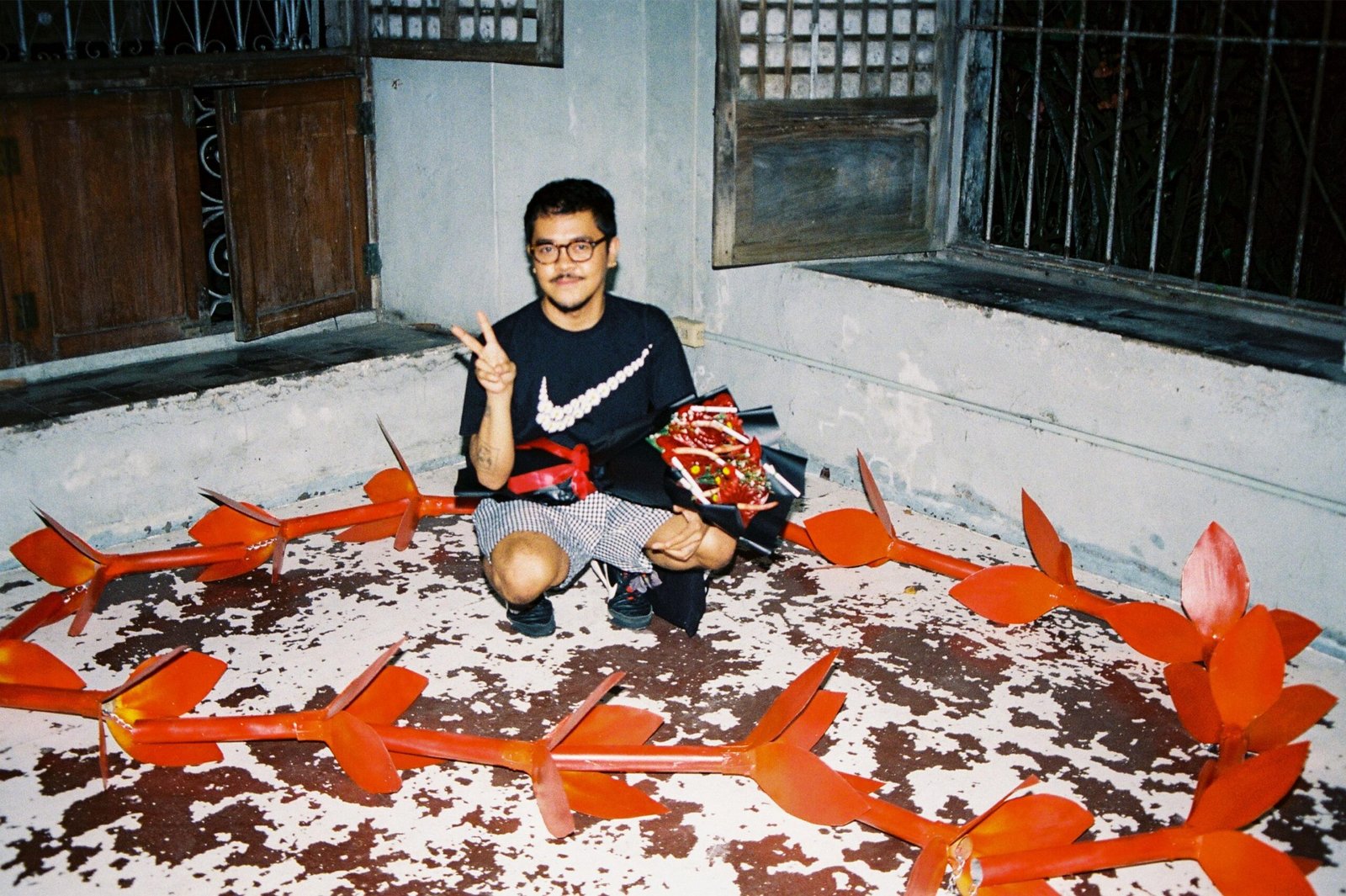
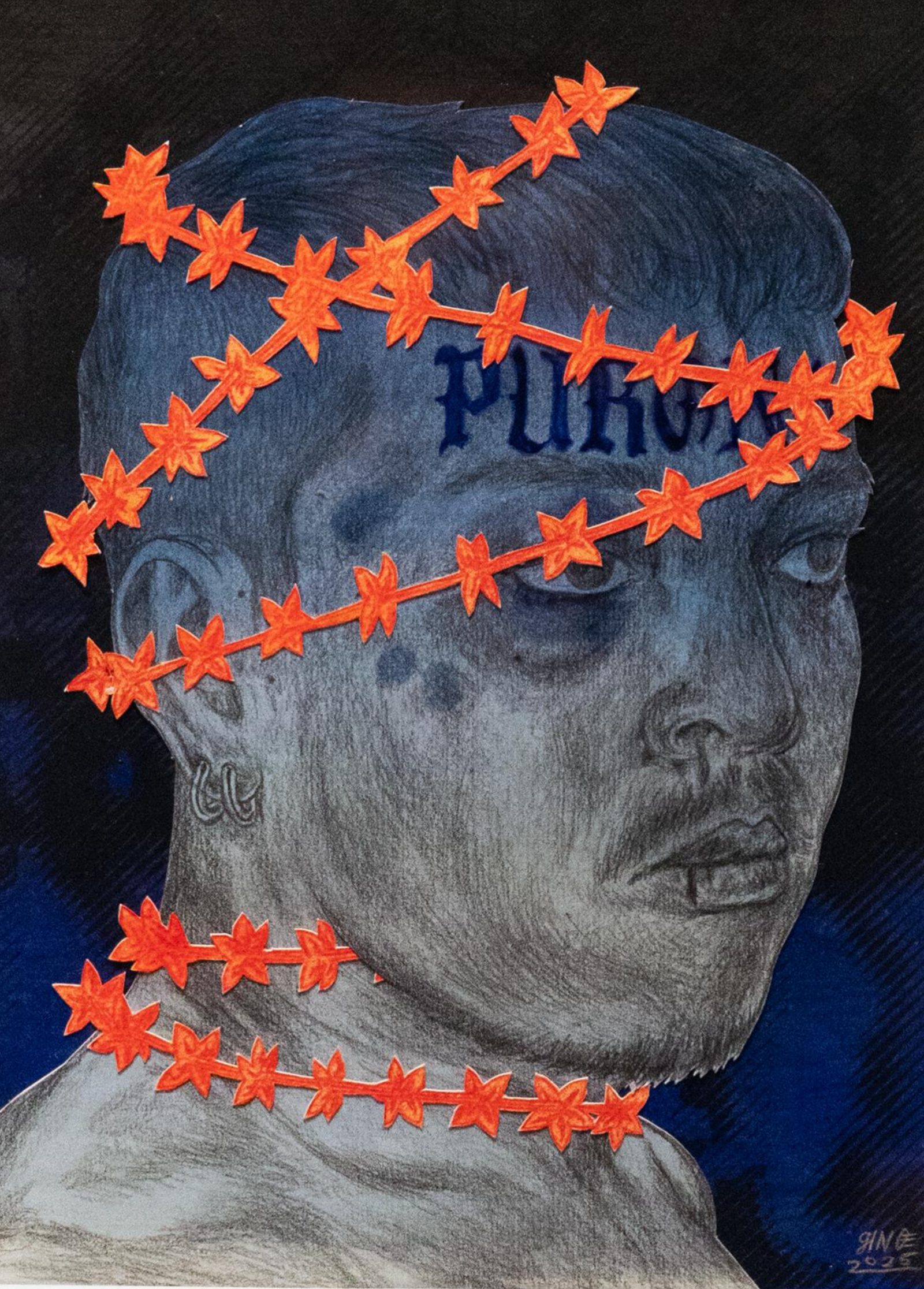
Ginoe also played with the idea of the santan flower, whose stems you can connect to form a flower crown, a common childhood play. Reflecting on his upbringing, he tells a story from when he was a kid: “Santan light siya and feminine, considered sya nga pinaloy nga hampang. Obrahon ko sya nga bug-at kay amo na ang feeling ko sa pagka-agi ko sang una (Santan is light and feminine. It is considered ‘gay’ to play with it. I will make it heavy because that’s how I felt about my queerness before).”
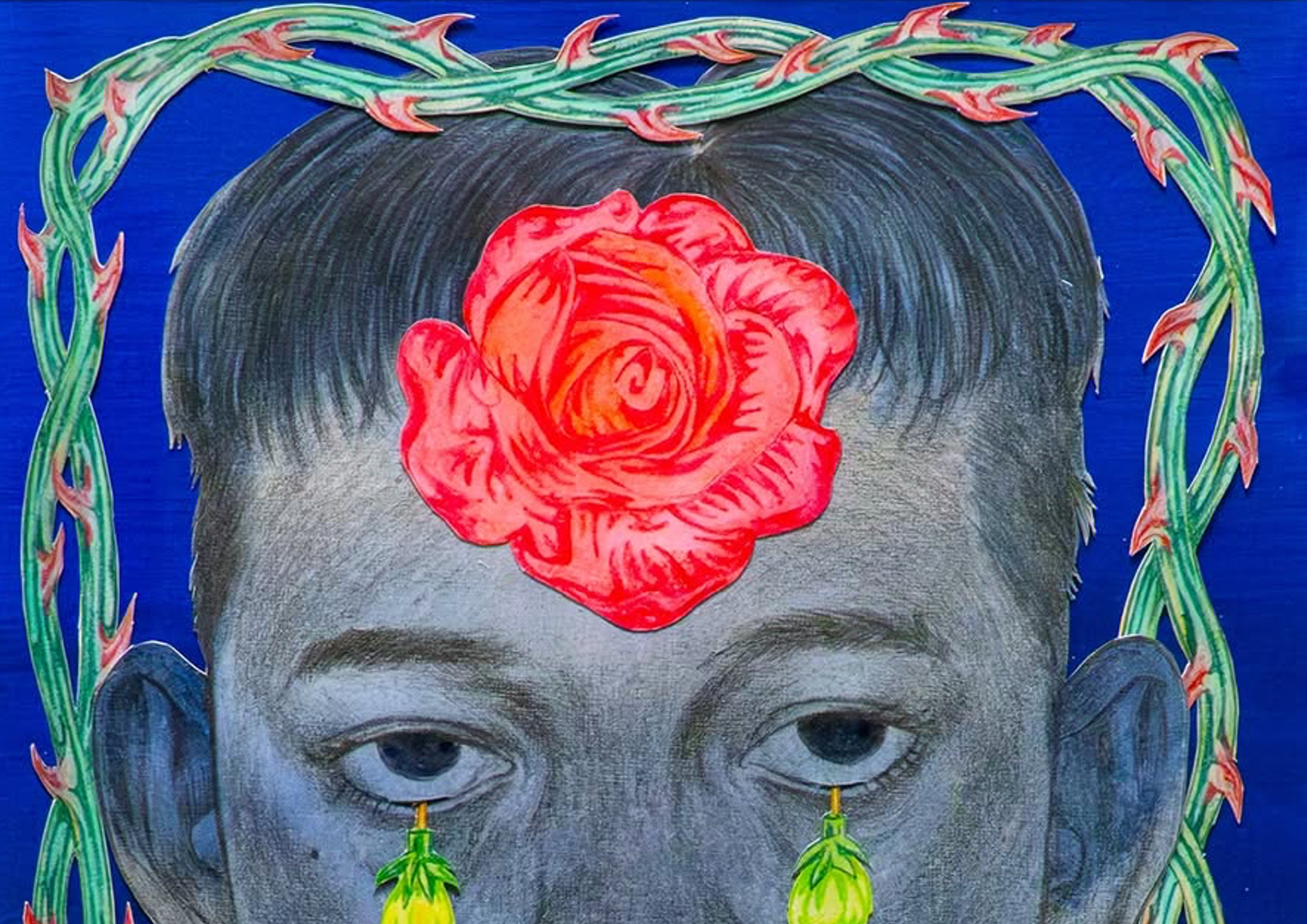
He has a work called Purong, translated as “crown” but also “cage”, which features Ginoe’s portrait covered in santan crowns as an adult with a bruised eye. The background of the work is a vintage illustration of boxers. This paints the memory of how his cousins used to ask him to box with other kids in the neighborhood so that he could prove he was not queer. To add, his only installation piece is a giant santan crown made of steel, a reflection of how he felt as a child.
One of his larger works is titled Sumpa Kita. The work depicts the artist naked, his body draped in layers of sampaguita wreaths. These flowers are traditionally sold outside Filipino churches to be hung around the necks of saints and holy figures like the Santo Niño. The etymology of sampaguita stems from “Sumpa kita” which is a vow or promise. The piece explores a common Filipino societal pressure that if you are queer, you must be exceptional to be accepted. This work recalls Ginoe’s previous piece in the exhibition Banal/Banal, where he was positioned on a pedestal like the Sto. Nino. That earlier work reflected his reckoning with his parents’ hope that he would be the savior of the family.
In Bayotany, Sumpa Kita addresses the necessity of achievement as a survival tactic in a heteronormative world. Ginoe explains, “It is not my mother’s fault if she says ‘Dapat mayuhon mo gid nak kay agi ka’ (You have to do well, my child, because you are gay).’ Her fear that I will not find a partner is not to underestimate my ability to form romantic relationships, but to acknowledge that the world is heteronormative and harder for queer people.”
Beyond its romantic connotations, “Sumpa Kita” can also be interpreted as a curse. In Ginoe’s experience, queerness is perceived as a curse his mother cannot lift and an everlasting worry. Being covered in sampaguita makes him look beautiful and fragrant to the public, yet the weight of the wreaths hinders his movement and obscures his vision. The backdrop features a sampaguita glass, a repeated pattern illustrating the reality of having to walk on glass in order to navigate society.
Some of the works reflecting on Ginoe’s life as an adult include a piece called Vanilla. Originally, he envisioned this as a work of himself and his lover seated on each other’s lap, with a vanilla orchid blooming from one of their crotches. The actual work is a portrait of his lover, Ron, reclining in the nude while a bouquet of vanilla orchids blooms behind him, drowning in a sea of blue.
While “vanilla sex” is often colloquially described as tame or boring, the artist points out that the vanilla plant itself is actually incredibly meticulous to grow because it is so sensitive that one must hand-pollinate the flowers to produce vanilla pods. “It is a fickle flower, sensitive man ang bulak (the flowers are sensitive).” Still, he wanted to demonstrate that nothing is boring about vanilla. Keeping relationships consistent and simple allows for a deeper, more intentional focus.
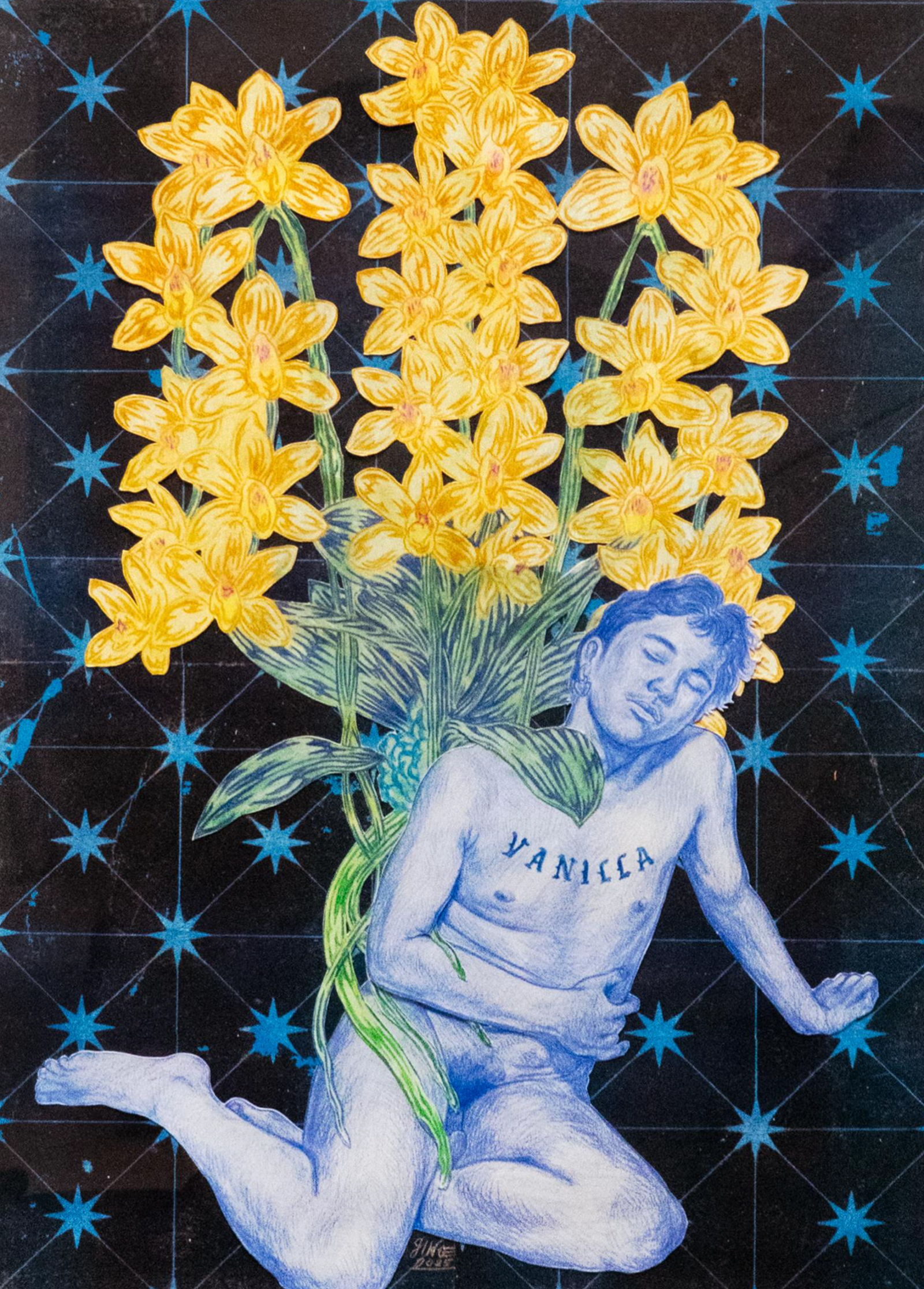
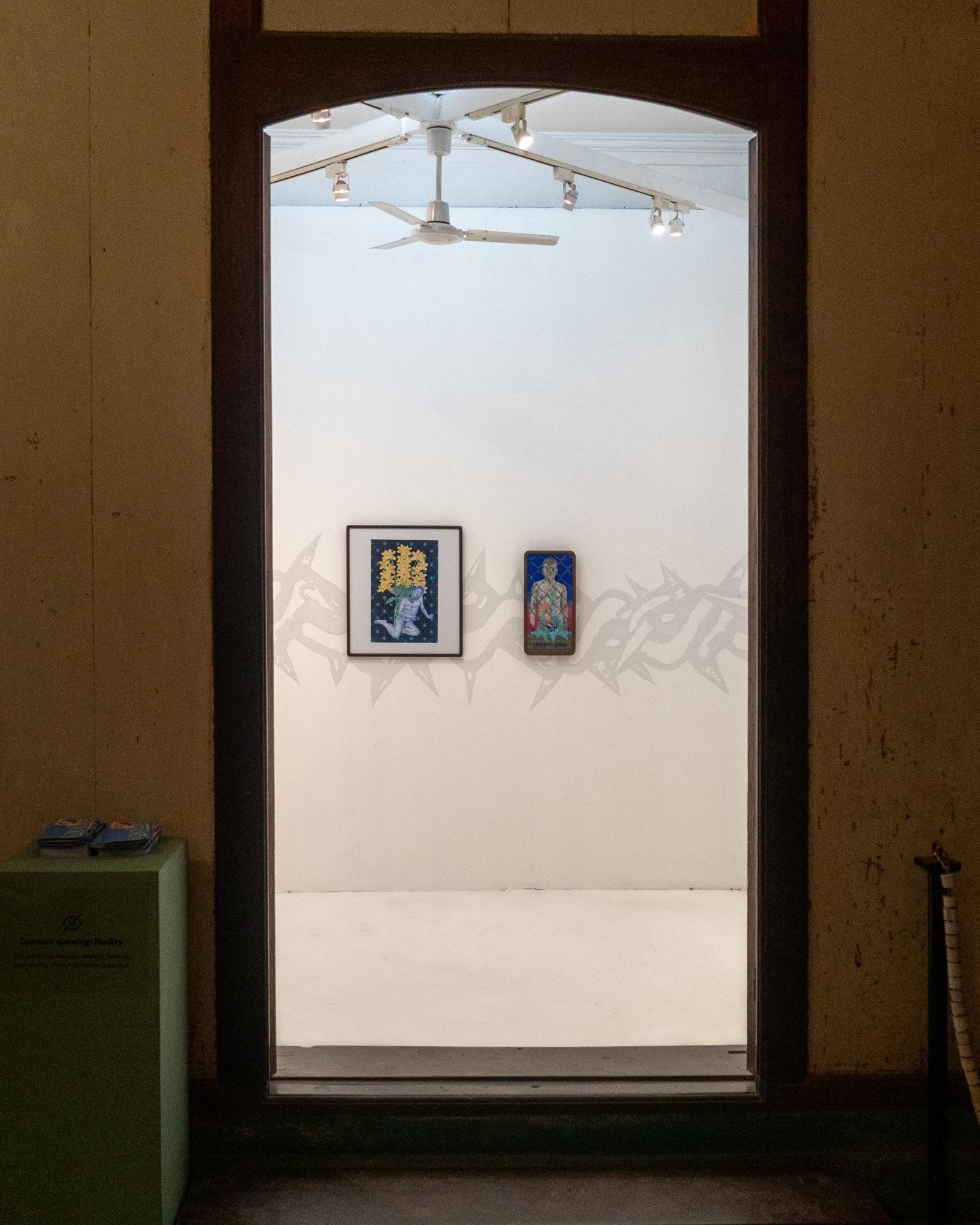
Left: Vanilla, Mixed media collage on Paper, Bayotany, 2025. Right: Exhibition view of “Vanilla.” Photo by Nicolas Tolentino.
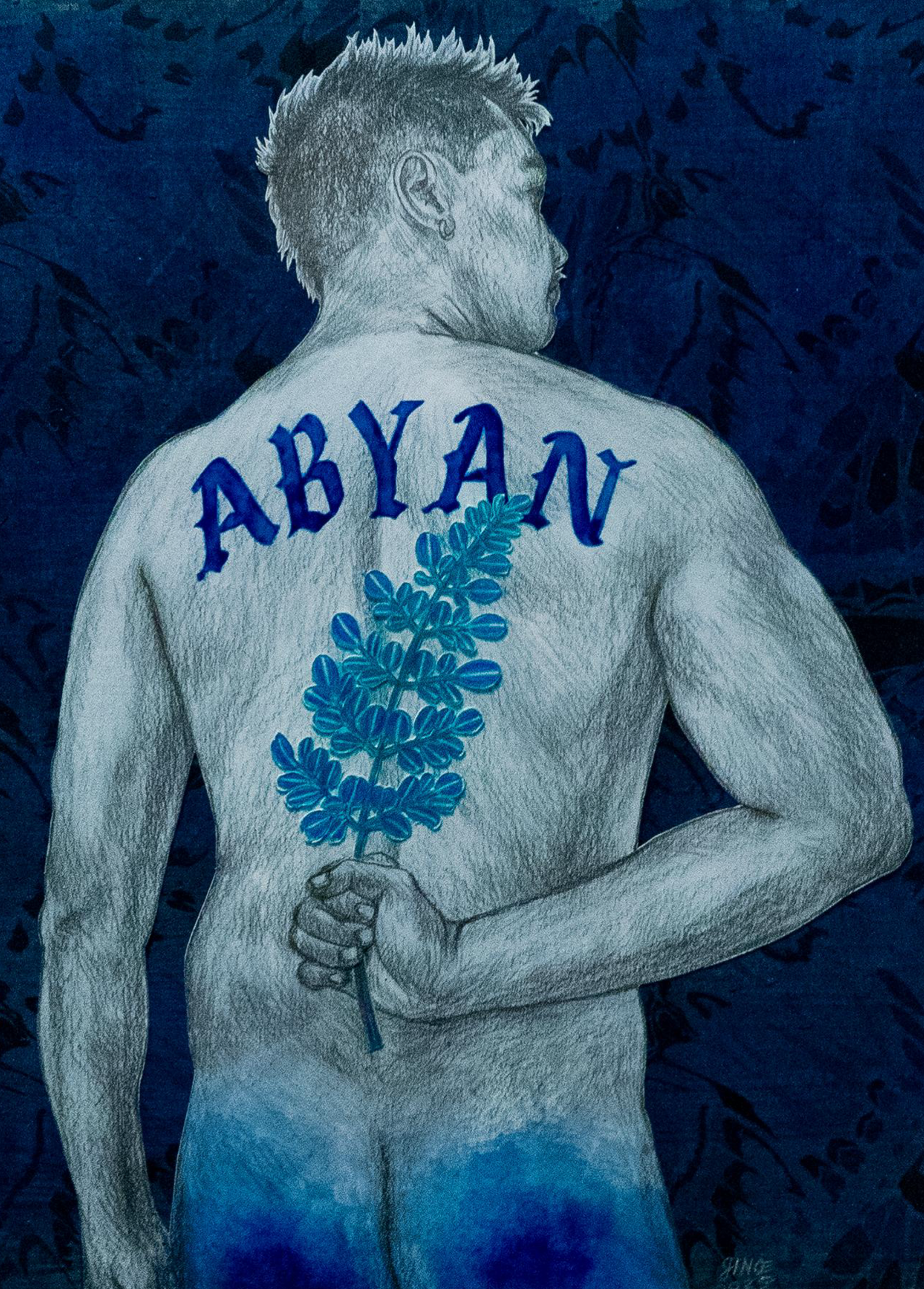
The artist explores the tenderness of adult friendships in Abyan, meaning friend, but is closer to comrade. The work features a nude figure of one of his dearest friends with his back turned, clutching a cluster of malunggay leaves. The pose mimics that of a lover hiding a bouquet behind his back as a surprise.
Through this, Ginoe seeks to dispel the notion that deep trust and intimacy are strictly reserved for romantic relationships, arguing that platonic intimacy carries the same weight and beauty. Malunggay is a plant ubiquitous in every Filipino neighborhood; it is a symbol of nourishment, sustenance, and the “tree of life” in many cultures. It also serves as a natural antiseptic. To Ginoe, malunggay is a beautiful plant even if it is not considered an ornamental one. He is drawn to the idea of elevating plants that are often overlooked or dismissed as non-decorative, mirroring the quiet, essential strength of a true friend.
One of these ideas is a personal favorite titled Out, Standing in the Field, a play on the phrase “outstanding in the field”. The work would have depicted a nude figure of Ginoe simply standing in a vast, open landscape. It serves as his commentary on the rat race of achievement and the pursuit of artistic accolades. While the art industry often demands prestige, Ginoe’s primary creative engine is a sense of play. He often begins a project with, “Daw sadya ni (This might be fun).” His knowledge production is exhibition making, just him outside and standing on the field.
Planting the Pieces
Everything in Bayotany consists of collage works on paper. Ginoe is drawn to collage because it mimics the sessile quality of plants, where the paper seems to follow the light, fluttering and swaying. “It tickles me that when you buy paper, they’re called leaves.”
“My collages are my drawings. My hands pass over the paper many times because I sketch, then paint, then cut,” Ginoe explained. His work is rarely deliberate; he leaves much to chance and allows himself the freedom to change his mind. He likes that the sketch is a loose line, the ink is a final line, and a cut is a subtractive line. “Collages are disparate pieces that I can move around. I find joy in betraying my initial sketches. There are ideas I thought I had nailed down, but then change right before I glue them.” This improvisational aspect, which he likens to a dance, prevents him from getting bored. He views collage as choreography, moving loose forms across a plane where the frames act as musical scores—the parameters in which his drawings are free to move.
Initially, the works were planned in black and white or as experiments with salmon pinks, greens, and sky blues. However, as the series progressed, Ginoe settled into a palette of deeper blacks, grays, blues, and reds, punctuated by an occasional pop of pink.
“I like to plan when I am preparing a show, but there are always the elements of time, money, and energy,” he mused. “Damo-damo ko ideas kag kung ano mag-guwa by the time nga isab-it na siya, okay na ina (I have so many ideas, but whatever is produced by the time it is hung, that’s it).” He embraces the serendipity of art production, knowing the process isn’t rigid. For him, ideas don’t wither just because a show is over; there is hope that they will continue to flourish beyond it.
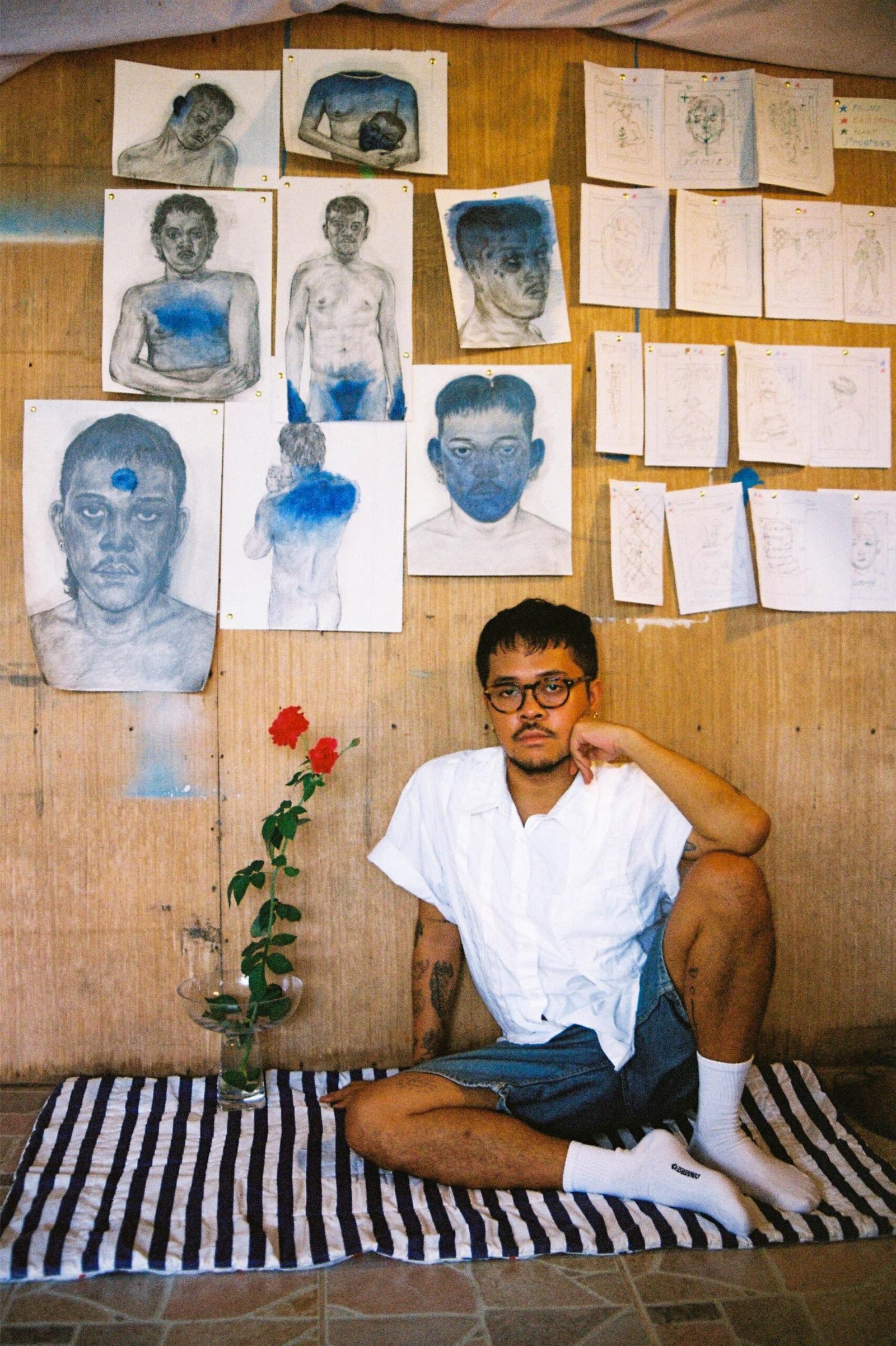
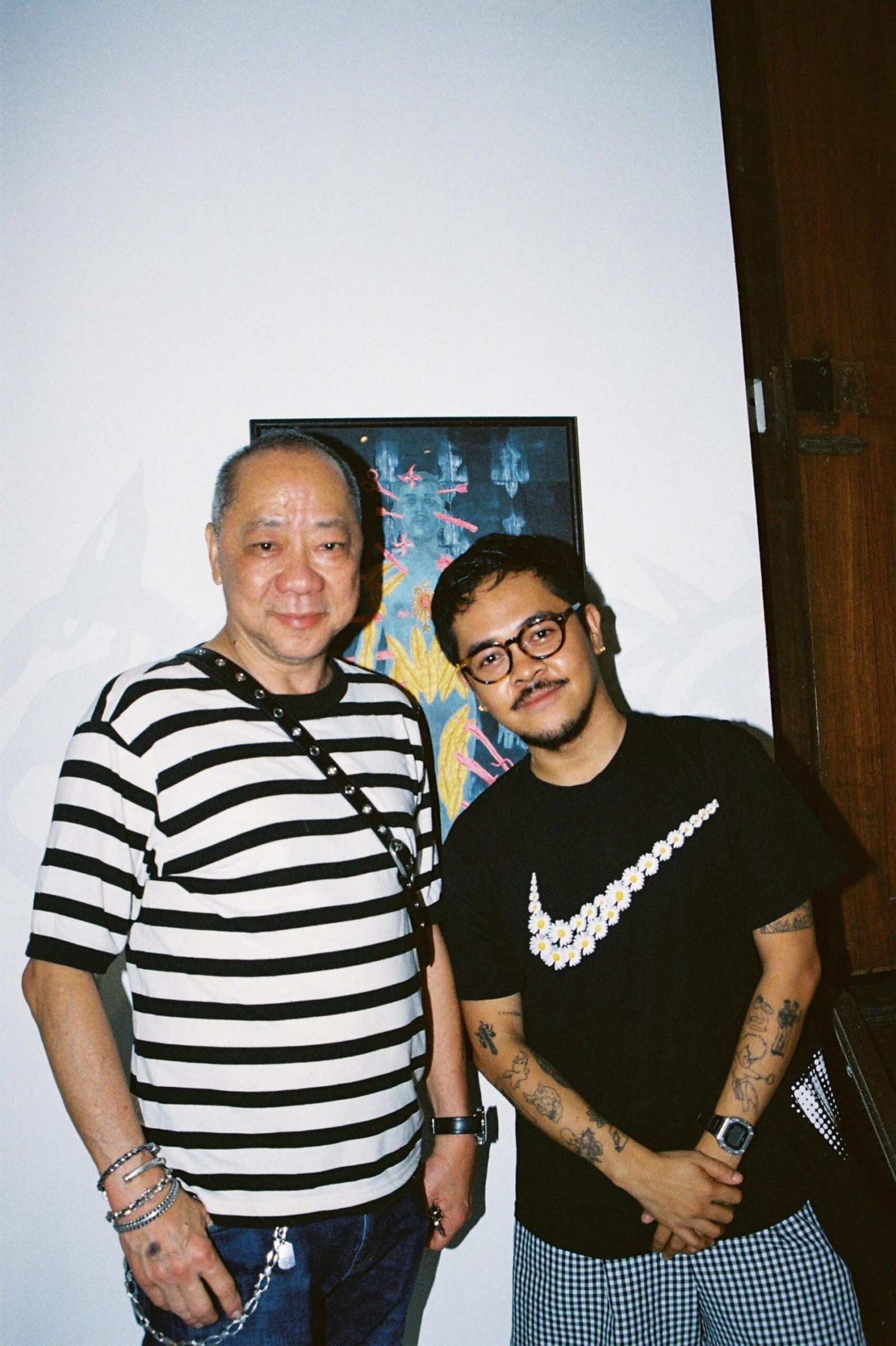
Left: Ginoe at his home studio while working on Bayotany. Photo by Inah Mara. Right: Renowned Bacolod artist Charlie Co with Ginoe. Photo by Inah Mara.
Enjoying the Garden
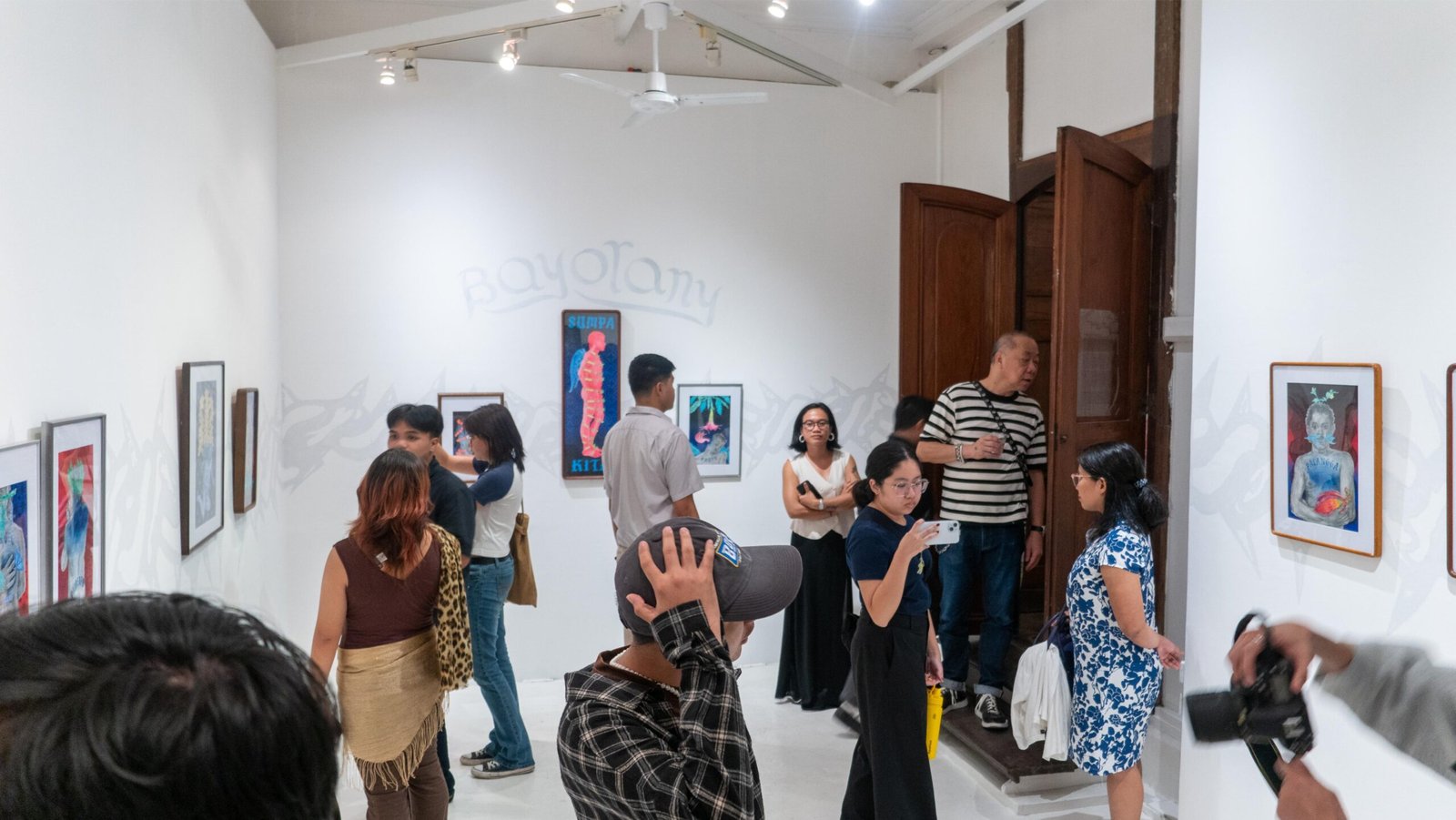
Bayotany held its public debut on December 27, 2025, at Kapitana Gallery in Balay Tana Dicang. Organized by Sachet Projects, the opening night transformed the gallery into a living extension of Ginoe’s ugsaran. The works were hung against a sprawling mural of Roma vines, lifted from Alfonso Ossorio’s Angry Christ and blown up until it resembled a crown of thorns spanning the room. Guests arrived in an array of florals, offering their own interpretations of the motif. The space was abloom with artists, enthusiasts, friends, and family, all moving from artwork to artwork like bees to a flower, sharing their own intimate histories with the plants depicted. A virtual set by DJ Cabbie set the tone as the crowd gathered into the immersive space.
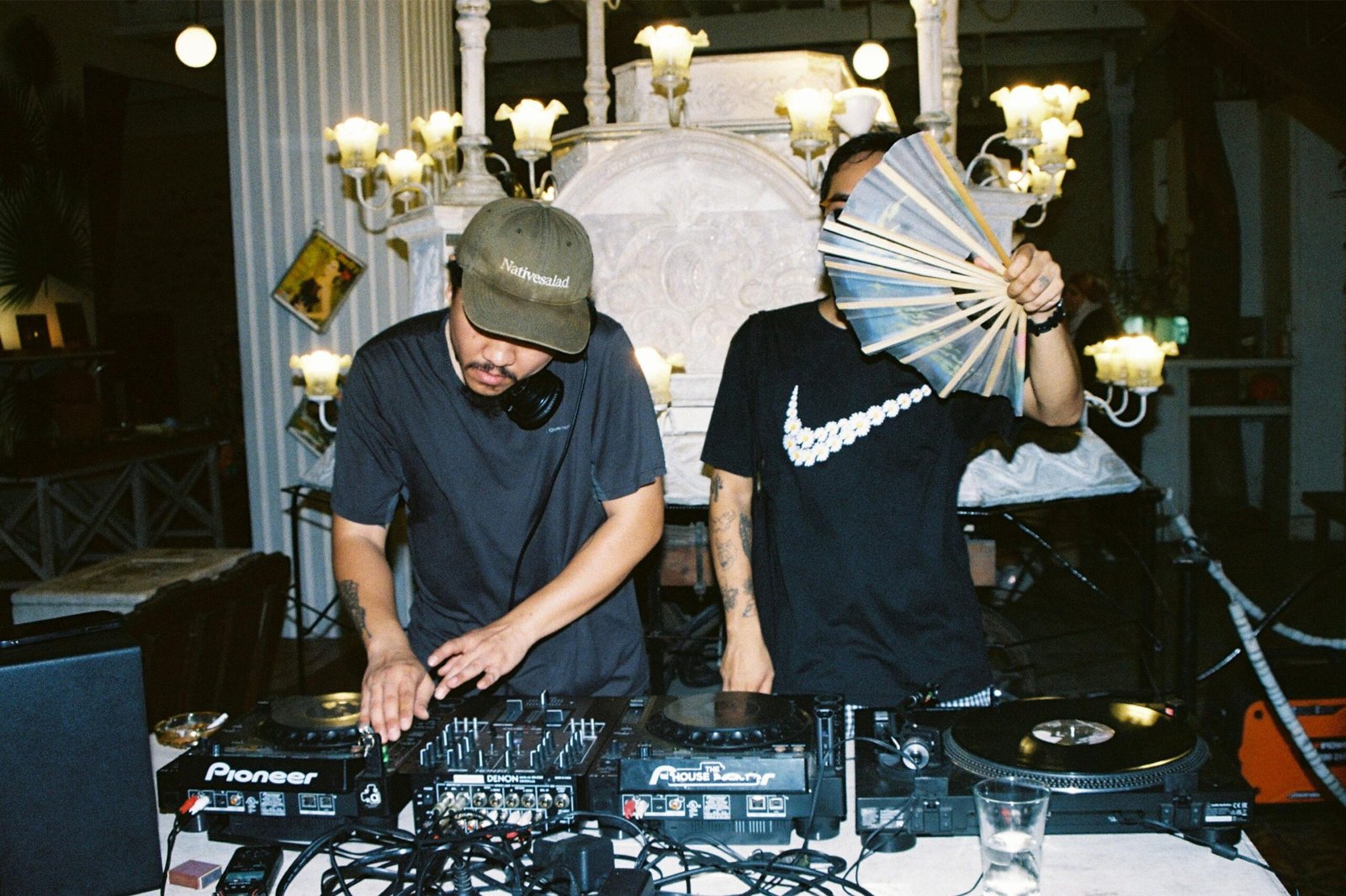
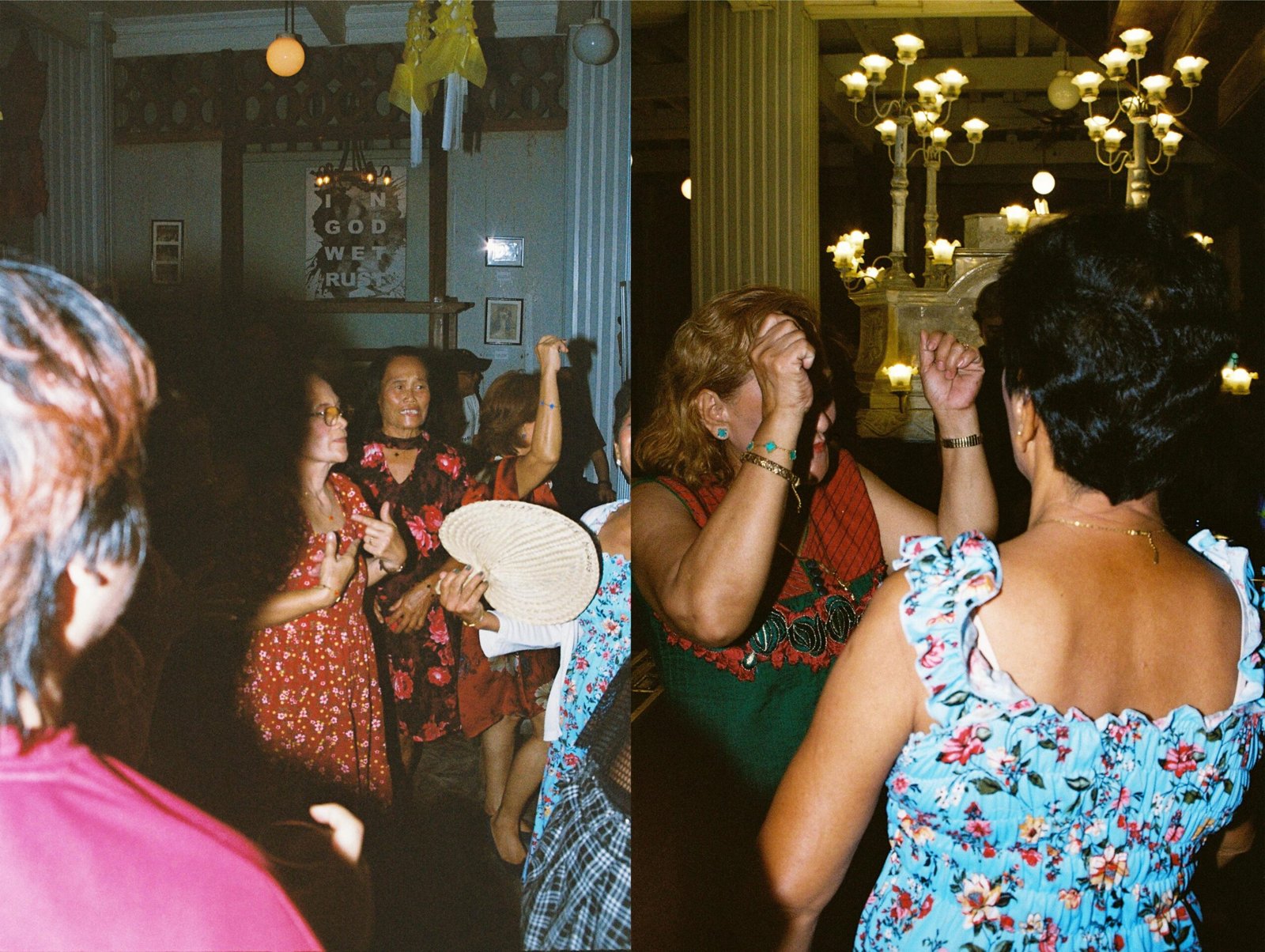
Later that evening, local artist M4r1w4r4 performed in front of a caro—the traditional carriage for Lenten saints—while guests sipped wine and danced after enjoying the art. Among the crowd, Ginoe’s mother, Rosene, and her friends moved through this harvest of the artist’s memories, their presence a living testament to the taxonomies of love and survival that birthed the exhibition. It was a night when the impenetrable concrete of the city was finally bypassed, allowing the fertile soil of the community to take root. •
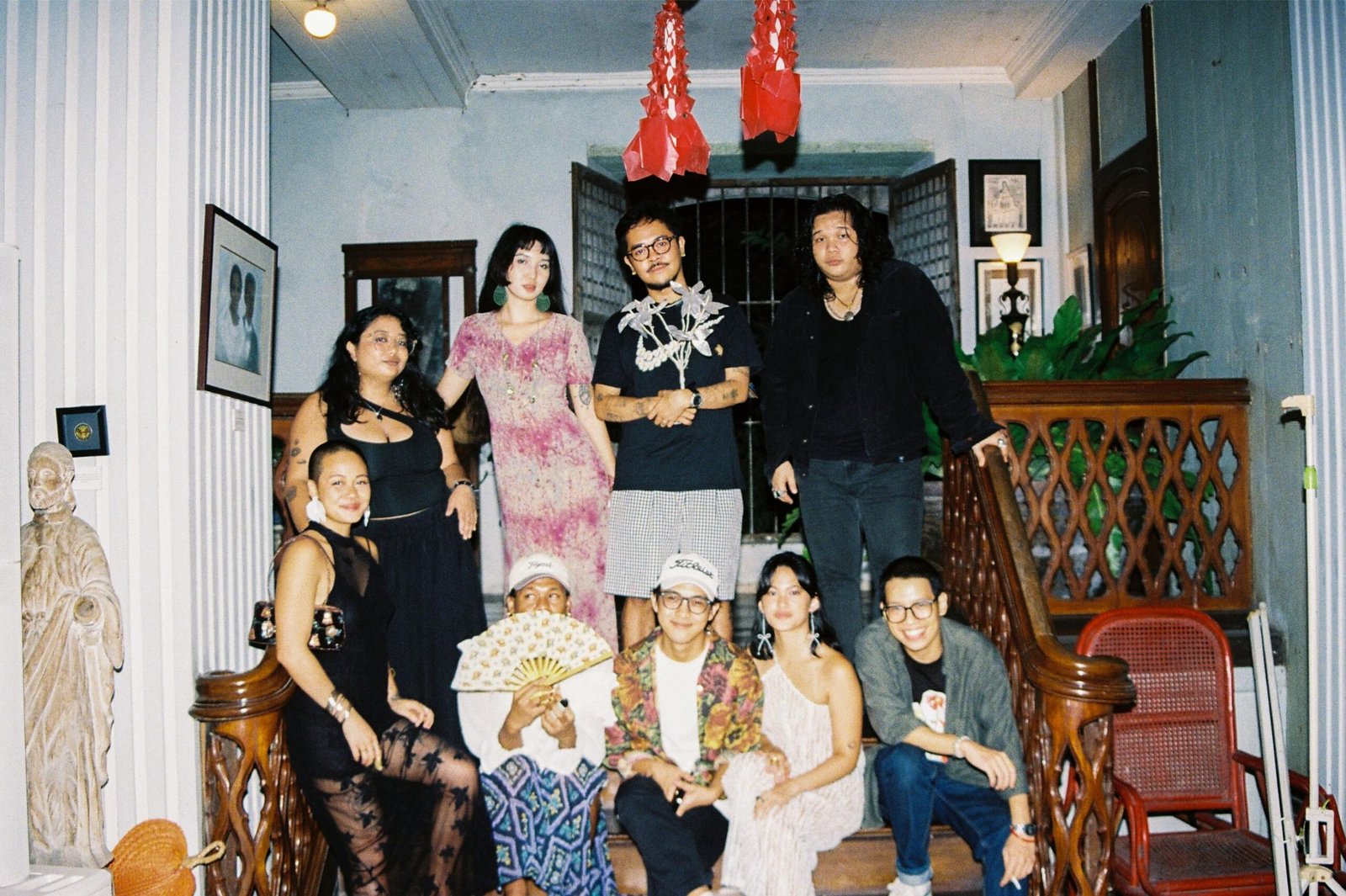
Bayotany is Ginoe’s first consolidated exploration of plants. An exhibition was held from December 27, 2025, to March 7, 2026 at Kapitana Gallery, Balay ni Tana Dicang, Talisay City, Negros Occidental. Select pieces remain and are in consignment with the gallery. Inquiries may be sent to Adrian Lizares via Instagram.