Interview Vanini Belarmino
Images Marah Arcilla and Sylvie Cox
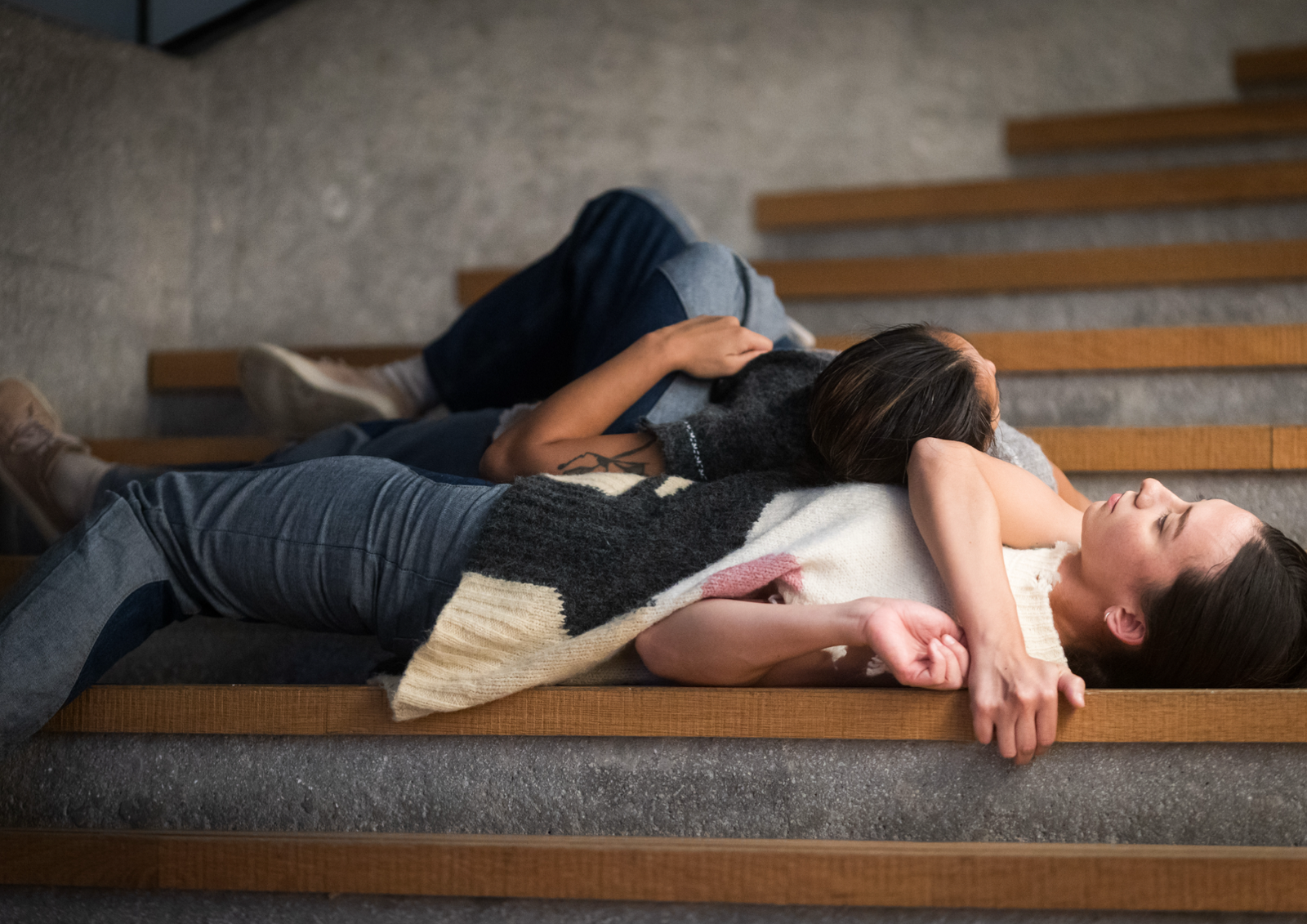
Dandelion Scream is about struggle, care, and transformation. It draws on the intimate gesture of a mother rising beside her sleeping child—carefully negotiating her own movement while bearing the child’s weight, attentive to not disturb their rest. This quiet, relational tension underpins the choreography, which unfolds through intertwined bodies that support and burden one another as they slowly ascend, evoking roots pushing through cracks in concrete in search of light.
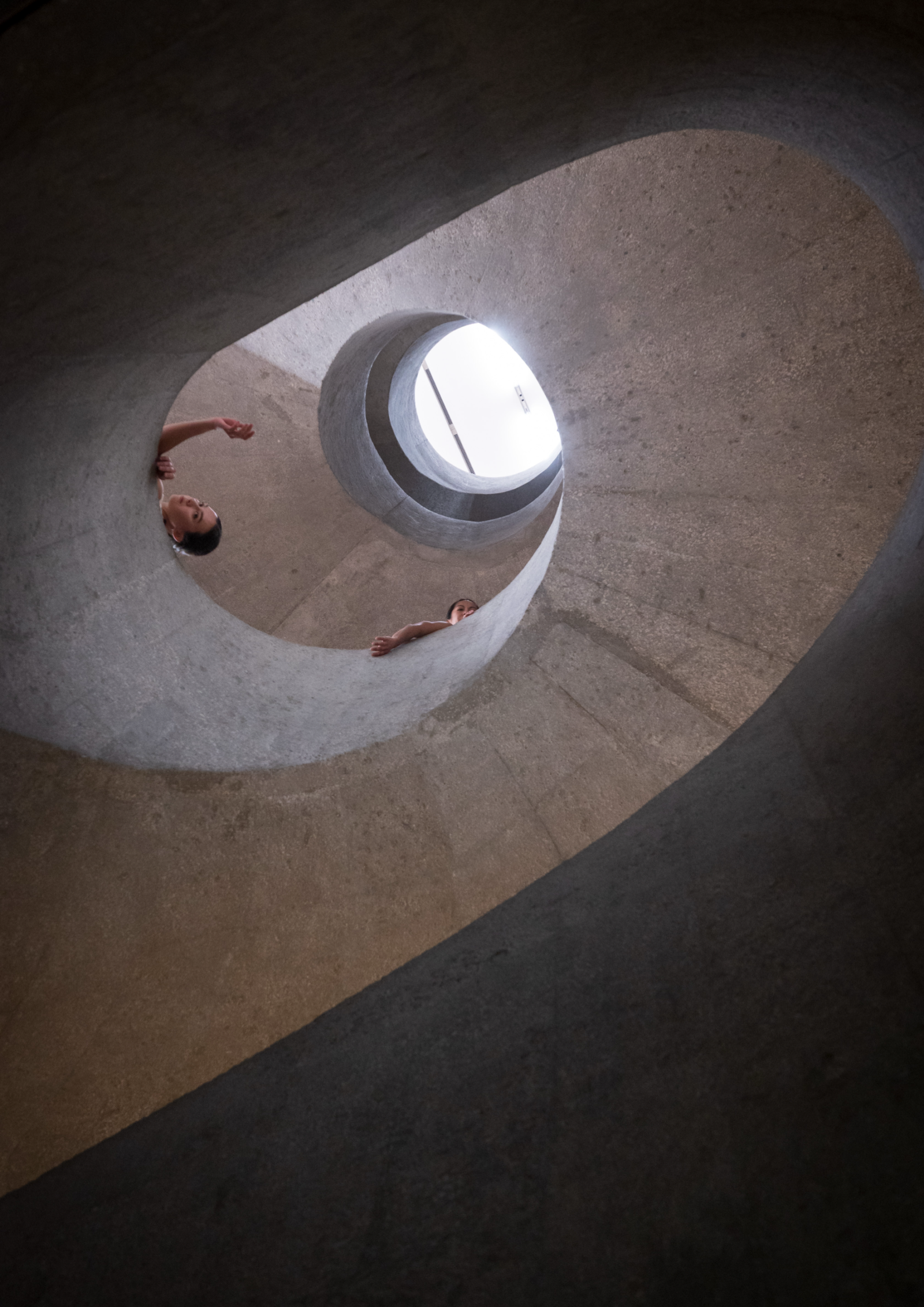
Originally conceived for a spiral staircase, Dandelion Scream embodies emotional states ranging from frustration and anger to helplessness and care. These affective pressures are translated into a physical language that engages architecture, spatial perception, and the audience’s shifting vantage points. Movements register both the weight of struggle and the tenderness of support, unfolding across multiple levels and perspectives.
For Triangulum’s Mothering/Unmothering, artists Marah Arcilla and Sylvie Cox will adapt the work for Ayala Triangle Gardens. In this 45-minute performance, audiences are invited to witness the poetics of care, persistence, and relational interdependence as they unfold in motion, shaped by the site’s open, public architecture. Having trained and worked with choreographers including Maria Hassabi, Tino Sehgal, and Xavier Le Roy, the artists will bring a rich lineage of contemporary movement practice to Dandelion Scream while articulating a distinct choreographic voice. The performance stands as a testament to their evolving movement vocabulary—balancing influence and innovation in a deeply personal yet collective meditation on struggle and care.


Dandelion Scream artists Marah Arcilla and Sylvie Cox
Dandelion Scream draws on the intimate gestures of a mother rising beside her sleeping child, as she negotiates her own movements while the child’s body presses against hers. Could you share how this performance came about and how this observation shaped its physicality and emotional tone?
Marah Arcilla, artist, Dandelion Scream: One time, a yoga student asked me if we could adjust the intensity of our private class. She said her energy was low because she hadn’t slept much. Her daughter had woken in the middle of the night, climbed onto her bed, and lay on top of her. She held the position to avoid disturbing the child until her arm began to feel numb. Ever so gently and slowly, she eased herself out of that position to free her arm.
From this conversation, I imagined a choreographic work and thought, “Wouldn’t it be nice to have someone’s dead weight on me?” The delicate, considerate, and conscious quality of movement is defined by the core physicality and emotional tone of the choreography.
The relationship between the carefree child in deep sleep and the dedicated mother’s interrupted sleep gave rise to the piece’s slow, careful, and intentional movement quality.
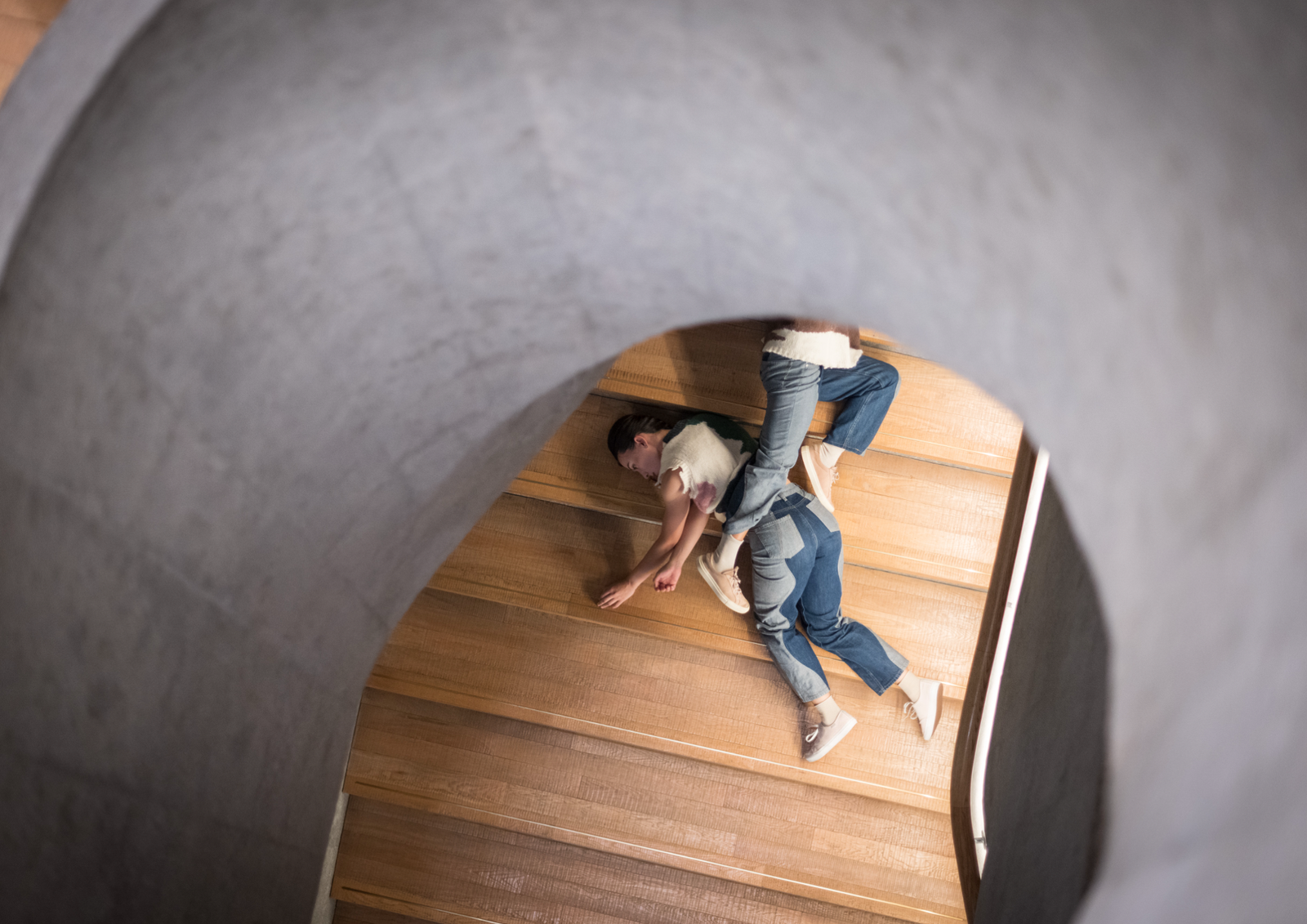
Originally conceived for a spiral staircase, the work unfolds through intertwined bodies that both support and burden one another as they ascend, allowing audiences to encounter it across shifting levels and perspectives. How does a site’s architecture inform your choreographic decisions, and what changes when the work is re-situated in a new spatial context? How do these spatial shifts reshape the narrative, emotional intensity, and the dynamic between performer and viewer?
Sylvie Cox, artist, Dandelion Scream: The site’s architecture is integral to the choreography, serving as a concrete, urban counterpoint to the organic materiality of our bodies. It also fundamentally shapes how the work is perceived. The spiral staircase disrupts the convention of frontal viewing, inviting spectators to encounter the performance from multiple levels, positions, and degrees of proximity.
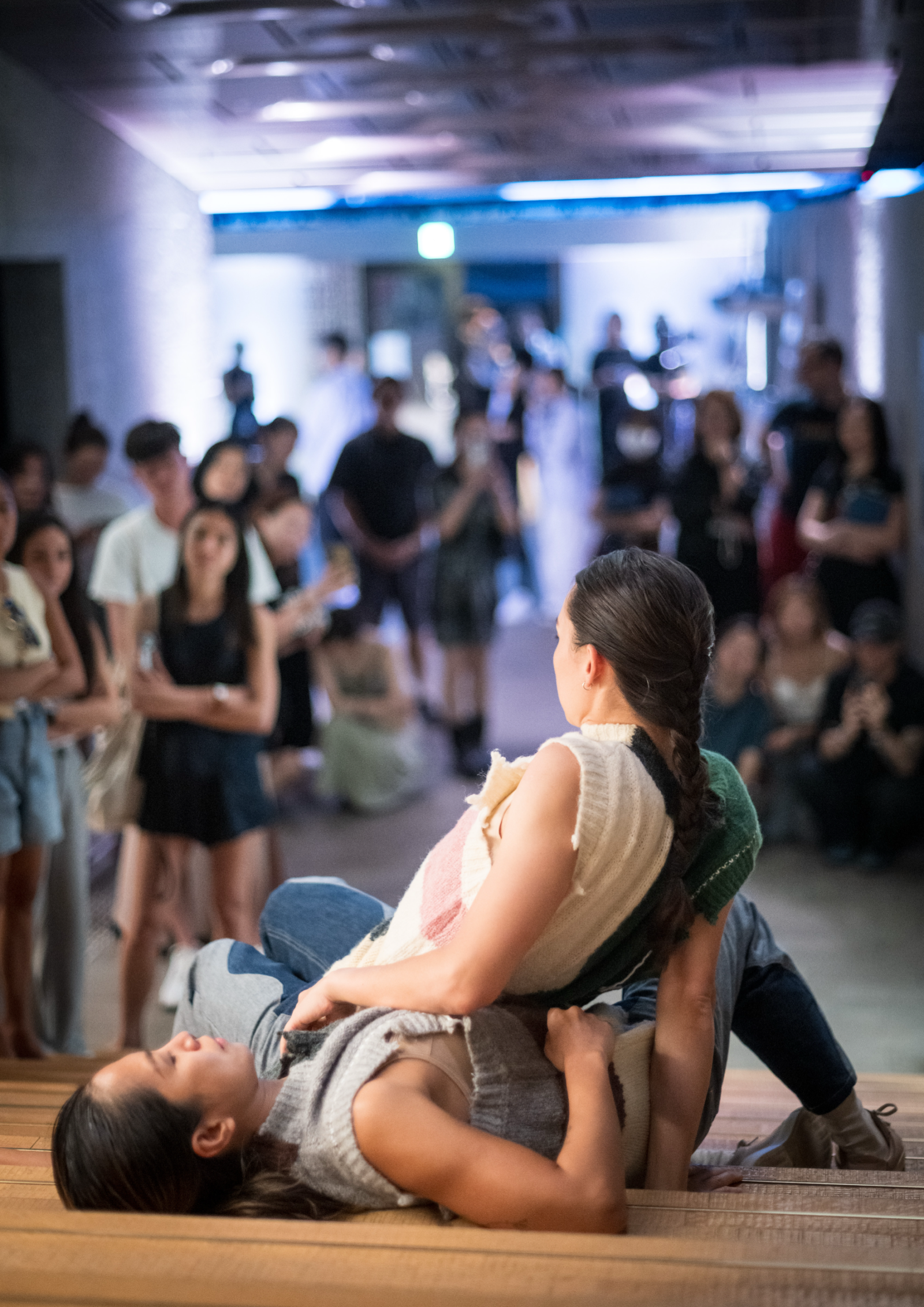
When the work is placed in new spatial contexts, we adapt to the site’s architecture while maintaining the challenge to fixed perspectives. The audience is given autonomy in how they choose to watch. Depending on their position, spectators may experience distortion or disorientation when viewing the work up close, while becoming attuned to subtle details such as breath, muscular effort, and emotional tension—producing resonant, in-the-moment sensations. From a higher vantage point or greater distance, the audience may instead perceive a broader visual composition, allowing a narrative to emerge more clearly.
Arcilla: A staircase is designed to connect different levels of a building, enabling movement upward or downward. I am interested in what causes this functional purpose to momentarily dissolve when performers inhabit the space. In site-specific performance, the way spectators position themselves becomes a central concern. How can choreography invite viewers to watch from a distance, then draw them closer? How can movement quality persuade the audience to follow us, both spatially and temporally?
These questions guide how we translate an existing work into a new architectural context. We are particularly interested in how spectators become part of the piece through their choices—whether to sit or stand, move or remain still, stay briefly or stay for the full duration. The circulation of passers-by alongside performers generates a form of social choreography.
For Dandelion Scream, our choreographic language focuses on slow, intricate, and nuanced movement to stretch a spectator’s attention. There are many ways of viewing the work: how one positions their body in space, how they shape themselves while watching, and whether they are relaxed, alert, or somewhere in between. A spectator’s commitment—how long they stay, which movements draw them in or push them away—directly shapes the relationship between viewer, performer, and the work itself.
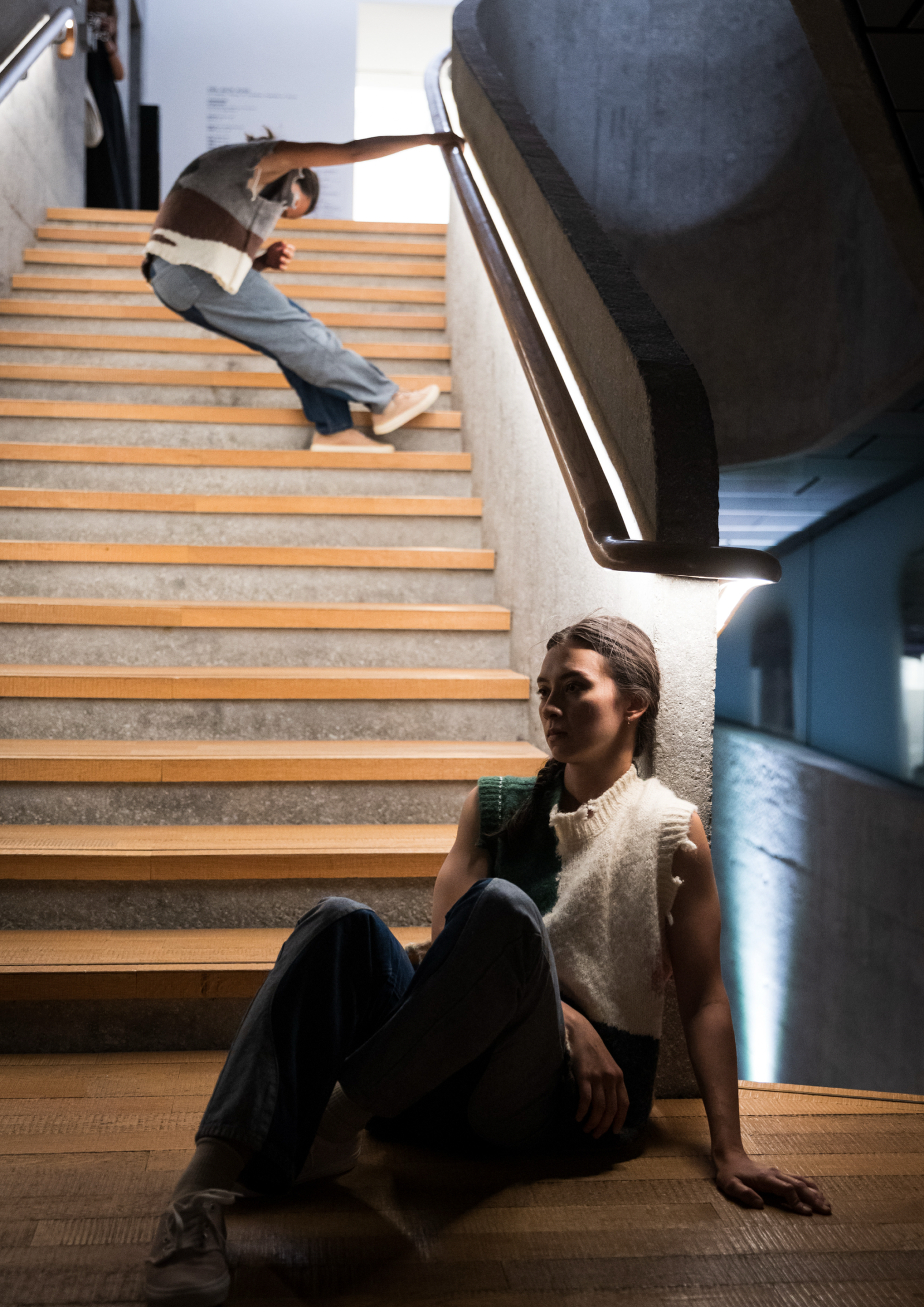
The performance navigates intense emotional states—frustration, anger, helplessness, and care. How do you translate these nuanced emotions into movement without relying on spoken language?
Cox: We embody these intense emotional states as we perform, and the physicality of our movements clearly depicts these. Visually, there will be contrasting moments: frustration building with repetitive movements, greater explosiveness when there’s anger, and stillness when there is helplessness.
Arcilla: Through memory, we revisit an experience that evokes a particular emotional state. We write down or describe the bodily sensations we feel toward each other. To get to the “how,” we simply “do”. One of the challenges is remaining truthful in expressing them. That’s where the intensity is felt.
Physical contact and interdependence are central to Dandelion Scream. How does the negotiation of weight, balance, and support function as a language of care, struggle, and transformation?
Arcilla: The weight of someone on us is the struggle life presents. The body underneath, accepting this heavy weight, is the act of surrender. This is a clear dialogue we set by listening to each other’s weight. Who is taking the role of giving and receiving? Switching roles from embracing to smothering.
The receiver takes the task of slowly coming out from underneath the other person. The considerate movement to release from an intertwined position shows the struggle and transformation, but only to assume the other role of putting their full weight on the person they released themselves from. This is the nature of interdependence.

Roots creeping through concrete recur as an image in the work. How do you translate these organic metaphors into bodily movement, pacing, or spatial composition?
Arcilla: The trajectory of moving upward along the staircase reflects the spatial composition of roots creeping upward in search of light. The delicateness of our extremities, in particular, plays an important role in portraying the fragility yet resilience of roots.
Having worked with choreographers such as Maria Hassabi, Tino Sehgal, and Xavier Le Roy, how did these experiences influence your approach, and how did you develop your own choreographic language in creating Dandelion Scream?
Cox: Working with these artists completely changed how I perceive a performance in a traditional sense. All of these artists challenged space, time, sound, and, most of all, the relationship between audience and performer.
The tension between individual effort and collective interdependence is palpable in the performance. How do you navigate personal expression while preserving the relational dynamics that embody struggle and support?
Cox: The piece is structured so that there is clarity as a collective, whether we are in physical contact or in our choreographic language. Hence, through our individual expressions, we maintain relational dynamics by staying true to our intention to break through that struggle.
Arcilla: The personal expression is about honesty in how we overcome the struggle. We don’t lose sight of how the other is navigating it, and through respect for the other’s creative decision, we maintain relational dynamics.
Improvisation and responsiveness are integral to the piece. How do you cultivate spontaneity while maintaining the conceptual and structural integrity of the performance?
Cox: The performance is structurally improvised, with very clear markers and sections within the piece where there is a change in either the emotion or the intention. Within those sections, we have the freedom to respond spontaneously, staying genuinely present to listen and sense each other, which is essential to maintaining the integrity of the performance without making it “performative.”
Arcilla: Listening, openness to what the other proposes, making room for possibilities, and truthfulness and sincerity in how we respond to each other are involved in encouraging spontaneity.
Beyond the immediate performance, what lasting impressions, reflections, or questions do you hope audiences take away, and how do you envision the work evolving across future iterations or in different architectural sites?
Arcilla: It will be very exciting to see how we will adapt Dandelion Scream in the future. I would love to develop other iterations of the work in entirely different architectural settings, perhaps with a larger collective of performers at a larger-scale site. Or perhaps develop a version of this work without a staircase, using scaffolding instead.
We hope that one takeaway the audience will have is a lasting emotion, whether that is awe, serenity, bewilderment, or empathy. •