

Interview Vanini Belarmino
Images Lynn Lu
For Mothering/Unmothering, Lynn Lu, based between Singapore and London, presents three interlinked works: Be Afraid Only of Standing Still, Maiden, Mother, Crone: The Human Library, and Amnion.
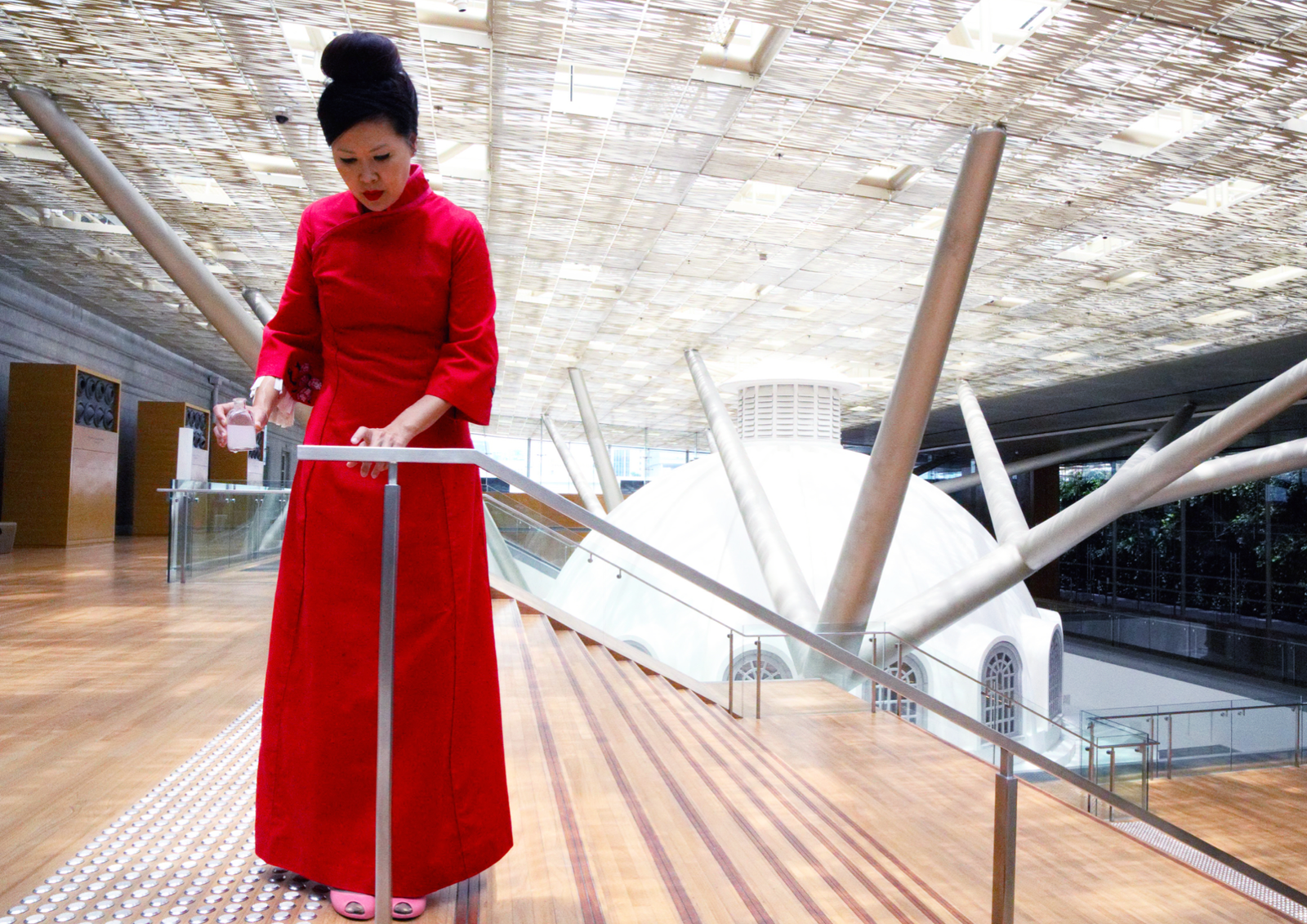
Be Afraid Only of Standing Still situates Lu in the Philippines through her Chinoy heritage: her maternal grandmother’s escape from China to the Philippines and her paternal grandmother’s from China to Hong Kong embed her family history in the country. For one day, Lu moves through Ayala Museum, along Greenbelt, and into Ayala Triangle Gardens, adhering texts from previous performances and family stories, diasporic border crossings, to walls and corridors, liminal spaces, using the artist and her daughter’s sweat and tears. As the texts loosen and drift, visitors encounter layered narratives of migration, memory, and intergenerational inheritance.
Maiden, Mother, Crone: The Human Library extends this exploration of female life stages. Joined by local crones and maidens, Lu invites participants to engage in one-to-one encounters with “human books,” reflecting on the lived experience, visibility, and authority from prepubescence to post-menopause.
Amnion considers the connections between bodies, water, and life cycles. This video considers water as a medium, all living creatures, hydrogeological systems and the only other species that live long post-reproductive lives. Focused on maternal embodiment and menopause, the film presents Lu and her daughter entwined in milky fluid, crossing borders of liquid and air, inside and outside the body, while gesturing toward the final shedding of eggs and the enduring enigma of post-reproductive life. Layered voices from philosopher Astrida Neimanis and writer Darcey Steinke probe the boundaries between bodies and the environment and the societal fears and fallacies surrounding menopause. Together, these works position migration, female embodiment, and menopausal experience as central to understanding presence, continuity, and transformation, establishing Lynn Lu as a vital contributor to Mothering/Unmothering.
Be Afraid Only of Standing Still situates your work in the Philippines through your Chinoy heritage. Can you share your starting point for this durational performance, the significance of the title, and how combining your grandmother’s story with texts from previous performances shapes its resonance here?
Lynn Lu, artist: The first iteration of this work was performed during the 2017 Venice Biennale preview week, in connection with the Diaspora Pavilion. My maternal grandmother had just passed away, and, while reminiscing about her life with my mother, we recalled her harrowing escape from communist China via cargo ship. My paternal grandmother fled China under equally dreadful circumstances, with jewels hidden inside her hair bun and sewn into the hems of her samfu. As part of the Chinese diaspora, I wanted to memorialize these personal histories of border-crossing.
Thinking about situating these chronicles in Venice, the legendary border-crosser, Marco Polo, of course, came to mind. Bringing together Marco Polo’s account of his travels from Beijing through SEA alongside the journeys of my ancestors, I wended my way from Marco Polo’s home through the Diaspora Pavilion to the waterfront where MP would have set sail, adhering text fragments of my grandmothers’ escape and of Polo’s trek through Asia onto the myriad surfaces of Venice associated with water—using a concoction of human sweat and tears. As the moisture evaporated, the slips of text fluttered off in the breeze, creating a new narrative of movement of their own.
The title is the 2nd half of a Chinese proverb 不怕慢,就怕停, which means: ‘Do not fear slow progress, be afraid only of standing still’, or be afraid only of stagnation. This proverb reminds us to value perseverance and to keep moving forward, and to me, epitomises the migrant mindset of resilience and courage in seeking opportunities on new shores.
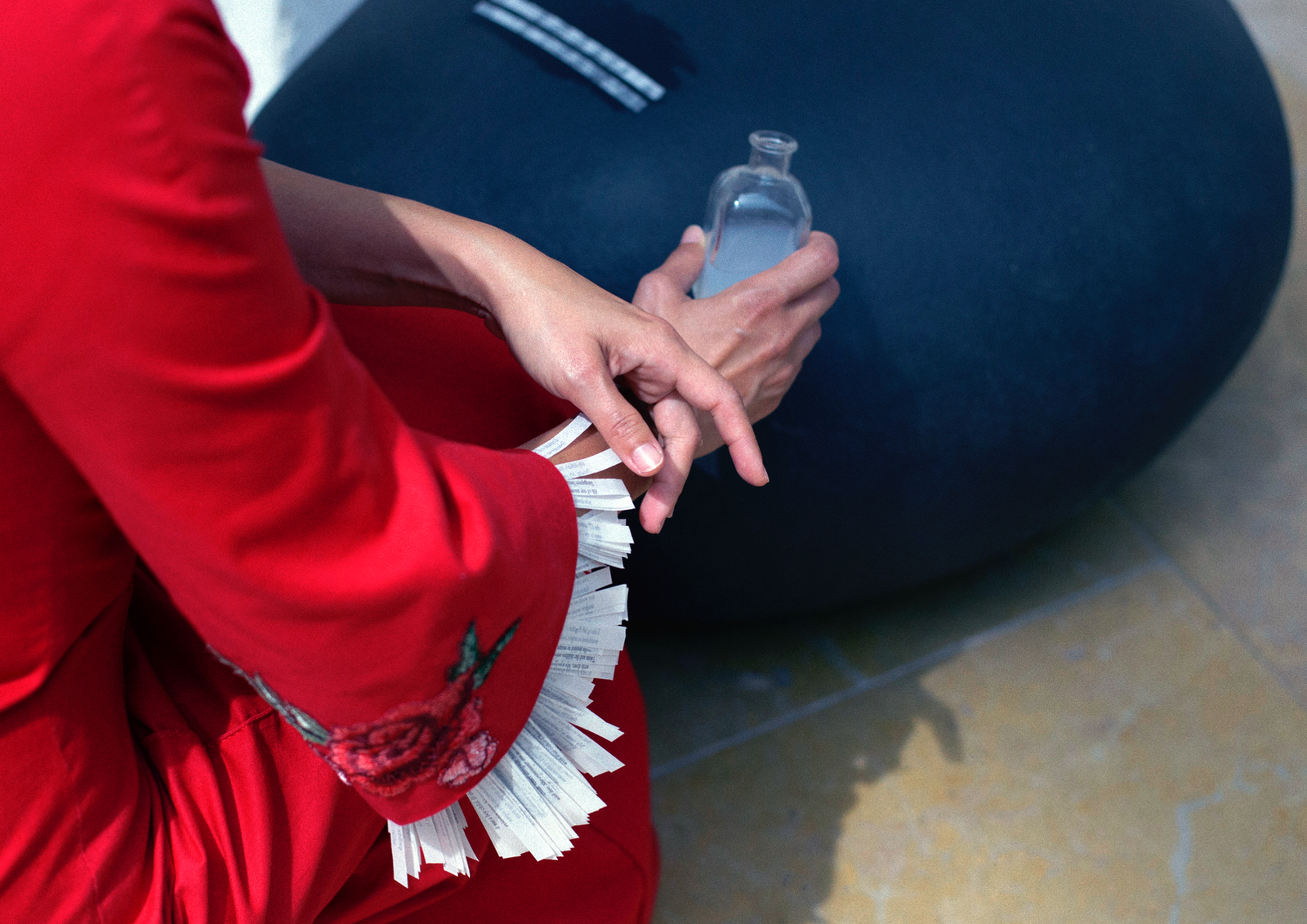
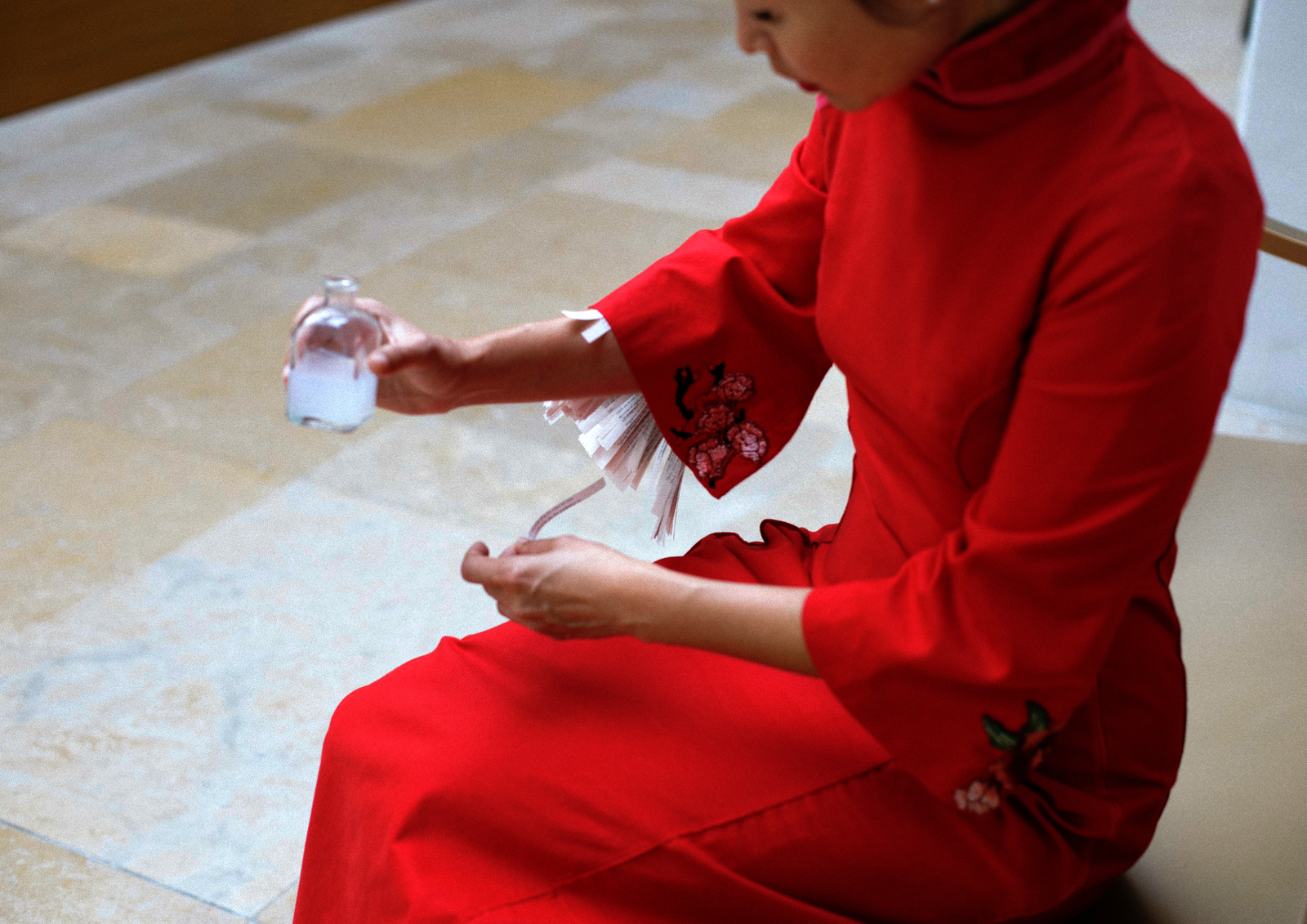
Be Afraid Only of Standing Still (Variation), National Gallery Singapore, 2017. Photographed by Murni Khaliesah Binte Uda.
You use your daughter’s sweat and tears to adhere the texts. What inspired this choice, and how does this physical engagement affect the way audiences experience stories of migration, memory, and intergenerational inheritance? Out of curiosity, can you talk about the process of collecting your medium?
The expression ‘Blood, sweat, and tears’ refers to intense effort, struggle, and sacrifice, which illustrate the experience of diasporic communities everywhere. I wanted these text fragments to adhere to surfaces associated with water, using the tears and sweat of my daughter and myself—ourselves foreigners in the UK—as an embodied connection to my grandmother’s lived experiences of forced displacement. Blood was omitted from this concoction because its dark colour would obscure the text.
The sweat is actually mine, collected in petri dishes whilst engaged in physical labour, in humid Singapore, where sweat flows freely. In London, the air is so dry that it’s nearly impossible to break a sweat. As for my daughter’s tears, when she was 3 years old in 2017, she threw quite a few “terrible 3s” tantrums. So whilst reasoning with her and/or comforting her, I would catch her tears in my petri dishes. I then sterilised the mixture of sweat and tears by boiling, diluted it with distilled water, and then I froze the concoction between performances.


Screenshots from Amnion, 2022.
Maiden, Mother, Crone: The Human Library invites one-to-one encounters with “human books.” For this performance, you’ll collaborate with Filipino women you are meeting for the first time. How do you think this will shape the performance’s intimacy, duration, and reflection on intergenerational knowledge?
Performing Maiden, Mother, Crone: The Human Library with Crones and Maidens unknown to me shifts the work from an intimate, autobiographical ritual into a collective, communal enactment of generational experience. When I performed it with my mother and daughter, the work was grounded in bloodline and familial intimacy. With the Filipino women and girls, the emphasis moves from personal genealogy to archetypal roles. Maiden, Mother, and Crone become lived positions inhabited by many bodies, affirming that stages are cultural and social as much as familial. A group of unrelated “books” foregrounds multiplicity, and the work becomes a living library in a fuller sense – a repository of embodied knowledge across difference.

The Crone is often rendered invisible in society. How does this work highlight the authority, wisdom, and presence of elder women?
It is actually only in individualistic societies that revere youth that women become invisible once they age out of stereotypical feminine beauty. In collectivist societies – the more traditional societies – women gain much freedom, status, and the respect of their communities, as they hold knowledge acquired over a lifetime that is crucial to the well-being of their people as healers, midwives, and wisewomen.
My Chinoy mother and grandmother were both lucky enough to have aged into their wisewoman years, and were central figures within their communities with their experience and knowledge accumulated over a lifetime of traditional healing practices and ancestral rituals for spiritual protection.
In Amnion, you explore maternal embodiment, menopause, and bodily connections through water and life cycles. How does this focus expand the thematic concerns of Mothering/Unmothering?
Amnion expands the thematic concerns of female experience by presenting womanhood as fluid, cumulative, and intergenerational, where ageing, reproduction, and embodiment are not hierarchical stages but interconnected expressions of lived continuity. Menopausal bodies are treated as sites of wisdom, memory, and sustained connection to others, challenging dominant narratives that equate female value with reproductive capacity. Water resists fixed boundaries and linear time. By grounding the layered narratives in tidal rhythms, Amnion frames the female body as a cyclical archive of ancestral histories.
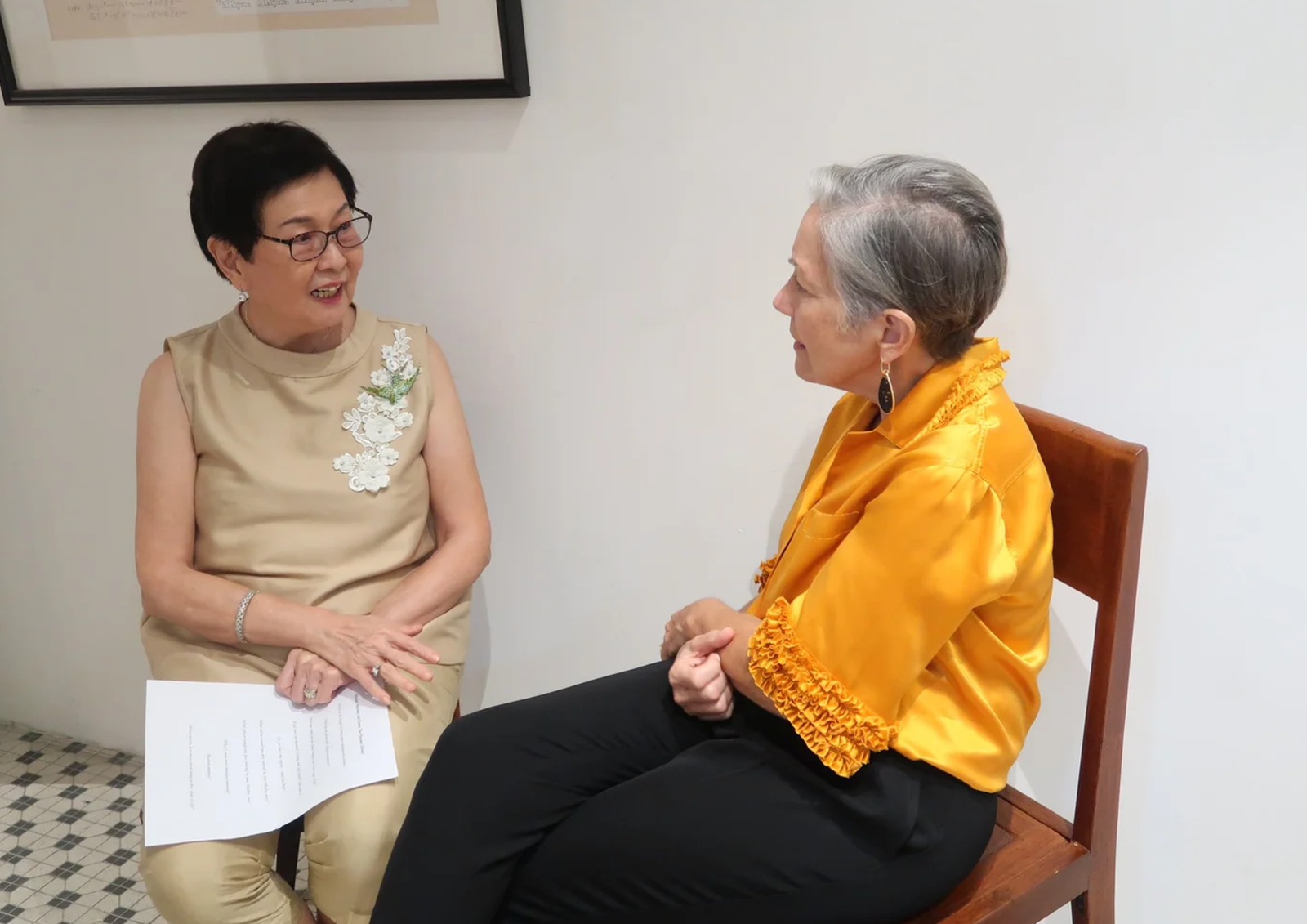
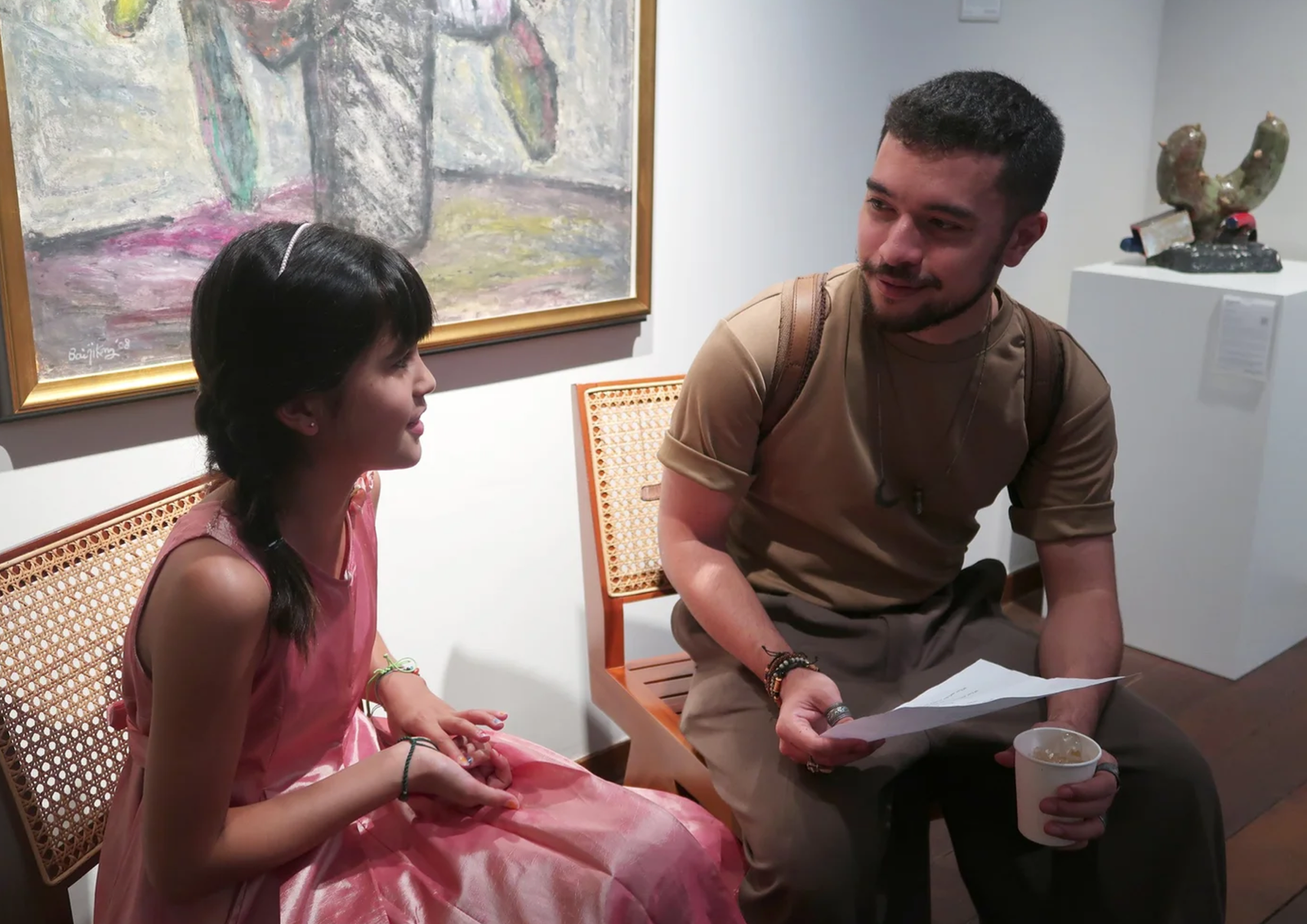
Lynn Lu, Maiden, Mother, Crone: The Human Library, Singapore, 2024. Photography: Kelly Janine, courtesy of AGAS Singapore Gallery.
Across all three works, the body, memory, and relationality are central. How do you balance personal narrative, inherited stories, and audience engagement in your practice?
These works balance the personal, the inherited, and the communal by treating the body as a shared archive and relational site—one where memory circulates, authorship is shared, and meaning is continually co-created in the act of being together.
Migration and lineage recur in your work. How do these concepts intersect with your research on menopause to shape movement, gesture, and thematic exploration?
Migration, lineage, and menopause intersect in my practice as embodied transitions. States of passage that reshape how the body moves, remembers, and relates.
Beyond the performances and installations, what lasting impressions or emotional resonances do you hope audiences take away about intergenerational care, female embodiment, and the continuity of life stages?
I’m not sure at the moment. I will leave it up to them. •
One Response