Interview Vanini Belarmino
Images Lilibeth Cuenca Rasmussen
In Mussel and Renaissance Swirl and The Mitochondrial Eve, Danish-Filipina Lilibeth Cuenca Rasmussen presents a body of performance works reconfigured for the Philippines, extending her sustained inquiry into motherhood, care, and cultural inheritance. First developed in Denmark in dialogue with public sculptures, these works now unfold across Philippine sites for Mothering/Unmothering, where movement, gesture, and ritual encounter different histories, climates, and modes of public life.
Mussel and Renaissance Swirl operate through slowness and repetition. Gestures accumulate rather than declare, inviting close attention and sustained presence. As movements recur, space is subtly recalibrated—from a site of passage to one of pause—allowing reflection, attunement, and renewal to emerge over time.
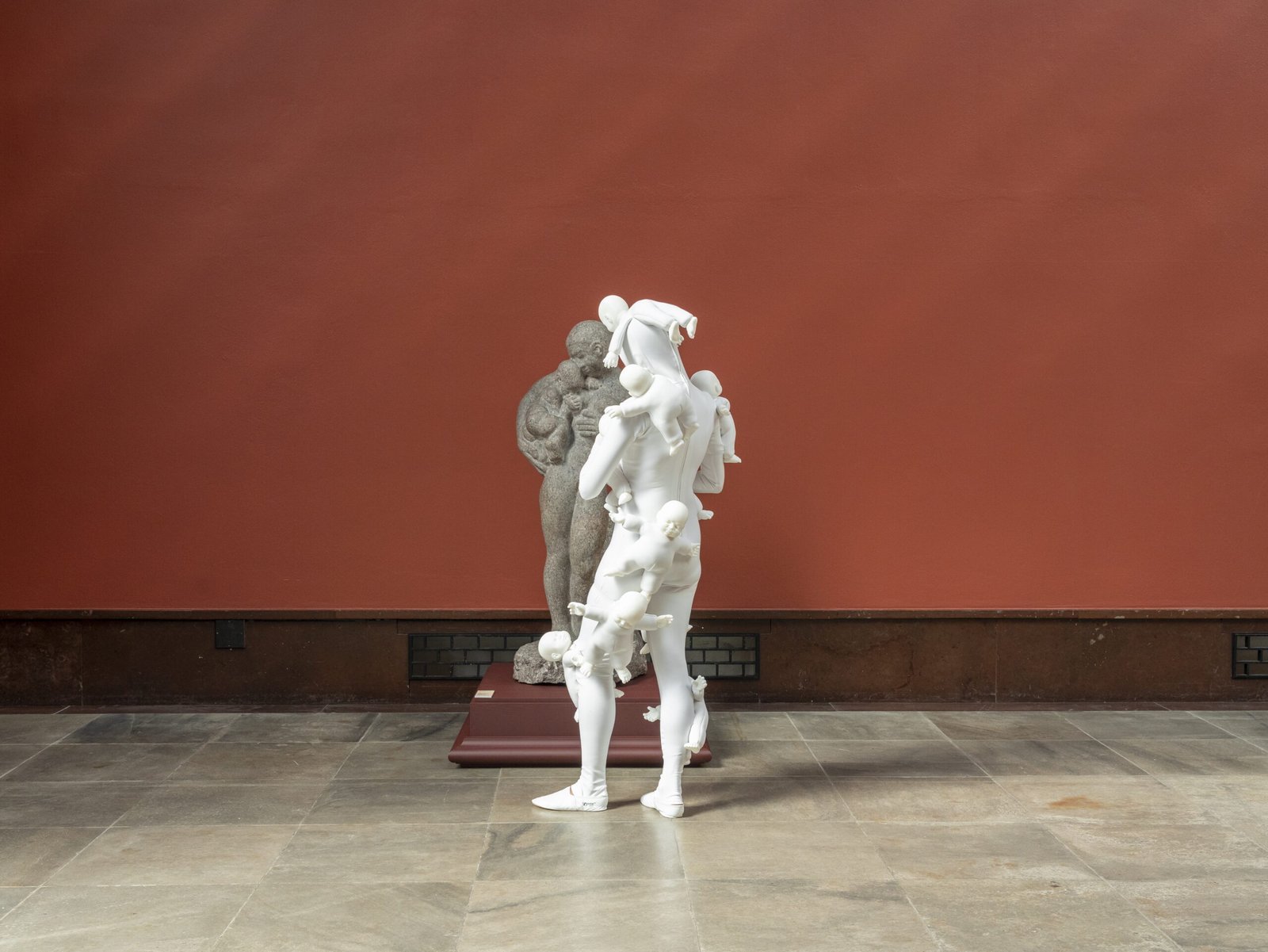
In The Mitochondrial Eve, Rasmussen engages more directly with the complexity of motherhood. Combining text, movement, and strong visual imagery—including a performance involving twelve babies inspired by Kai Nielsen’s Vandmoderen (The Water Mother)—the work transforms public space into an intimate, exposed arena. Motherhood appears here not as a stable role, but as a condition shaped by power, vulnerability, inheritance, and contradiction.
Seen in the Philippine context, these performances acquire new resonance. They engage with local narratives of care, kinship, and collective memory, while foregrounding tensions between creation and release, continuity and change. What remains are traces rather than conclusions—gestures that linger, questions that stay open, and a heightened awareness of how care is enacted, negotiated, and let go.

As an artist, mother, and daughter, what does Mothering/Unmothering mean to you? What was the first thing that came to mind when you were invited to this show in the Philippines?
Lilibeth Cuenca Rasmussen: My first thought: I have a piece, The Mitochondrial Eve, that would fully contextualise the exhibition theme. I have wanted to work on this theme for many years, but have been hesitant because, in a way, I think it is too obvious and banal. As I have matured, as an artist and as a mother, my daughter is now 24. I still need to express the dualities of being a woman, which may mean being a mother too, if not to a child, then to a man… I have had many thoughts and reflections on this existential theme, which raises so many questions about identity and belonging.
There are many changes over a lifetime in the roles of mother and daughter, and now, as a mid-career artist, I thought it was the right time to make the piece about mothering/unmothering. I also got the right opportunity. I was commissioned to create a work for The Vigeland Museum in Oslo in April 2025, during a Kai Nielsen exhibition, when Vandmoderen was on loan. In this monumental museum, in a dominantly sculptural masculine universe, there is a vitalistic expression. It was the right choice to take on this theme and to wear and carry it on my own body.
In your body of work, you have always introduced and presented extraordinary women, using your body as a vessel to embody their beings. To what extent would you say these women are different, and to what extent are they similar? That said, which of these female characters do you resonate with the most?
They have different stories, looks, and cultures. Their similarities lie in their power! I had never wished to portray a victimised woman.
Good question. I resonate most with Absolute Exotic, my first performance and “music video”, in which I sing. I like it because it is bold, straightforward, and complex. In this work, I am bad, jealous, vulnerable, and flirtatious. But my favourite character is the blond femme fatale in Ego Song from 2006. Here, the character is an egocentric diva appropriating Marlene Dietrich.
What was your starting point for Mussel and Renaissance Swirl? Could you talk a bit about the title?
The starting point was to heal a specific site in Copenhagen, the Town Hall Plaza, which I always found chaotic and weird. It is not fulfilling its purpose as a gathering space. In my research, I discovered that the original plaza had a mussel-like formation. It was quite beautiful, cosy, assembling and inclusive. So I recreated the outline of the mussel formation at its original size, painted with chalk paint. It was gone the day after because there was a mountain bike event.
The mussel comes from this story, the original shape of the plaza, and Renaissance Swirl refers to the paradigm shift in our time.

While researching the different kinds of mothers, you created The Mitochondrial Eve. Which kind of mother or carer does this particular work represent?
I have tried to portray many mother types, young and old, animal mothers, women who did not become mothers, the woman in menopause who can no longer become a mother, the daughter, the schizophrenic mother…
Could you share a bit about the reference you used for The Mitochondrial Eve, specifically Kai Nielsen’s sculpture?
It is a brilliant sculpture. I love the precision and humour in Kai Nielsen’s work. Every mother knows this feeling… this sculpture portrays babies, kids, all over the place. It gives me this feeling of all these people wanting something from you, and you just want to run away.

With the freedom from such reference for the performance in the Philippines, what do you wish for the audiences to take with them from your performance?
I believe this feeling of being an “over-mother” is universal, and I can travel far, and people will resonate with this character. As in all my works, I don’t wish for anything specific, but I hope people will have reactions and reflections, interact with the character, and listen to the text I wrote about the multifaceted mother—The Mitochondrial Eve. •