

Words Patricia Herbolario
Images Stef Tafalla and Zeus Batondo for the Idea First Company
Director Tuxqs Rutaquio has an instruction for his cast as the show returns for a second run. “For this rerun of About Us But Not About Us, we don’t begin by trying to recreate what happened before,” he says. “In fact, I discourage it. Every production exists within a different moment, a different audience, and even a different version of ourselves as artists.”
The IdeaFirst Company’s production, a story about power dynamics and two-faced tragedy, returns this October 2026 with the twisted triangle between literature professor Eric, late writer Marcus, and writing mentee Lancelot. The whole play unfolds during a dinner between Eric and Lancelot, with Marcus mentioned and appearing only in flashbacks.
Writer and producer Jun Robles Lana says Romnick Sarmenta, Elijah Canlas, and Epy Quizon are playing their roles for the last time, and he says audiences will understand in time. Lana adds that he is excited for new performers to interpret the characters this October. Alternating with the three are Rutaquio as Eric, Andoy Ranay as Marcus, and Kobie Brown as Lancelot. Each of them faces the same question: where does mimicry end and character creation begin?

Two directors and a screen actor take the stage
Beyond performing alongside the main cast, the alternates wear their own hats and masks, which they swap in and out of the show. Rutaquio directs the production he now also acts in, and Ranay, a director, has returned to the cast as Marcus, while Brown moves from the glaze of screens to the immediacy of the stage.
Rutaquio on joining the cast and switching hats: I honestly didn’t imagine that I would be part of that new cast. Jun Lana himself offered me the role of Eric, and it took me a while to say yes because I really wasn’t expecting it. It’s been almost a decade since I last acted onstage. I’m still learning when to switch hats. During these early rehearsals, I sometimes catch myself watching actors as a director—taking mental notes and eventually giving those notes to them.
I suppose it’s difficult to completely turn that part of me off because I’ve lived with the production from the other side for so long. But when it comes to my own work as Eric, Elmer Gatchalian, our artistic director, watches the rehearsals and gives me notes. I need someone outside the scene to look at my performance objectively, especially because I obviously can’t direct myself while I’m in it.
Film director Ranay on being an actor for About Us: I don’t think [being a director] ever completely turns off. The difference is that I’ve learned when not to listen. During rehearsals, my responsibility as an actor is to trust the director. My job isn’t to solve everyone’s scenes—it’s to fully inhabit my own character and contribute to the larger vision. Of course, the director in me notices staging, pacing, or storytelling choices. But I’ve learned that collaboration also means humility. Sometimes the best thing I can do is simply be present as an actor and allow someone else’s vision to guide me. Ironically, becoming a director has made me a better actor because I’ve come to appreciate trust and teamwork more deeply.
Brown, who won the role of Lancelot through auditions, on transitioning from screen to stage: I think it’s important to let actors explore different mediums. At the end of the day, if an actor auditions for a role, earns the opportunity, and is willing to put in the work, then I don’t think there should be a problem with them stepping into that space. I’m here because I genuinely love the medium, I want to learn, and I want to prove myself through the work. I think the audience should ultimately judge you by what you do on stage, not by where you came from.
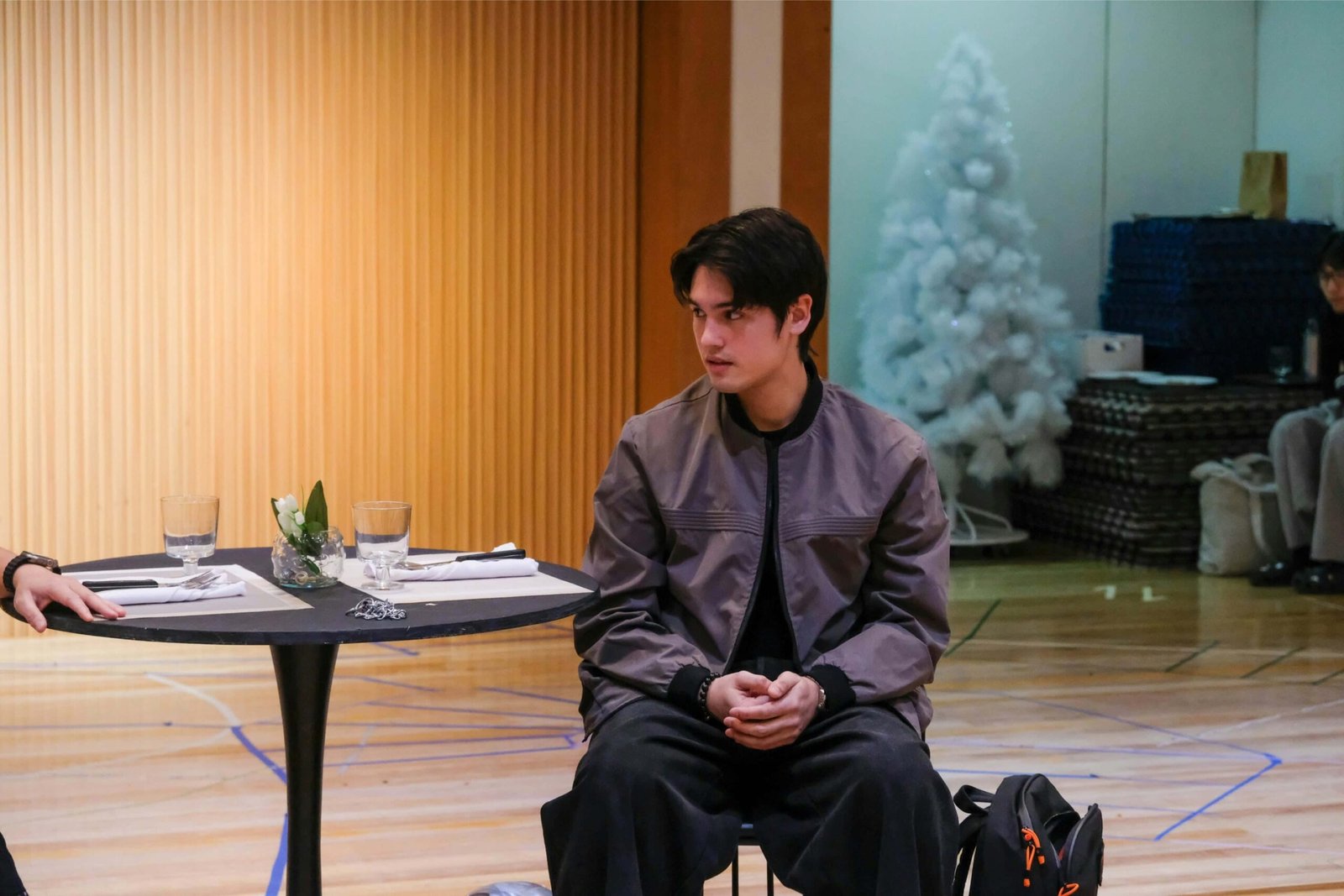

The same role with a different actor is a different show
Sarmenta and Canlas are synonymous with About Us But Not About Us, having originated Eric and Lancelot for the film the show was based on, and they reprise them for the first run and now the second. For the alternates, the job can mean filling the primary cast’s shoes and emulating their performances, but is that all there is to it? We ask the alternates how they collaborate with the original cast to bring their shared character to life and where their own performance begins as they take on the role.
Rutaquio: I guess the most obvious difference is that Romnick and I are built differently—physically and vocally, at least. But beyond that, we also come from different experiences as actors and as people. So even if we’re working with exactly the same text, we will inevitably offer different perspectives on the character. I don’t think the goal is for me to consciously find ways to be different from Romnick. In fact, the moment I start thinking, “Romnick did it this way, so I should do it another way,” then I’m already making choices based on his performance rather than on Eric. What matters more is for both of us to find our own truth in the character. If those truths lead us to very different performances, then that’s actually exciting.
Ranay: Epy is an actor I deeply admire. He’s incredibly instinctive and brings remarkable truth to every role he plays. Naturally, we exchange ideas because we’re both serving the same script and the same production. But at some point, you have to let go of comparison. The audience isn’t watching an impression of another actor—they’re watching your interpretation. I don’t consciously ask myself how my Marcus differs from Epy’s. Instead, I ask what Marcus is thinking at this exact moment, what he wants, and why he chooses these words. Once those questions become honest, the performance naturally becomes your own.
Brown: I think it’s impossible not to be aware of the work that Elijah has already done with Lancelot, especially because he has lived with the character of Lancelot for so long. I don’t think my job is to recreate his performance. My responsibility as an actor is to understand the character and then find my own truth in him. I also think that’s one of the exciting things about having an alternate cast. You’re seeing the same character and story, but through a different person. I want my Lancelot to feel intelligent and charming on the surface, but underneath, he’s desperately looking to be seen, validated, and accepted.
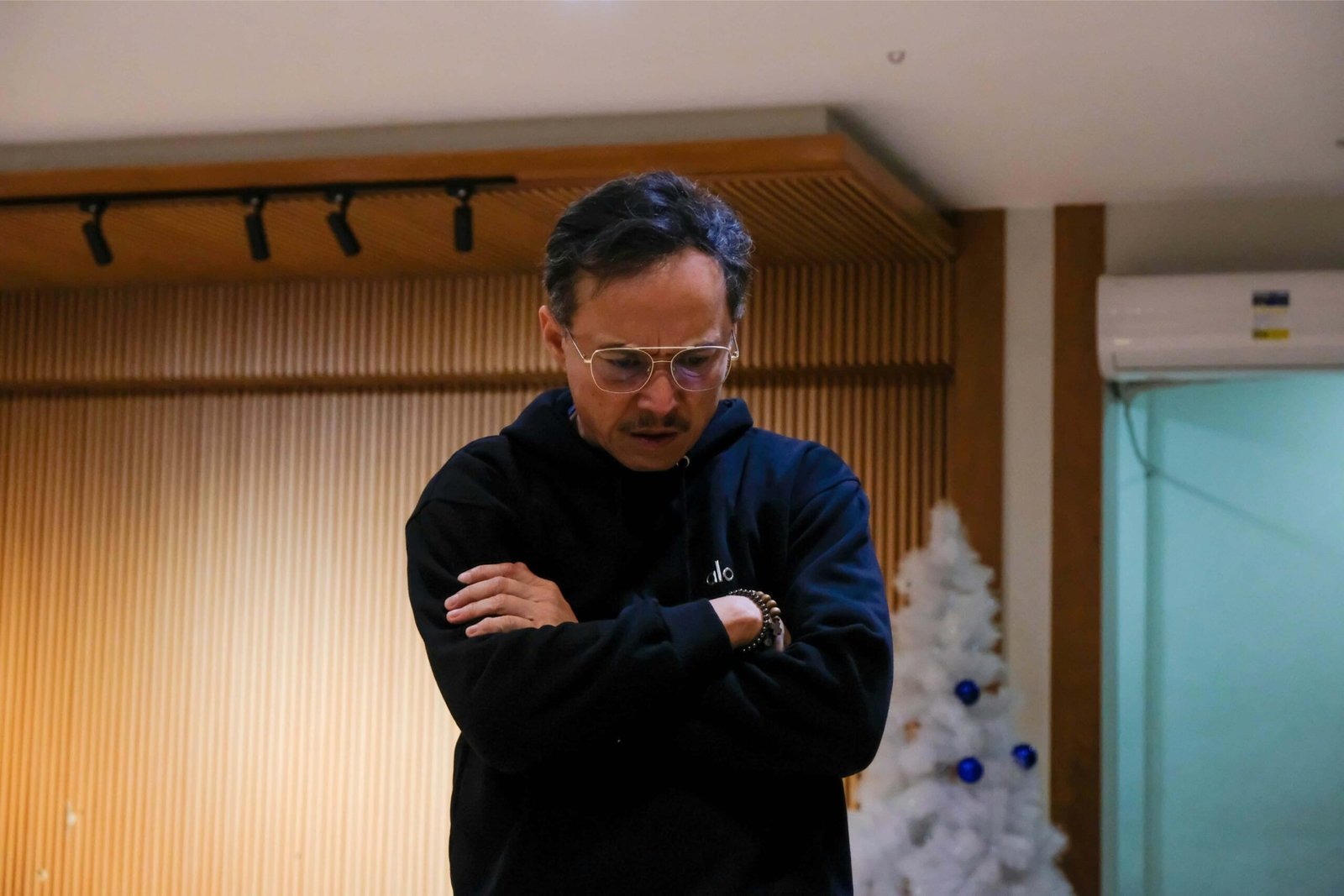
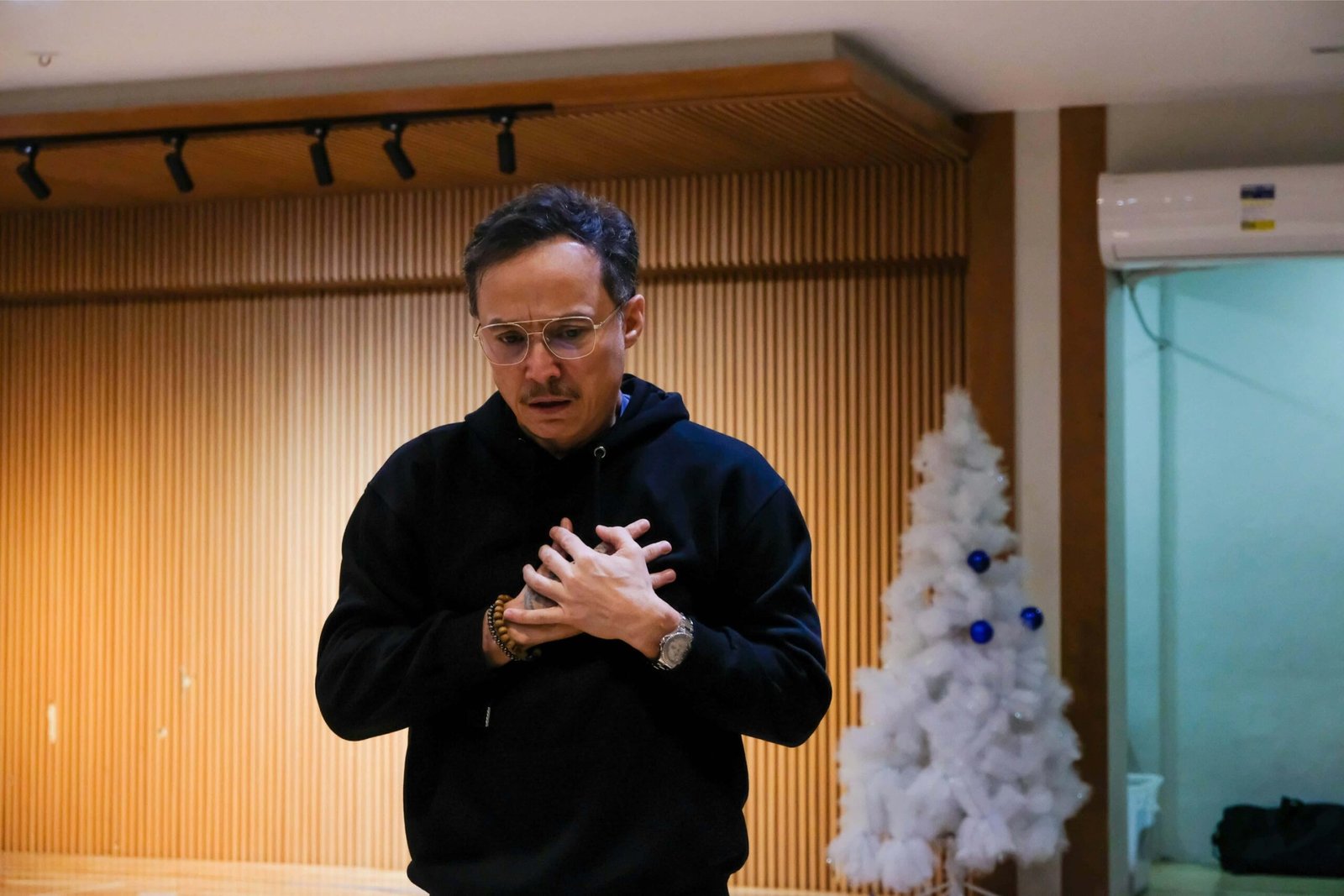
Eric wants to be loved, and Marcus is afraid
Without giving too much away, every character in About Us, But Not About Us lives in a moral gray area, and weighing each one’s motives would spark a lengthy debate, which is the point of the play. We turn to the three actors on what one thing they think audiences often overlook about the characters they play.
Rutaquio: I think one thing people may overlook about Eric is that underneath all the intelligence, manipulation, ego, and even the questionable choices he makes, there is a very basic desire to be loved. Eric has been with Marcus for a long time, and perhaps at some point being loved and being accustomed to someone can start to feel like the same thing. Then Lance enters his life, and suddenly Eric feels seen in a new way. He is admired, desired, listened to. He wants to believe that someone has chosen him. Perhaps the tragedy is that, in trying so desperately to hold on to that feeling, he becomes capable of hurting the very people from whom he wants that love.
Ranay: I think people sometimes mistake Marcus’ confidence for emotional strength. To me, Marcus is actually terrified. He jokes because it’s easier than admitting he’s hurt. He becomes sarcastic because vulnerability feels dangerous. Even his cruel moments often come from self-preservation rather than malice. That doesn’t excuse his actions, of course. But I think understanding where cruelty comes from is more interesting than simply labeling someone cruel. Marcus isn’t trying to be the villain of anyone’s story. Like most of us, he’s simply trying to survive emotionally—and sometimes people make terrible choices when they’re afraid.
Brown, turning the question toward what the play asks of its audience: I think one of the biggest things the story reminds us is to really think about the consequences of our actions before we make certain decisions. From Lance’s perspective, I think it’s also about understanding that our own pain doesn’t give us permission to hurt someone else. You can understand why someone behaves a certain way without necessarily excusing them. The play makes you question where you draw the line between understanding someone and holding them accountable.

Alternates ask audiences to look at the same role twice
Audiences may book with a certain name on the marquee in mind, yet alternates are the backbone of the line ‘the show must go on.’ We ask the alternate cast what it means to share a role and what they hope audiences understand about the job.
Rutaquio: When different actors inhabit the same characters, they inevitably bring different histories, instincts, rhythms, physicalities, and emotional truths to the work. The text remains the same, the circumstances remain the same, but something shifts because a different human being is experiencing it. I don’t think we should measure an alternate cast’s value by whether they can “outperform” the original cast. For me, that’s part of what makes theatre exciting. A character doesn’t belong permanently to one actor. The material can reveal something different depending on who performs it—and even on who watches it. So I hope audiences don’t necessarily ask, “Who did it better?” but perhaps, “What did I see differently this time?
Ranay: Being an alternate isn’t “less than.” It’s simply a different responsibility. I actually think audiences today are becoming more open to different interpretations. Theater is a living art form. Every actor brings different life experiences, instincts, and emotional textures to a role.
That’s the beauty of theater. Two actors can say the same lines, yet reveal entirely different emotional worlds,” shares Ranay. “At the end of the day, that’s what great theater should do—not celebrate one performer over another, but deepen our understanding of the human experience.
Brown: There’s pressure because you’re filling big shoes, especially when you’re stepping into a character so closely associated with another actor. But I don’t look at it as a competition. We’re working as a team, and I don’t think the goal is to outperform each other. The goal is to give the audience another experience of the same story. I don’t want audiences to watch my Lancelot and think, “This is the alternate version.” I want them to watch the show and hopefully just think, “That’s his Lancelot.” •

‘About Us But Not About Us’ is running from October 2 to October 25, 2026 with only 12 shows. Shows run on Fridays (8:00PM), Saturdays (3:00PM and 8:00PM), and Sundays (8:00 PM). Tickets are available on the Idea First Website or Ticket2Me.