Introduction and images Jason Cruz
Interview The Kanto team
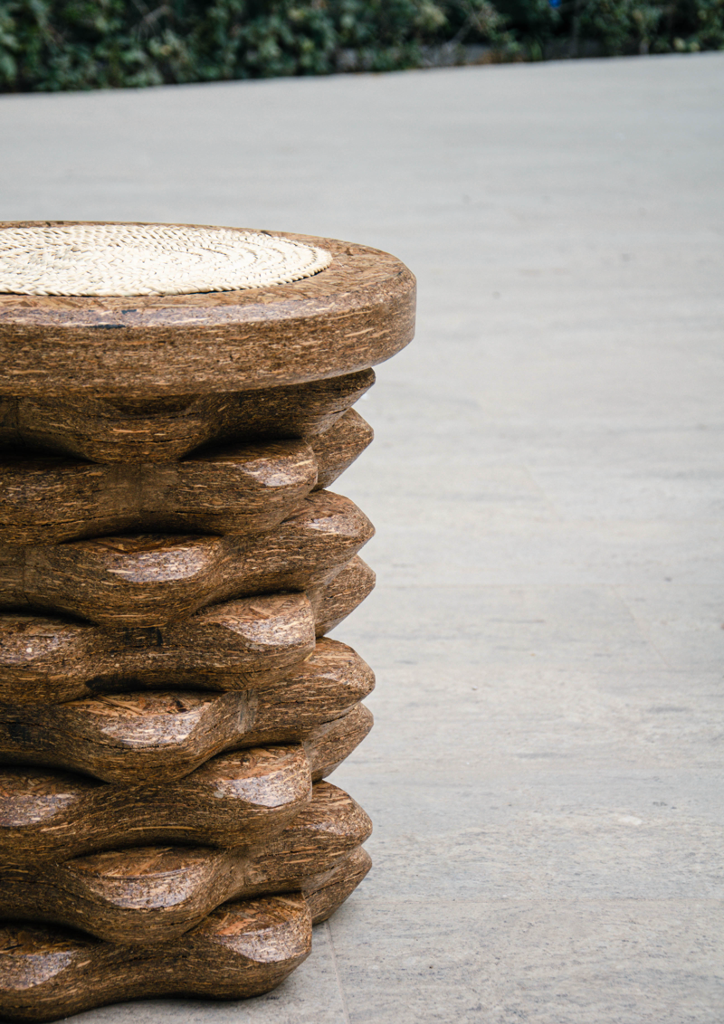
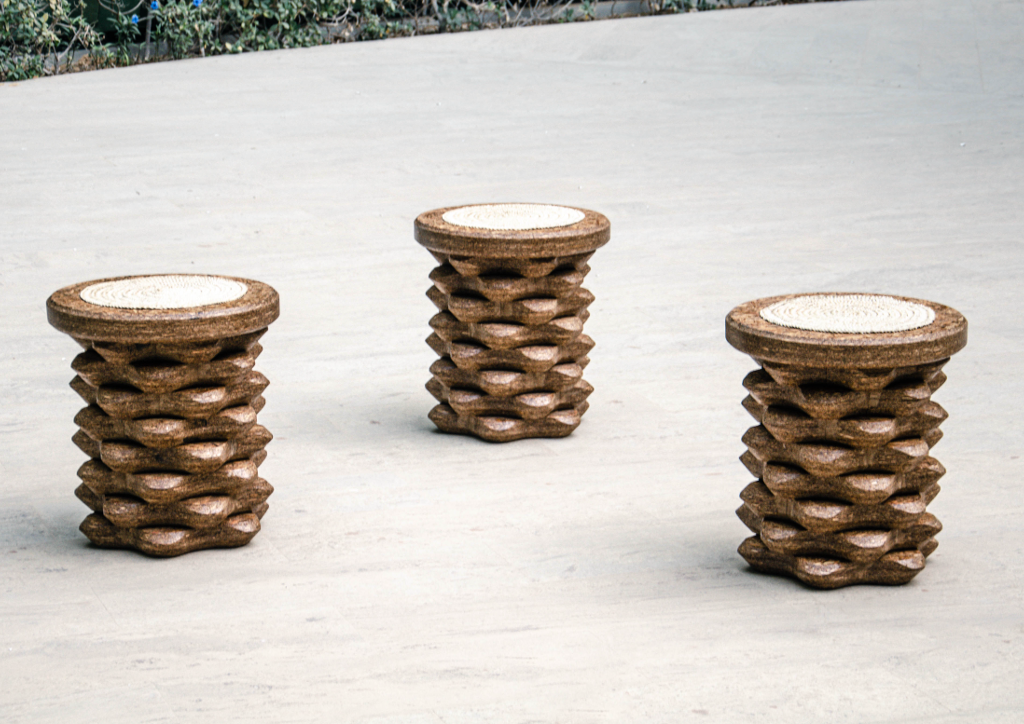
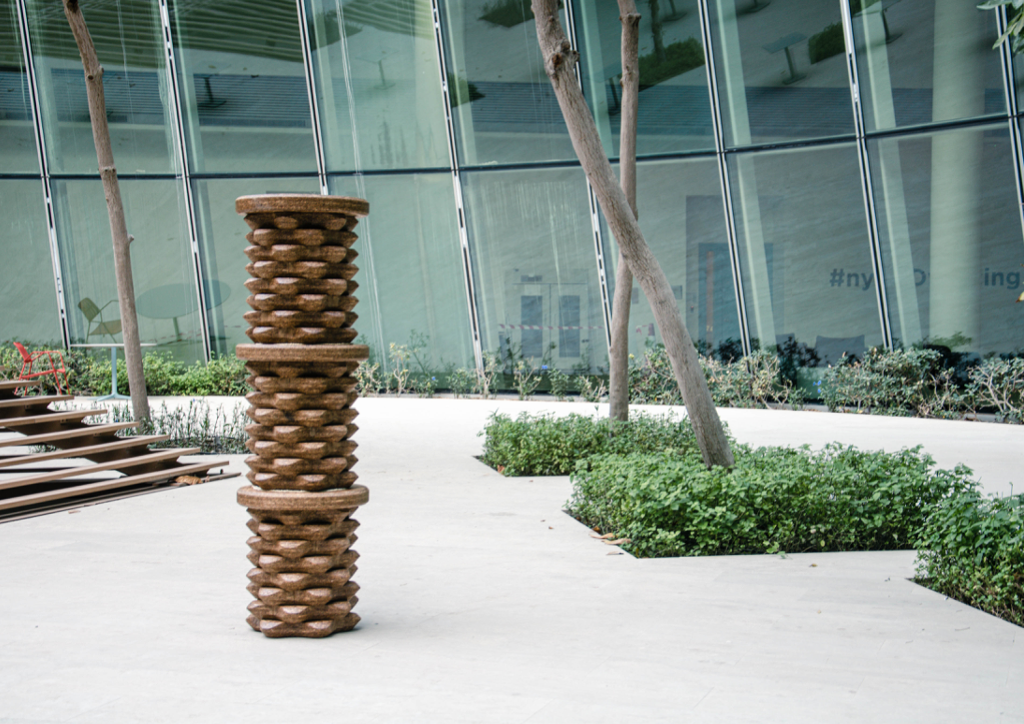
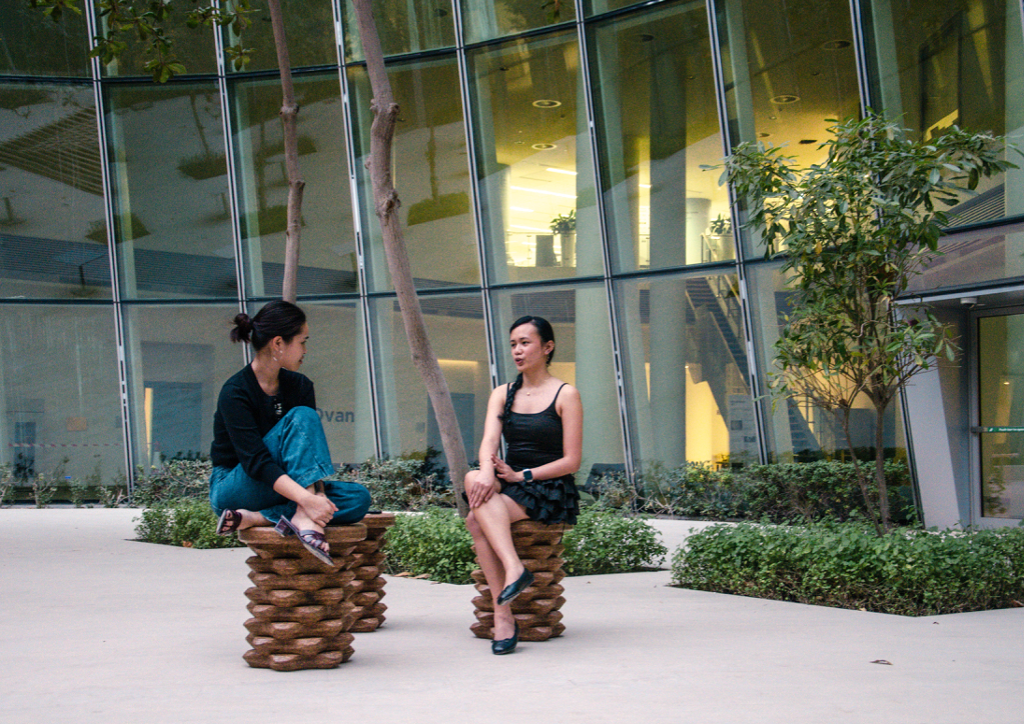
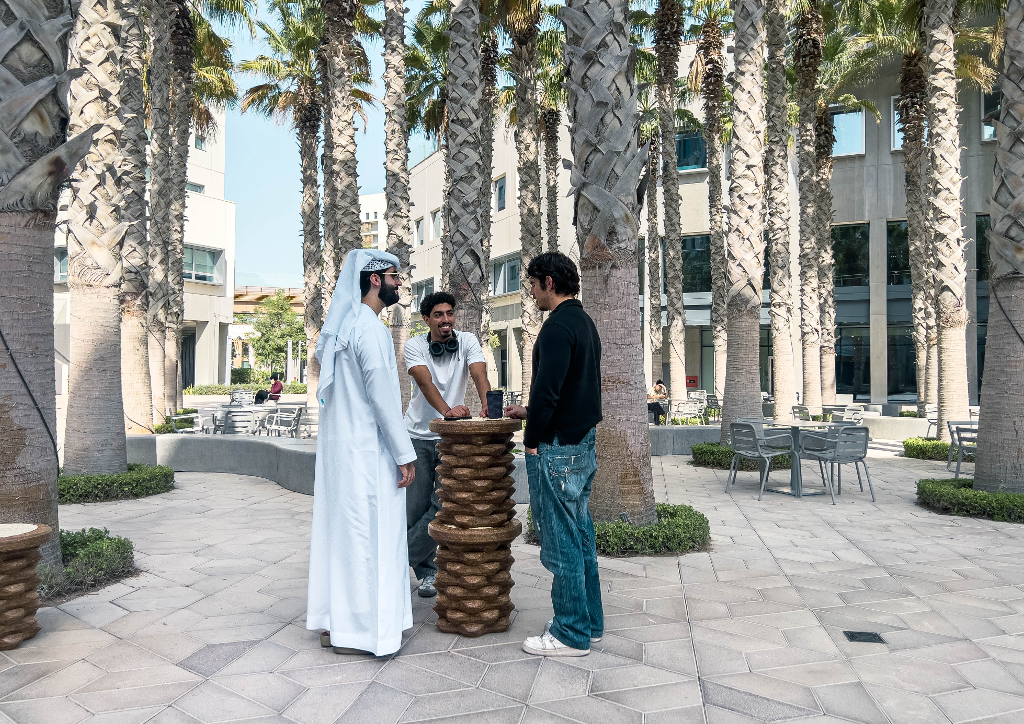
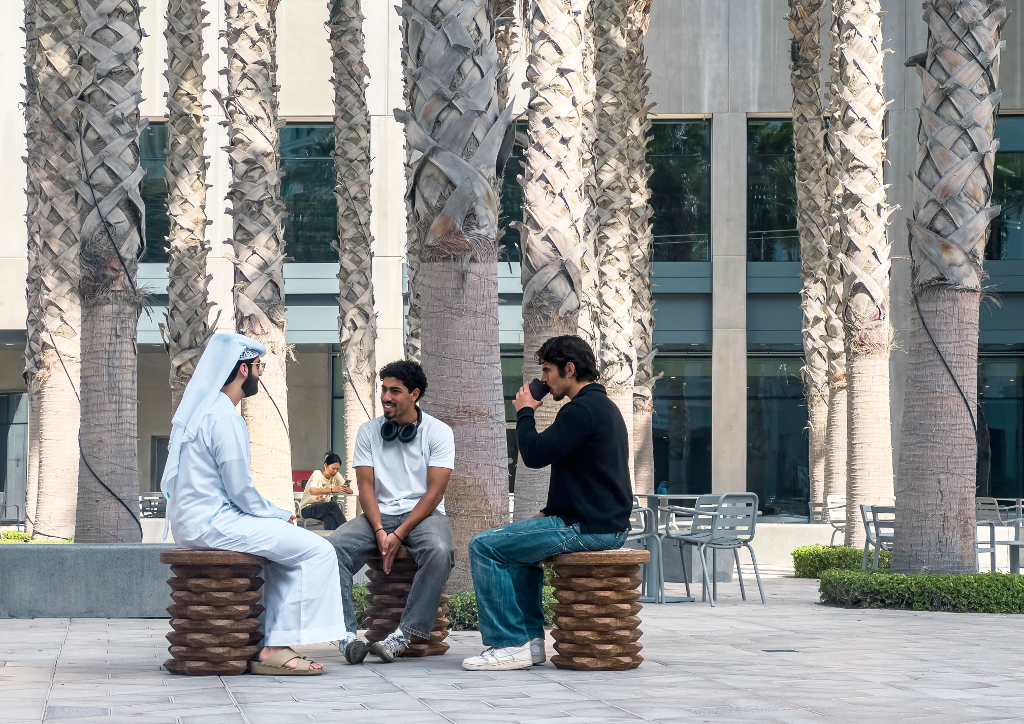
The Nakhla Stool is a set of social furniture pieces designed to fully embody the Date Palm Tree. Its form is inspired by the palm trunk’s texture and geometric motifs in Arabic architecture, while its materiality is derived from the date palm itself: Khoos (woven dried palm leaves), handcrafted by an artisan, and DesertBoard, a locally produced engineered wood made out of waste palm fronds. The stools are as versatile as the Date Palm in functionality, activating social spaces as individual seats (1 stool), standing tables for events (2 stools), and serving as a sculptural piece (3 stools). The piece was first exhibited at Qasr Al Hosn in Abu Dhabi and was then showcased at NOMAD Abu Dhabi.
The Nakhla Stool was commissioned for and received 3rd Place in the Furniture Category of the inaugural House of Artisans Design Competition, hosted by Abu Dhabi Culture. The competition celebrates the living heritage of the UAE by inviting designers to engage with traditional crafts through a contemporary lens. The initiative promotes innovation in product and furniture design while creative exploration in cultural knowledge and material heritage.
Welcome to Kanto, Jason! Thank you again for sharing the story of the Nakhla Stool with us. Let’s start with a fun one: If the stool could introduce itself at a talk on industrial design, what do you think it would say about its target demographic, best feature, and how it wants people to use it?
Jason Cruz, architectural designer and civil engineer: Thanks for the interesting question! If the Nakhla Stool could speak, I think the first thing it would say is “gather around and use me as you see fit.” At its essence, the stool is a modular system designed to activate social spaces, and its functionality reflects this. The design of the top of the stool itself invites people to try to lift it, allowing users to move and arrange the stool to their needs, even at different scales.
In intimate spaces like homes, the ability to arrange the stools from individual seats to a sculptural piece allows the stool to adapt and remain a staple of the room it’s in. For public spaces, people can move the stools around when gathering or place them next to the changing shade throughout the day. In the winter, when many outdoor events happen, two stools stacked together would create a standing table for events without needing to use additional furniture. The fact that it can do all this from a single building block of the stool is its best feature, and it would want people to use it as they see fit.
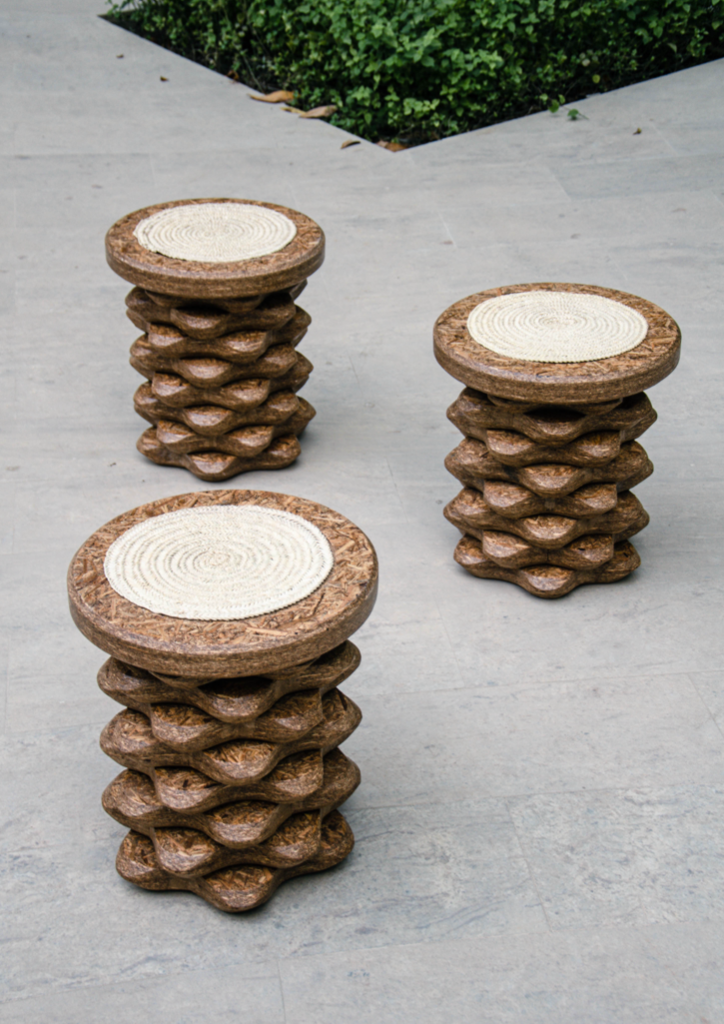
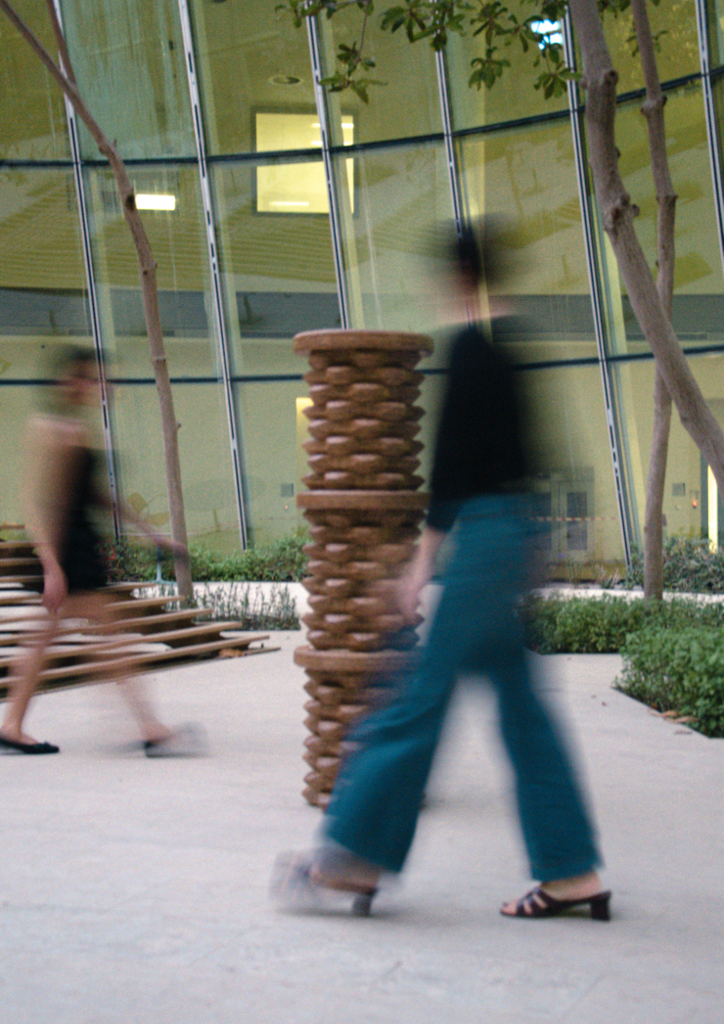
The Nakhla Stool references the date palm’s trunk for its form and is also made from date palm byproducts. Besides being “versatile in function,” what made the date palm a fitting inspiration for a stool such as Nakhla?
The Nakhla Stool, in its current form, was developed as an entry for the “Sit Happens” stool design competition for B+Abble 2025. Given the theme of “micro-locality” and that other entries for the competition would most likely be based on contexts in the Philippines, I was drawn to responding to a more unique context, which I’m also familiar with: the United Arab Emirates. The date palm became an immediate icon to take inspiration from—in the harshness of the desert, it is one of the few plants that thrives. It holds an important place in Emirati culture for being a versatile resource, used as food through its date fruit, materials through its leaves and fronds, and providing cooling through its shade. It is an ubiquitous, universal symbol found throughout the country– in backyards, roadsides, and oases. The Nakhla Stool celebrates this abundance by embodying the date palm and placing it in people-centric spaces.
What did you learn from the process of retranslating a conceptual design into something practical? And with your prototypes on show and in use, what was the most memorable feedback you’ve received about your design?
What makes the Nakhla Stool stand out is the intentionality behind its design decisions. The choice to use palm-derived materials is a bold one, as despite its abundance, date palm wood is rarely used as it’s difficult to work with. Furniture pieces have been designed before that resemble the date palm, but are made of different materials. Other projects, such as pavilions, have used date palm trunks directly, but the process is relatively expensive and impractical, especially at a larger scale. For me, the goal was to create a furniture piece that truly embodies the palm tree; working with different palm-derived materials throughout the prototyping process allowed me to achieve exactly that.
The most memorable feedback I’ve received was the “aha” moments when people begin to peel back the conceptual layers of the date palm from the modular stool form. When first seeing the furniture piece in person, the immediate link with the form of the palm tree is made. Upon closer inspection, the materiality and functionality reveal themselves. The times when I received comments when people made these connections were humbling moments for me. These showed that the well-thought-out design led to the stools’ current form.
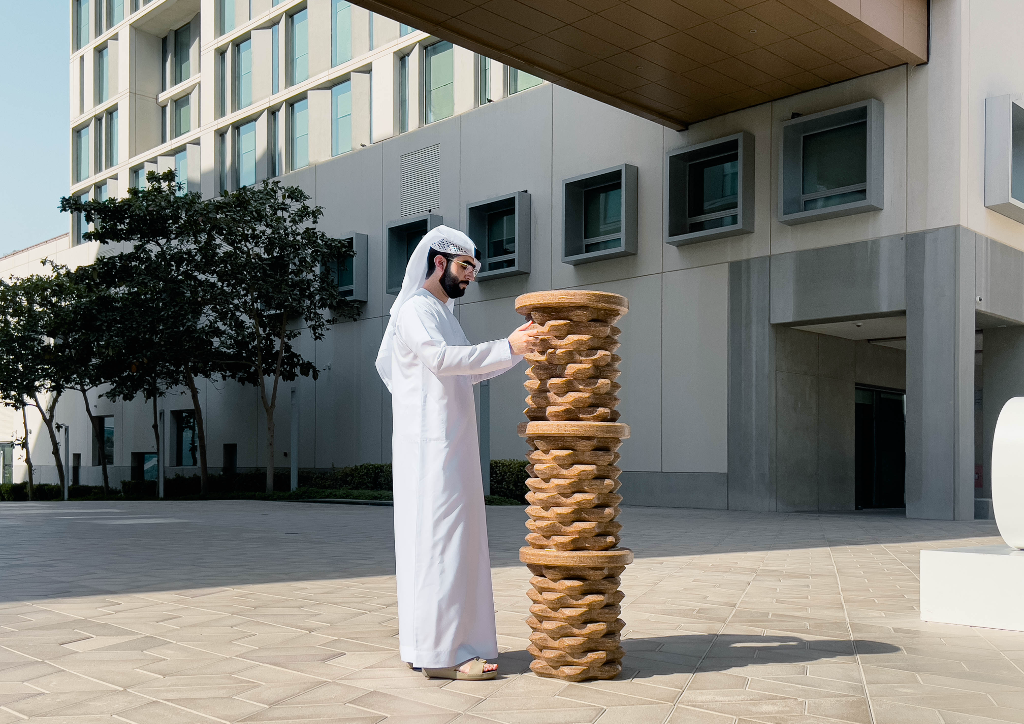
The stool shifts from individual seating to standing event tables, to even a sculpture. How did practical factors such as dimensions, weight, and joinery guide these transformations? What scenarios did you imagine to make each functionality feel natural?
Ergonomics and weight were the key constraints for the design of the stools. It started with the design of the individual stool, the building block of the modular system. Getting the dimensions for comfortable sitting right was the first step. Then I expanded the system, checking if stacking two on top of each other made sense for a standing table height, and so on. It involved a lot of 3D modeling, using reference furniture pieces, and imagining how I’d use the stools in physical space by using measured heights as a reference.
As part of the competition, we had the chance to iterate and create a physical prototype before moving on to final production at a woodworking space provided to us. This informed the design as I created interlocking pieces to create the geometric, circular form of the trunk. While the dimensions were good for the prototype, weight proved to be a challenge as the stool was too heavy to be handled in the configurations I envisioned.
Since I was working with the palm-based chipboard in a way it wasn’t necessarily designed for, the structure had to be optimized to balance weight and strength. This resulted in an almost hollow interior of the stool, where vertical forces are transferred vertically at the joints, and interior material is reduced as much as possible to save weight. The result is a stool that is light enough to be handled when changing configurations, but is still heavy enough that it deters people from simply taking it with them when in public spaces, for example.
You trained as an engineer and move through the Emirati design space as a Filipino. How do these two factors show up in the Nakhla Stool, especially in terms of local craft, industrial material, and your cultural point of view?
I see many similarities between Emirati and Filipino values, especially when it comes to the spaces we inhabit. In both cultures, there is an emphasis on community and gathering, as living rooms and majlises (sitting or gathering rooms) are important staples in each of our homes. Thus, the Nakhla Stool fully embraces its role in activating these social spaces. Resourcefulness also plays a part. My background growing up in the Philippines shaped the importance of making the most of the resources available to you. On the other hand, my background in engineering allowed me to work with the constraints of the palm material in interesting ways, leading to many iterations and the final design.
As part of the competition, I collaborated with an artisan from the House of Artisans in Abu Dhabi who works with Khoos, the traditional Emirati craftwork of weaving dried palm leaves. I even learned the process myself and drew many connections to crafts we’re familiar with, such as rattan and abaca weaving. Being in a place with such diverse cultures, the open-mindedness to different perspectives and learning new things gave me insight into the craftwork and allowed me to integrate this intricate, hand-woven aspect of the piece in the final design.
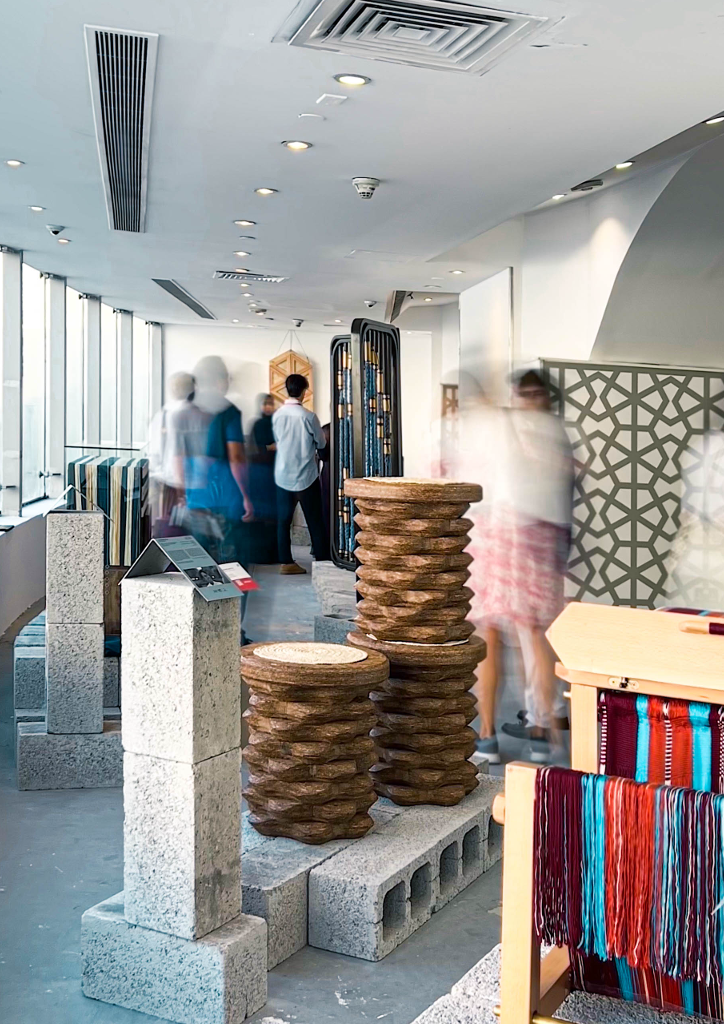
After seeing the Nakhla Stools in exhibitions like Qasr Al Hosn or NOMAD Abu Dhabi and interacting with a larger audience, did the experience change how you think about scale, proportion, or future iterations, and how the stool could work in everyday spaces?
My practice is rooted in designing site-specific, sensitive interventions in the built environment, so from the beginning, I envisioned the Nakhla Stool to find its place in social spaces. Whether it be people’s homes, in institutions, or public spaces, it was designed to be a scalable furniture piece where more of it can be added over time. When presenting the stool at NOMAD, many suggested that future iterations of the piece can be extended to other types of furniture pieces, such as benches, tables, and so on, based on the modular components that make up the stool’s form.
However, the most moving interaction I had was actually not at the exhibitions, but when I brought the stools to the campus of my alma mater, NYU Abu Dhabi. I left them at the “Palms,” the central plaza where paths cross in between classes and where students go to relax, read, do homework, and meet friends. I watched as people began curiously looking at the stools and sitting on them. Then I ended up demonstrating the different configurations, and they continued to use them naturally. This time, I saw that the stool was in its context, unlike when it was in exhibitions. It affirmed the scale that I see the Nakhla Stool expanding towards. As I continue to develop the furniture piece, I want to make the Nakhla system accessible at all scales, from individuals to institutions.
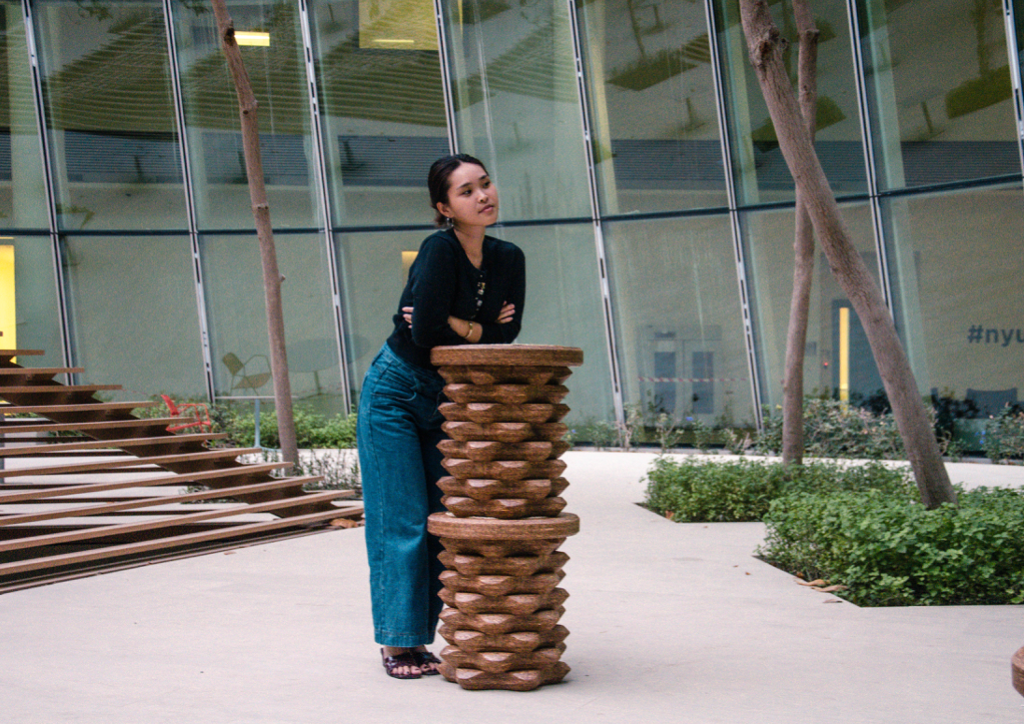
Industrial design serves, but it also consumes resources. Why does the Nakhla Stool deserve to exist in a world already choc-full of stools, and how does it argue for seating made responsibly and sustainably?
The Nakhla Stool exists in its “micro-locality”, the context of the UAE. In a country that is interconnected to the world, where many materials are easily accessible, and where the budget to acquire those materials is less of a constraint, it sends a powerful message to create a furniture piece that sources everything locally. The main structural material, DesertBoard, is an engineered chipboard-like wood made out of palm fronds sourced here in the UAE, and is produced here in Abu Dhabi.
Further, being made of all palm-derived materials allows the stool to be biodegradable after its life of use. On top of this and the way it integrates Emirati craftwork, its multifunctionality reduces the need to buy excess or temporary furniture to serve specific functions throughout the year, especially at an institutional level.
I believe the Nakhla Stool stands as a case study of championing local, sensitive design. It continues my philosophy of using the potential of simple, sustainable materials to create high-impact, meaningful spaces. •